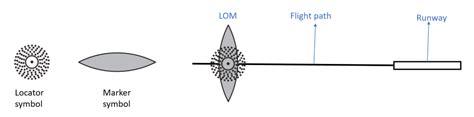
The Locator Outer Marker (LOM) is an important navigational aid used in aviation. It combines two key components: a locator and a marker. The locator is a low to medium frequency Non-Directional Beacon (NDB) that assists pilots during the final approach. Meanwhile, the marker is a low-powered transmitter that sends its signal upward in a narrow pattern.
Typically, the LOM is positioned about 4 nautical miles (NM) from the runway threshold. However, this distance can vary between 3.5 NM and 6 NM, depending on local terrain and other factors. Both the locator and marker have limited coverage areas. The locator usually covers a range of 10 to 25 NM, while the marker’s range is approximately 600 meters, with a possible variation of plus or minus 200 meters (or about 2,000 feet, plus or minus 650 feet).
When an aircraft flies over a marker, it provides an aural identification signal. All markers operate on a carrier frequency of 75 MHz, with their identification being frequency modulated. The outer marker emits a continuous signal of two dashes per second at a tone of 400 Hz. The locator, or NDB, is identified by a code consisting of two or three letters.
On aeronautical charts, LOMs are represented by a symbol that combines both the locator and marker. The orientation of the marker is set perpendicularly to the flight path, ensuring effective navigation for pilots.