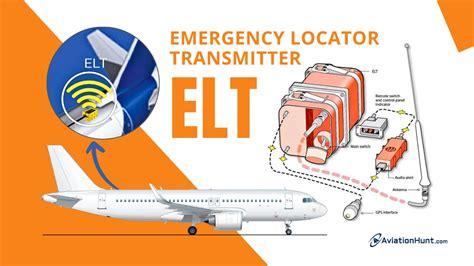
An Emergency Locator Transmitter (ELT) is crucial safety equipment used in aviation. According to the International Civil Aviation Organization (ICAO), an ELT broadcasts unique signals on specific frequencies. It can be activated automatically upon impact or manually by the crew. There are different types of ELTs:
-
Automatic Fixed ELT (ELT(AF)): This type is permanently attached to the aircraft and activates automatically.
-
Automatic Portable ELT (ELT(AP)): Similar to the fixed version, but it can be easily removed from the aircraft.
-
Automatic Deployable ELT (ELT(AD)): This ELT is attached to the aircraft and automatically deploys and activates upon impact, sometimes using hydrostatic sensors.
-
Survival ELT (ELT(S)): A removable ELT designed for use by survivors after an accident, which they can activate manually.
When properly set up, an ELT becomes part of the COSPAS-SARSAT international satellite system used for search and rescue (SAR). Once activated, whether manually or automatically, ELTs emit distress signals that satellites can detect. These signals help rescuers pinpoint the location using GPS trilateration and Doppler triangulation.
According to ICAO regulations, all ELTs must operate on both 406 MHz and 121.5 MHz frequencies. While SAR satellites no longer utilize the 121.5 MHz signals, this frequency remains vital for homing purposes. Additionally, all ELTs that transmit on 406 MHz need to be coded and registered with the appropriate national agency responsible for Search and Rescue operations. ICAO also recommends that airplanes on extended flights over water or certain designated land areas should have an automatic ELT. The same recommendation applies to specific helicopter classes during overwater missions.
However, there are concerns about the reliability of ELTs. Research by the Australian Transport Safety Bureau (ATSB) identified several factors affecting ELT performance during accidents. Issues such as antenna damage, improper activation before flight, incorrect installation, dead batteries, lack of waterproofing, and disconnection of cables can hinder functionality. Moreover, there are worries that ELT batteries could lead to fires, impacting the certification of these devices.
Several incidents highlight the challenges faced by ELTs. In 2013, a S76 helicopter near Moosonee, Canada, went unlocated for over five hours because its ELT failed due to a severed antenna. In another case, an E190 aircraft crashed in Namibia without transmitting a signal due to a broken cable connecting the ELT to its antenna. Similarly, a B744 aircraft’s ELT activated but failed to send a signal because it was inoperative in water. Other cases, including an MD83 and C30J, showed that ELTs did not transmit signals due to damage from impact forces. Lastly, a B788 incident at London Heathrow revealed that a rapid discharge from the ELT’s battery caused a fire.
Overall, while ELTs play a vital role in enhancing safety in aviation, their effectiveness can be compromised by various factors. Ensuring proper maintenance and adherence to installation guidelines is essential for maximizing their reliability.