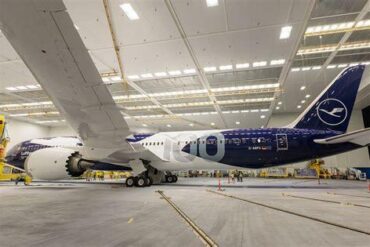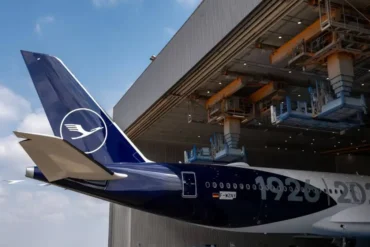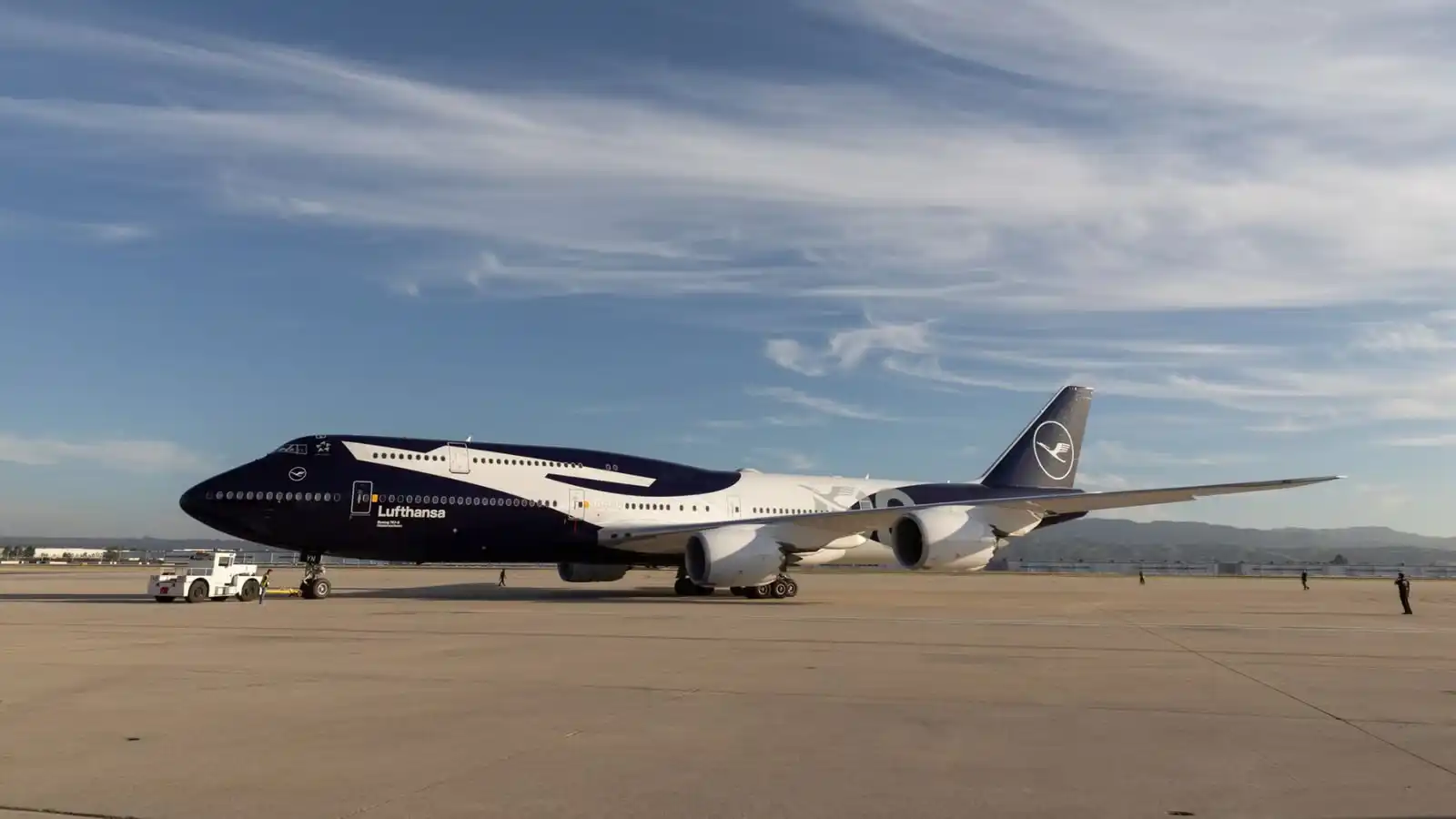
Lufthansa has revealed a striking new chapter in its visual history with the introduction of a specially painted Boeing 747-8, created to celebrate 100 years since the founding of Deutsche Luft Hansa in 1926. The commemorative aircraft transforms one of aviation’s most iconic airframes into a flying tribute to the airline’s past, present, and future. As the only European carrier still operating the passenger version of the Boeing 747-8, Lufthansa’s decision to place the anniversary livery on the legendary “Queen of the Skies” underscores the aircraft’s enduring symbolic importance within the airline’s identity.
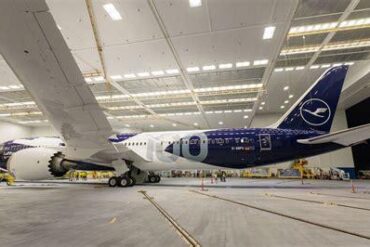
The aircraft received its celebratory design in San Bernardino, California, where Lufthansa completed the specialized paint process before preparing the jet for its journey back to Germany. Operating under flight number LH9913, the aircraft departed the United States for Frankfurt Airport, Lufthansa’s primary hub and the operational home of its 747-8 fleet. Scheduled to arrive in Frankfurt on March 5 at approximately 10 a.m. local time, the aircraft immediately became one of the most visible ambassadors of the airline’s centenary program.
Unlike museum pieces or limited exhibition aircraft, this Boeing 747-8 will remain fully active in commercial service. Lufthansa plans to deploy the aircraft across its long-haul network spanning North America and Asia, ensuring passengers around the world encounter the anniversary design firsthand. The strategy blends marketing, heritage storytelling, and operational reality, allowing a historic aircraft to carry the airline’s legacy to major international gateways.
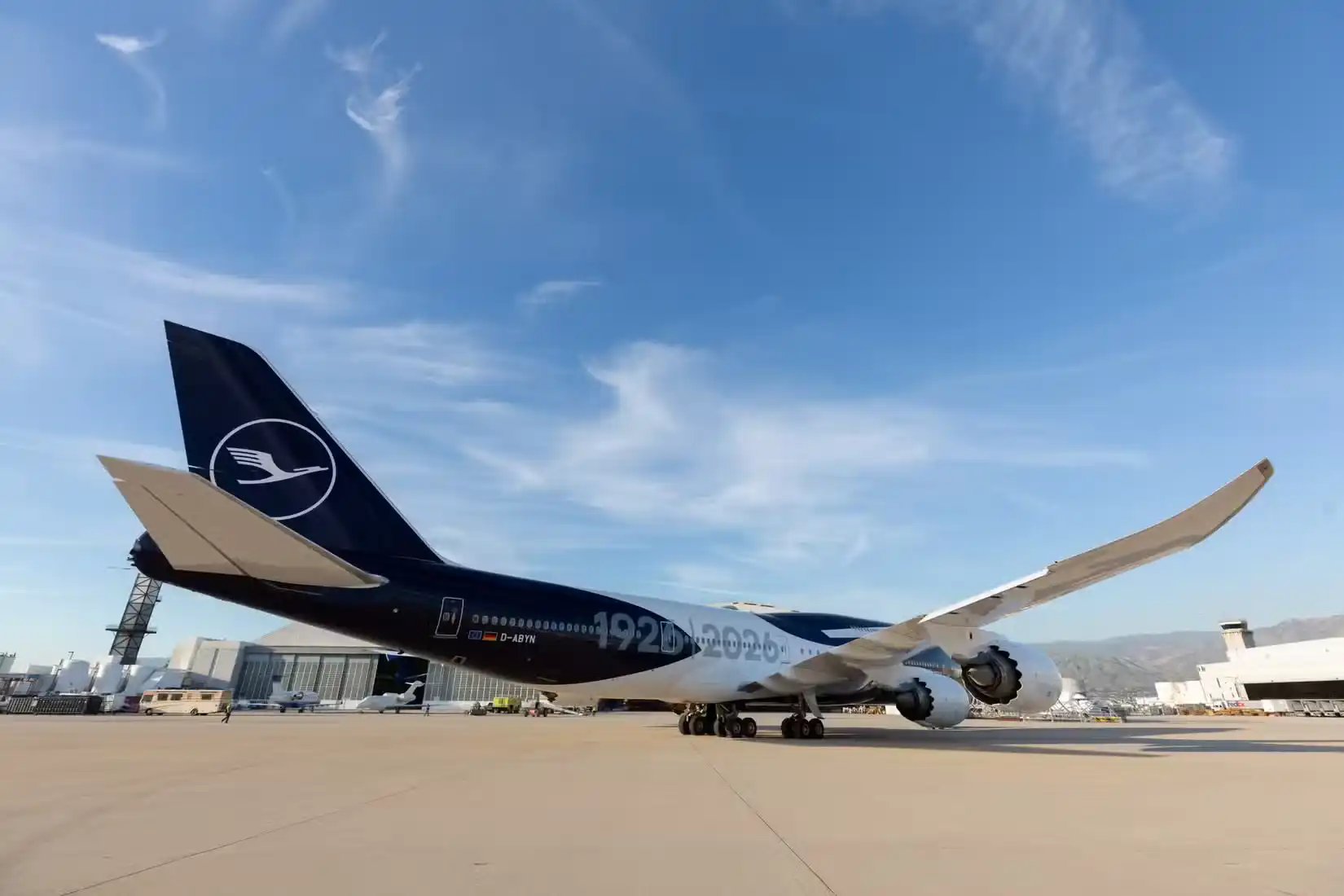
A Dramatic Crane Livery Redefines Lufthansa’s Visual Identity
The most striking feature of the anniversary aircraft is the dramatically enlarged crane emblem stretching across the forward fuselage. The crane has served as Lufthansa’s defining symbol for nearly a century, representing reliability, global reach, and technical precision. For the centenary edition, designers integrated the historic icon into the airline’s modern blue-and-white corporate livery, but at a scale rarely seen before.
Rather than appearing as a small badge near the cockpit windows, the crane now spans a vast section of the aircraft’s nose and forward body. The bold graphic turns the aircraft into a moving visual statement, visible from terminals, taxiways, and even distant vantage points at major airports. By magnifying the logo, Lufthansa highlights the longevity of one of aviation’s most recognizable brand symbols while simultaneously modernizing its presentation.
This design choice reflects a careful balance between heritage preservation and contemporary aesthetics. Over decades, the crane emblem has evolved through subtle stylistic updates, but its fundamental form remains unchanged. Enlarging the emblem on the Boeing 747-8 reinforces continuity across generations of aircraft, employees, and passengers who have associated the symbol with German aviation.
Why the Boeing 747-8 Remains Central to Lufthansa’s Identity
Choosing the Boeing 747-8 as the canvas for the centenary design carries deep historical significance. Lufthansa’s relationship with the 747 family dates back to the early 1970s, when the airline became one of the pioneering carriers to introduce the original jumbo jet into commercial service. The aircraft revolutionized long-haul travel, offering unprecedented passenger capacity and reshaping global air transport networks.
Over the decades, Lufthansa operated multiple variants of the iconic jet, including the 747-100, 747-200, and later the 747-400. Each generation expanded the airline’s long-haul capabilities and reinforced its reputation as one of Europe’s premier intercontinental carriers. The 747-8, introduced much later, represents the most technologically advanced version of the jumbo jet ever built.
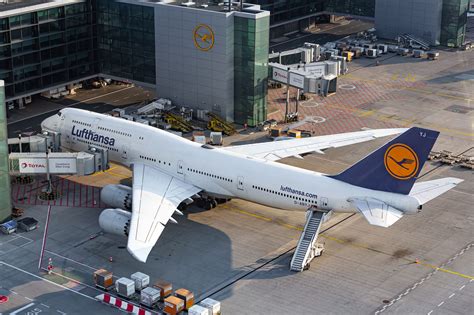
The aircraft features aerodynamic wing refinements, modernized systems, and next-generation engines that significantly improve fuel efficiency compared with earlier 747 models. Despite the aviation industry’s shift toward twin-engine widebody aircraft such as the Airbus A350 and Boeing 787, the 747-8 continues to serve as a powerful tool on routes requiring both high passenger capacity and long range.
Today, Lufthansa stands alone in Europe as the sole airline operating the passenger version of the Boeing 747-8. This unique position strengthens the association between the German carrier and the legendary aircraft. For aviation enthusiasts and frequent travelers alike, spotting a Lufthansa 747-8 has become one of the last opportunities to see a four-engine jumbo jet in regular passenger service.
Inside the Aircraft: A Distinctive Four-Class Experience
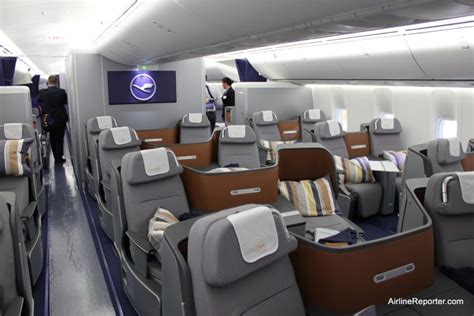
Beyond its exterior transformation, the centenary Boeing 747-8 continues to deliver Lufthansa’s flagship four-class cabin configuration. One of the aircraft’s most distinctive features is the placement of First Class in the forward section of the main deck, a layout unique to the 747-8 among modern widebody aircraft.
Passengers in this section experience a quiet and spacious environment positioned far ahead of the wings and engines. The upper deck, long regarded as one of the most exclusive spaces in commercial aviation, houses Business Class seating, offering travelers a boutique-style cabin with a sense of privacy rarely found elsewhere in the sky.
Further back, Premium Economy and Economy Class provide the high passenger capacity that makes the 747-8 especially valuable on heavily traveled routes. The aircraft’s two full passenger decks allow Lufthansa to accommodate large numbers of travelers without sacrificing comfort or cabin segmentation.
A Flying Tribute to a Century of Aviation Progress
The unveiling of the centenary 747-8 is part of a broader initiative marking one hundred years since the founding of Deutsche Luft Hansa, the airline that laid the groundwork for modern Lufthansa. Over the past century, the carrier has navigated dramatic changes in aviation—from propeller-driven airliners to supersonic experimentation and today’s era of fuel-efficient composite aircraft.
Throughout this transformation, Lufthansa maintained a strong presence in long-haul aviation. Its aircraft connected Europe with destinations across the Americas, Asia, Africa, and the Middle East, helping shape global travel patterns and international commerce.
The anniversary program includes historical retrospectives, onboard commemorative details, and digital storytelling initiatives designed to highlight the airline’s journey since 1926. By pairing these initiatives with visually distinctive aircraft, Lufthansa ensures that its centenary celebration remains visible far beyond corporate announcements or museum exhibitions.
The Future of Lufthansa’s Long-Haul Fleet
While the commemorative 747-8 celebrates history, Lufthansa’s long-term strategy remains firmly focused on modernization. The airline continues introducing Airbus A350 and Boeing 787-9 aircraft, both of which offer improved fuel efficiency, advanced passenger cabins, and reduced environmental impact compared with older widebody models.
Yet the Boeing 747-8 retains an important operational role. On slot-restricted airports and high-demand intercontinental routes, its large capacity provides efficiency that smaller twin-engine aircraft cannot always match. In this sense, the jumbo jet still delivers strategic value even as the industry evolves.
The centenary livery ensures that during this milestone year, Lufthansa’s most recognizable aircraft will also serve as its most visible storyteller. Every departure and arrival becomes a reminder that aviation history is not confined to archives—it continues to fly, one intercontinental journey at a time.