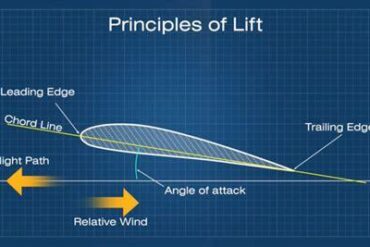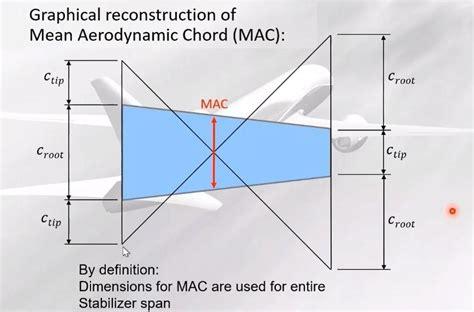
Mean Aerodynamic Chord (MAC) refers to the average chord length of a tapered and swept wing. The chord is defined as the distance between the leading and trailing edges of the wing, measured parallel to the airflow. When the leading and trailing edges are parallel, the chord remains constant along the wing’s length. However, most commercial transport airplanes feature wings that are both tapered and swept, causing the width to vary along the entire span. The widest part of the wing is at the root, where it connects to the fuselage, and it gradually narrows toward the tip.
As a result, the chord changes along the span as well. The average length of the chord is referred to as the Standard Mean Chord (SMC). In larger aircraft, both the center of gravity limitations and the actual center of gravity are often expressed in terms of percent MAC. The Mean Aerodynamic Chord (MAC) can be defined mathematically using coordinates along the wing span, wing area, span, and chord lengths. Essentially, MAC serves as a two-dimensional representation of the entire wing.
The pressure distribution across the wing can be simplified to a single lift force acting on the MAC and a moment around its aerodynamic center. This means that both the length and position of the MAC are significant. Notably, the aircraft’s center of gravity (CG) is typically measured relative to the MAC, indicating the percentage distance from the leading edge of the MAC to the CG.
It’s important to note that the MAC does not always occur at points where the leading or trailing edge sweep changes. For shapes that are not simple trapezoids, an evaluation of the integral is necessary. Additionally, the aspect ratio—defined as the ratio of the span of a rectangular-planform wing to its chord—is crucial as it indicates the lift-induced drag produced by the wing. For wings with non-rectangular planforms, the aspect ratio is calculated as the square of the span divided by the wing area. Wings with higher aspect ratios generate less induced drag compared to those with lower ratios. Induced drag is particularly significant at low airspeeds, which explains why gliders are designed with long, slender wings.