Semi-Prepared Runway Operations (SPRO)
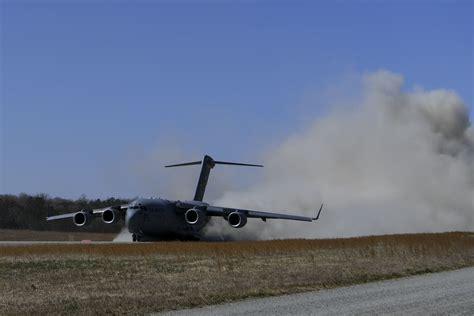
Semi-Prepared Runway Operations, or SPRO, primarily involve military aircraft landing at marginal airfields or temporary landing zones (LZs). However, the insights in this article are also relevant for light General Aviation (GA) aircraft engaged in off-strip operations. SPRO is often utilized in combat situations, where aircraft may need to operate from runways close to the front lines. Beyond military use, SPROs are frequently employed for disaster support and famine relief efforts.
What Are Semi-Prepared Runways?
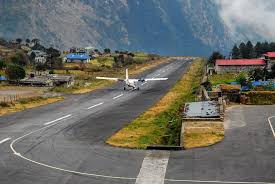
A semi-prepared runway can take various forms. Typically, an existing GA airfield is enhanced to accommodate specific airlift aircraft types. This may involve lengthening or widening the runway, creating offload ramp areas, clearing obstacles like trees, and improving the load-bearing capacity using materials such as pierced steel planking. Alternatively, a semi-prepared runway might simply be a cleared area, like a dry riverbed or a field, where snow, rocks, and other obstructions have been removed, and the surface has been leveled and fortified as much as possible.
Setting Up Operations
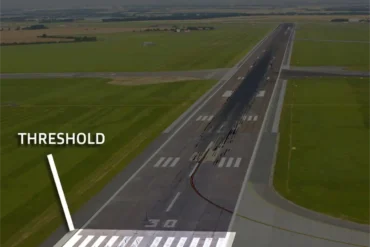
Establishing a semi-prepared runway often falls to the military units planning to use that LZ. In these cases, they know the location, orientation, dimensions, and load-bearing capabilities in advance. However, during disaster response missions, a third party usually sets up the landing zone, and the details provided can be vague. In such situations, the crew of the first aircraft to arrive must confirm the location, orientation, and dimensions of the runway while assessing any operational limitations.
Key Considerations for Crew Selection
SPROs can pose significant challenges for flight crews. These challenges may include limited approach aids, absence of runway lighting, landing distance constraints, and obstacles that necessitate one-way-in, one-way-out operations. Therefore, it’s crucial that the crew conducting the LZ validation flight is experienced with the aircraft type and understands its capabilities and limitations well.
Understanding LZ Usage
To effectively evaluate a semi-prepared runway’s operational capability, the crew must know how the SPRO will be executed. This includes whether the LZ is designated for inbound, outbound, or bi-directional loads. They should also have an estimate of the expected aircraft movements or chocks that the LZ can handle.
First Flight Methodology
Whenever possible, the evaluation flight should occur during daylight and under Visual Meteorological Conditions (VMC), using a lightly loaded aircraft. The crew should carry enough fuel to reach the LZ, conduct several low passes, and perform touch-and-go landings before finally stopping on the runway. After spending some time on the ground with engines running, they should return to their departure point with sufficient fuel reserves.
Pre-Flight Preparations
Before the mission, a pre-briefing should involve all crew members to ensure everyone understands the flight profile and expectations. Thanks to modern GPS technology, locating the intended LZ is generally straightforward. However, the evaluation crew should still review imagery and topographical maps beforehand to confirm the LZ location and study the terrain and nearby features.
Arriving at the LZ
Upon reaching the LZ, the aircraft should slow to approach speed and make several low passes at an altitude of 200-500 feet above ground level (AGL). During these passes, the crew should:
-
Note natural or artificial landmarks to help subsequent flights locate the LZ.
-
Confirm the usable length of the landing surface using time and groundspeed calculations.
-
Assess both ends of the runway for obstacles and obstructions.
-
Determine if the LZ allows for two-way operations or is restricted to one-way only.
-
Look for signs of human or animal activity in the vicinity.
-
Check the landing surface for ruts, holes, and signs of recent rain.
-
Ensure there is adequate clearway at the ends and sides of the runway for the intended aircraft types.
-
Evaluate if there’s sufficient space for turning around at the runway ends.
Assessing LZ Capability
After completing the observation passes and recording the data, the load-bearing capability of the runway should be assessed. The aircraft should be configured for landing and execute a touch-and-go landing, aiming for the runway centerline in the touchdown zone. Following this, a low pass should be made to inspect the depth of any ruts created during the landing. If the width allows, another touch-and-go can be performed on either side of the original touchdown point to further evaluate the load-bearing capability. If deemed acceptable, the next step is to land the aircraft and assess the surrounding LZ environment.
During ground time, at least one engine should remain running to avoid being stranded in case of a failure.
Post-Landing Assessment
Once the aircraft has landed, the Pilot Flying (PF) should quickly taxi to the end of the runway. At the end:
-
The aircraft should be turned around, taking note of any clearance issues or soft spots near the runway edges.
-
Record the coordinates of the runway end.
-
Taxi the full length of the runway, offset from the centerline, to evaluate any ruts from the landing.
-
Upon reaching the approach end, turn around again and check for wing clearance and turning issues.
-
Record the runway end coordinates once more.
-
Evaluate the offload area to assess surface conditions, maneuverability, and the best locations for ground support equipment (GSE) or fuel storage.
Ground Assessment
At this stage, personnel may disembark to perform necessary load-bearing measurements and assess the landing zone closely. Tasks include:
-
Evaluating the landing surface for tire puncture risks.
-
Checking for soft spots, rut depths, and surface material displacement at runway ends during turns.
-
Assessing clearway length and obstacle height at both ends of the LZ.
In addition to the physical characteristics of the LZ and ramp areas, the recce crew should identify available facilities to support upcoming operations. This might include:
-
Existing structures like hangars or control towers.
-
Services such as potable water, electricity, or phone access.
-
Proximity to public roads and local fire services.
Once all tasks are completed, personnel should return to the aircraft and prepare for departure. Before leaving, the mission commander must confirm that everyone is on board and review the assessment plan to ensure all items have been evaluated.
Departure
The aircraft should be restarted if needed and readied for departure. Takeoff considerations should include:
-
Utilizing the full runway length for departure.
-
Implementing maximum performance takeoff procedures.
-
Using timed acceleration protocols to assess any performance penalties due to the LZ surface.
Assessment Report
The mission commander should compile all collected information from the LZ evaluation for submission to the appropriate authorities and distribution to airlift crews. The report should detail the physical dimensions and capacities of the semi-prepared runway and ramp area, along with any usable structures or facilities. It should also assess hazards and risks associated with operations at the LZ, including:
-
Feasibility of night operations with or without Night Vision Imaging System (NVIS).
-
Recommendations for optimal arrival and departure profiles.
-
Maximum number of aircraft that can be on the ground simultaneously.
-
Required ground support equipment.
-
Any necessary aircraft modifications.
LZ Command and Control
Operational authority for the SPRO varies by mission type. For military operations, the LZ is likely under military control, either through a forward air control element or a military presence. In relief missions, a United Nations contingent or a non-governmental organization (NGO) may oversee the LZ, with tactical control possibly delegated to military or civilian parties. In multinational airlift efforts, each country may have its representative on the ground.
The LZ commander is responsible for managing arrival and departure slots, coordinating with other airlift operations, and liaising with local authorities. The National Aviation Authority (NAA) or relevant local agencies should be consulted for communication frequencies, operational hours, and potential security threats.
It’s also crucial to identify and mitigate wildlife threats, such as animals on the runway or migratory routes nearby.
LZ Utilization and Maintenance
SPRO operations typically start with a plan based on the recce flight. However, as airlift timings change or the nature of cargo and personnel shifts, adjustments to the airlift plan may be necessary. Some wear and tear on the LZ should be expected over time, and if deterioration accelerates due to adverse weather or heavier-than-anticipated landings, repairs will be needed to maintain operational status. At a minimum, the need for filling ruts and holes should be anticipated, materials sourced, and time allocated for maintenance in the airlift plan.