Runway Holding Position
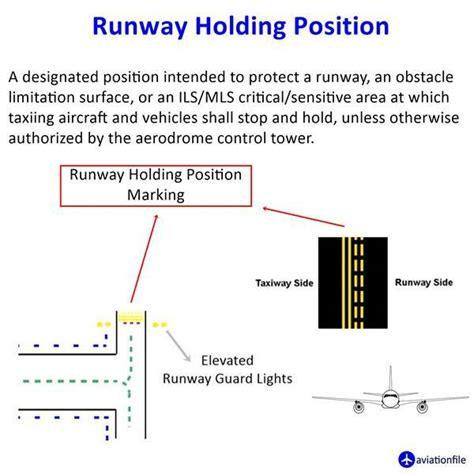
Definition A runway holding position is a specific area designed to protect a runway and certain critical zones, like the obstacle limitation surface or an ILS/MLS sensitive area. In this spot, taxiing aircraft and vehicles must stop and hold unless the aerodrome control tower gives other instructions. It’s important to note that in radiotelephony, the term “holding point” is used to refer to this runway-holding position.
Description When an aircraft is between the holding position and the runway, it is treated as being on the runway for Air Traffic Control (ATC) operations. This means:
-
A landing aircraft is not considered to have left the runway until it has passed the holding position.
-
A departing aircraft that moves beyond the holding position is viewed as being on the runway, even if it is technically still on the taxiway.
If an aircraft crosses the holding position without proper authorization, this action is classified as a Runway Incursion. To illustrate this, consider the following examples of aircraft related to the holding position: (1) at the holding position, (2) passed the holding position, (3) about to vacate, and (4) vacated the runway. In this context, aircraft (2) and (3) are deemed to occupy the runway, meaning no other aircraft can receive takeoff or landing clearance at that time.
More than one holding position may be established for a taxiway or runway crossing, often due to the presence of a CAT II/III ILS. If ILS signals can be influenced by reflections from nearby aircraft, a secondary holding position is set further from the runway. For example, AB13, AB12, AB11, and A10W are designated as CAT I holding positions, while A13, A12, and A11 serve as CAT II/III holding positions. Additionally, COBRA, DINGO, RABIT, SNAPA, C2, and D2 are considered intermediate holding positions rather than runway holding positions.
Phraseology While ICAO documents use the term “holding position,” radio-telephony refers to it as “holding point.” For instance, a controller might instruct, “Airjet 123, taxi to holding point runway 22.” The clearance would include the name of the holding position and the taxi route to avoid confusion. The switch from “position” to “point” was made to differentiate from a similar instruction used in the United States, “Taxi into position and hold,” which meant lining up on the active runway. To minimize confusion and prevent runway incursions, ICAO updated the term. In September 2010, the Federal Aviation Administration (FAA) revised JO 7110.65 (Air Traffic Control) by changing “Taxi into position and hold (TIPH)” to “Line up and wait (LUAW).”
Related Articles
-
Runway Incursion
-
Taxiway Surface Markings and Signs
-
Taxiway Lighting
-
Standard Phraseology
-
Non-Standard Phraseology
-
Categories: General, Runway Incursion