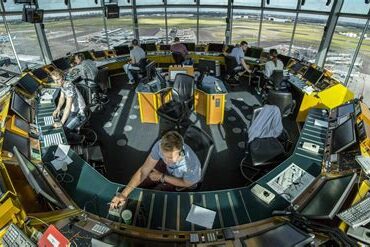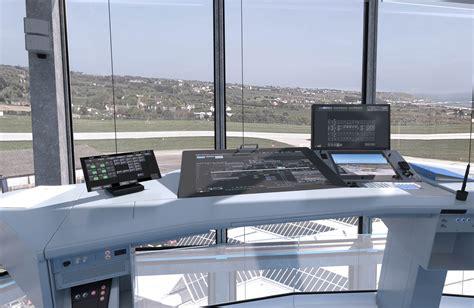
In today’s air traffic control (ATC) towers, controllers interact with various systems, each with its own interface. Unfortunately, these systems don’t share information effectively. As technology advances, the number of systems providing data will increase. This highlights the need for integrating airport airside system components into a cohesive Integrated Tower Working Position (ITWP). The ITWP project is part of the EUROCONTROL Medium Term Work Program. Effective information management and integration will empower controllers as the final decision-makers in future airport operations.
The ITWP aims to integrate data from multiple sources, including TMA/APP sectors, arrival managers (AMAN), departure managers (DMAN), advanced surface movement guidance and control systems (A-SMGCS), electronic flight strips (EFS), METEO systems, wake information, stand and gate management, data link applications, and ATFM applications, among others. A-SMGCS and EFS will serve as the foundation for the ITWP, providing essential surveillance and alerting functions that will be further developed in European airports.
Current Situation and Issues
Currently, there is no system integration, leading to minimal data exchange between individual systems. Decision support tools are lacking, and each human-machine interface (HMI) varies significantly, making it challenging to add new systems like AMAN and DMAN due to the absence of a common interface.
Main Objectives of the ITWP Project
The primary goals of the ITWP project include:
-
Developing commonly agreed functional specifications and HMI requirements.
-
Designing an HMI solution that meets these specifications.
-
Creating a prototype to demonstrate the ITWP.
-
Evaluating the effectiveness of the ITWP once delivered.
Benefits of the ITWP
The ITWP offers numerous advantages:
-
Access to all critical information through a single integrated interface.
-
Improved situational awareness for controllers.
-
More efficient traffic flow management, enhancing both throughput and safety.
-
Standardization of the working environment in control towers.
-
Economies of scale through common information and HMI.
Results of ITWP Activities
Research has been conducted in several ATC towers, and a controller task analysis has been completed with input from ENAV, LFV, DSNA, NATS, DFS, and NAV Portugal. The first version of the ITWP prototype has been evaluated, incorporating A-SMGCS, EFS, Air Traffic Monitor, MET, and Airfield Equipment Monitor. Three control positions have been studied: Runway, Ground, and Clearance, each designed to manage specific traffic types.
All necessary information is now displayed on a unified HMI. Controllers benefit from a single 30-inch screen, enhancing their ability to manage air and ground traffic. The ITWP provides composite radar images and facilitates multiple window management, ensuring that the most critical information is always front and center. Furthermore, it improves communication between applications.
The ITWP creates a common environment tailored to each controller’s role, allowing for personalized configurations based on task requirements. Electronic strips enhance coordination among controllers by enabling seamless sharing of flight strips, eliminating the need for manual transfers. Controllers can interact with flights via electronic strips and radar labels, while anticipated logical events are predicted based on controller actions.
Safety support tools are also integrated, detecting potential hazards and issuing alerts for non-conformances, inconsistent clearances, runway conflicts, and errors related to airport layout. Overall, the ITWP represents a significant advancement in air traffic control technology.