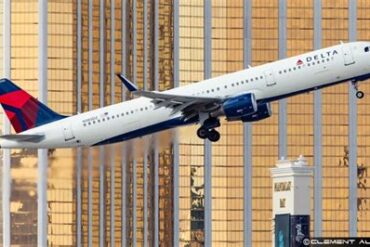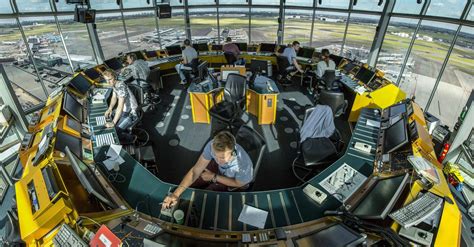
The Tower Controller, also known as the Aerodrome Controller, plays a key role in managing air traffic in and around an airport. Their primary responsibility lies in overseeing the manoeuvring area, which includes runways and taxiways. While they do communicate with aircraft on the aprons, these areas fall outside their formal scope of responsibility.
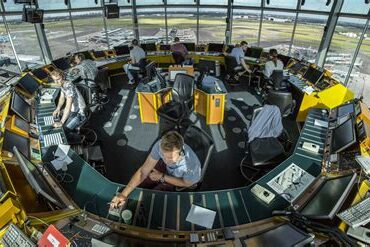
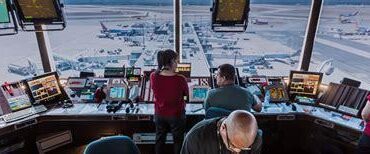
Tower controllers are stationed in the control tower, where they use direct visual observation to manage traffic. This sets them apart from area and approach controllers, who work in operations rooms and rely on radar displays. In some modern setups, remote tower solutions replicate the visual environment using high-definition screens and camera feeds, allowing tower controllers to work from a different location while maintaining visual oversight.
Types of Traffic Managed by Tower Controllers
Tower controllers typically handle three main categories of air traffic:
- Departing flights
- Arriving flights
- Transit overflights, which are aircraft flying through the control zone without landing or taking off
Overflights are generally a smaller portion of the total workload, but still require careful attention.
The procedures used by tower controllers vary depending on the airport’s size, traffic levels, and local policies. At busy airports, the focus is on streamlining communication and standardizing operations to reduce workload and miscommunication. At smaller or less busy aerodromes, controllers often have more flexibility to accommodate specific crew requests, such as runway preferences. Regardless of the situation, safety remains the top priority.
Managing Departures
Handling departures involves several steps, each with specific responsibilities for the tower controller.
Start-Up
The first contact between a flight crew and the tower controller often happens during the start-up request. This is usually approved unless there’s a safety concern—like an emergency landing nearby—or a need to delay the process for sequencing purposes. During this exchange, the crew also confirms the latest ATIS (Automatic Terminal Information Service) data and may receive their CTOT (Calculated Take-Off Time).
Depending on local procedures and traffic conditions, the departure clearance might also be issued at this point. However, if coordination with the approach controller is still pending, it may be provided later.
Pushback
If an aircraft can’t taxi forward from its stand—like when it’s parked at a gate—it requires a tug vehicle to push it back and align it with the taxiway. Pushback needs approval from either the tower or apron control, based on local protocols. The controller may also give specific instructions, such as which way the aircraft should face after pushback is complete.
Departure Clearance
The departure clearance outlines the aircraft’s assigned route (usually a SID, or Standard Instrument Departure), the cleared altitude, and any restrictions or assigned codes like the SSR transponder code. Ideally, this clearance is given early to avoid disrupting the crew’s workflow during start-up or taxi. If it can’t be issued right away, the controller may wait until taxi-out or allow the crew to request it at a convenient time.
Delivering the clearance during taxi should be avoided when possible, especially for aircraft with a single pilot, as it could increase the risk of ground collisions. If necessary, the clearance should be given during a straight segment with good visibility and no immediate obstacles.
The crew must read back the clearance in full. The controller then checks for errors and ensures all items are acknowledged. Any changes must be re-coordinated with the approach controller.
Taxi-Out
Once the crew requests taxi clearance, the controller evaluates the situation, factoring in the airport layout, current traffic, and weather. A suitable taxi route is then provided, ideally one that avoids potential conflicts. If necessary, the controller gives additional instructions, such as holding at certain points or giving way to another aircraft.
When crossing another runway is involved, the controller clearly states whether the aircraft has permission to cross or must hold short. Sequencing during taxi is also considered, with faster aircraft typically given priority over slower ones to avoid delays after takeoff.
Line-Up
As the aircraft nears the runway holding point, the tower decides whether to issue a line-up clearance or have the plane hold short. If the runway is clear and there’s no traffic on final approach, the controller may allow the aircraft to line up and possibly take off. If another aircraft has just landed or is close to touching down, a line-up and wait instruction might be more appropriate.
In some cases, even if an aircraft is on approach, a takeoff can still proceed if both the controller and crew agree it’s safe based on available time and distance.
Takeoff Clearance
A takeoff clearance is only issued when the controller is certain the runway is safe and clear. This includes checking for any hazards like debris, animals, or conflicting aircraft. A final visual scan of the runway is done before the clearance is given, often as early as when the aircraft enters the taxiway.
Once cleared for takeoff, the controller continues monitoring the aircraft and runway, but avoids unnecessary communication unless there’s a serious safety issue. The clearance also accounts for necessary separation minima, including wake turbulence considerations.
After the aircraft becomes airborne, the controller notifies the approach unit and transfers control during the initial climb.
Managing Arrivals
Tower controllers take over arriving flights during final approach and guide them through landing and taxi-in.
Landing Clearance
Landing clearance is granted when the controller confirms that the runway is safe and free from obstacles. This includes a final scan to spot any potential dangers. Instructions for a possible go-around or details about the exit taxiway should be given before this clearance.
Once the aircraft lands and begins to slow down, the controller avoids additional transmissions unless there’s an urgent safety concern.
Taxi-In
After the runway is vacated, the controller gives taxi instructions toward the apron or a designated handover point. At some airports, the tower controller also guides the aircraft all the way to its parking position. However, they’re generally not responsible once the aircraft enters the apron.
Overflights
Sometimes, the tower provides service to transit flights that are simply crossing the control zone without landing or departing. These are often VFR (Visual Flight Rules) aircraft flying at lower altitudes. Before entering the controlled airspace, these flights must request and receive clearance.
Based on traffic levels, the controller may assign a specific path or even ask the aircraft to perform holding maneuvers, such as orbits. Once the overflight exits the area, it’s handed off to the next appropriate control unit.
Other Types of Flights
In addition to regular operations, tower controllers also manage:
- Training flights, which often involve repeated circuits, takeoffs, and landings
- Calibration flights, used to check navigational aids
Although these flights technically fall into normal categories, their extended presence in tower-controlled airspace makes them a unique operational case. The controller must account for them when issuing clearances and may need to coordinate missed approach procedures to ensure safe separation.
These flights often require close coordination with approach controllers, especially if they switch between units multiple times during a session.
Handover and Control Transfer
The exact point at which control is handed off between tower and other ATC units varies. This depends on local procedures, weather conditions, and airspace structure. For example, if an airport lacks an approach unit, coordination happens directly between the tower and area control center.
In low-visibility conditions, handovers may occur earlier or later than usual, depending on safety requirements.
Tools and Equipment
Tower controllers rely heavily on visual observation, using the panoramic windows of the control tower. If parts of the area are blocked or not visible, a visual surveillance system can help fill in the gaps. Binoculars are often used to spot distant or smaller objects.
In addition to visual cues, controllers may have access to:
- Radar-based surveillance like ADS-B or MLAT
- SMR (Surface Movement Radar) and A-SMGCS, which assist in tracking ground movements
These systems are especially valuable at night or during poor visibility. In many countries, including EU member states, controllers require specific endorsements to use these tools operationally.
Tower controllers also use flight progress strips—either paper or electronic—to keep track of each aircraft. Modern digital strips can link with automation systems for added safety and efficiency. Emergency communication tools like light guns and pyrotechnic flare guns are also available, providing visual signals when radio contact is lost.
Working Positions and Staffing
Staffing in the tower varies depending on traffic volume and airport layout. Small airports may only need a single controller, occasionally assisted by a coordinator. At busier airports, responsibilities are split into positions like:
- Ground Control (GND) – handles start-up and taxi phases
- Clearance Delivery – issues initial ATC clearances
- Runway-specific controllers – for parallel or intersecting runways
Each controller is responsible for a specific phase of flight, ensuring smooth transitions and optimal traffic flow.