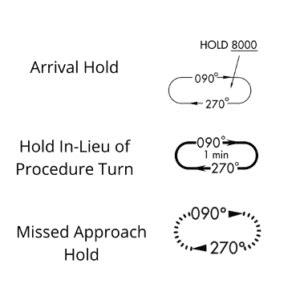
Definitions
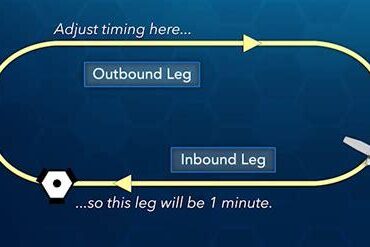
Holding Pattern: A holding pattern is an oval course that aircraft fly while waiting for clearance, particularly for landing.
Hold Procedure: This is a planned maneuver that keeps planes within a specific airspace until they receive further instructions from air traffic control.
Holding Fix: This is a point that pilots can identify using navigation aids or visual ground references. It helps in maintaining the aircraft’s position while holding.
General Information
Holding patterns serve as a delay method. They are used when air traffic control needs to manage airspace congestion or during approach delays. Pilots may also request a hold to complete emergency checklists or other necessary procedures. Under Instrument Flight Rules (IFR), pilots must follow specific holding procedures, including speed, entry methods, timing, and turn rates. These procedures ensure safe separation from other aircraft.
Standard Holding Pattern
A standard holding pattern is shown in diagrams depicting the path an aircraft would take in calm air. The holding fix can be a VOR, NDB, radial/DME fix, a waypoint, or sometimes even the aircraft’s current position as determined by the Flight Management System (FMS).
In a standard holding pattern, all turns should be made to the right after entering the hold. Pilots flying manually should maintain a bank angle of at least 25 degrees or a turn rate of 3 degrees per second, whichever requires less bank. The inbound leg follows the assigned radial to the fix, while the outbound leg is adjusted based on wind conditions. The outbound leg is flown for a specific time to ensure proper inbound timing: one minute below 14,000 feet and one and a half minutes above that altitude. When ATC gives a departure time from the holding fix, pilots should adjust their flight pattern accordingly.
Non-Standard Holding Pattern
In a non-standard holding pattern, turns are made to the left, or the inbound timing differs from standard values. Unless ATC instructs otherwise, pilots should make all turns to the right after entering the hold. This means they must follow the standard holding pattern unless specifically told to do something different.
Entry Procedures
Entry sectors for a standard holding pattern depend on the aircraft’s heading when approaching the holding fix. There are three entry sectors, each with a 5-degree flexibility zone on either side of the boundary. Pilots can choose the entry procedure based on their discretion.
-
Sector 1 (Parallel Entry): Turn outbound upon reaching the fix, then return to intercept the inbound track. On the second arrival over the fix, turn right and follow the holding pattern.
-
Sector 2 (Offset Entry): Upon reaching the fix, turn to a heading resulting in a track angle of 30 degrees or less from the inbound track. After the appropriate time, turn right to follow the inbound track.
-
Sector 3 (Direct Entry): Turn right immediately upon reaching the fix and follow the holding pattern.
For non-standard holding patterns requiring left turns, entry procedures mirror those of the standard pattern but are oriented around the 70-degree line on the holding side.
DME Procedures
DME holding follows the same procedures as standard holding patterns, except distances in nautical miles are used instead of time values to define the holding limits. ATC will specify the DME distance for inbound and outbound legs, and pilots will use DME indications to determine when to end each leg. If equipped with FMS, pilots might be cleared to hold at a specific waypoint along a defined track with a leg distance in nautical miles.
DME Holding Speed Limitations
Expected holding speeds for charted patterns are listed on associated charts. If no speed is specified, pilots must enter and fly holding patterns at or below the appropriate airspeed for their altitude. Speeds vary by region, so pilots need to know the limits in their operational area. According to ICAO regulations, maximum holding speeds are:
-
At or below 14,000 feet: 230 KIAS
-
Above 14,000 to 20,000 feet: 240 KIAS
-
Above 20,000 to 34,000 feet: 265 KIAS
-
Above 34,000 feet: Mach .83
-
For Category A and B aircraft only: 170 KIAS
Pilots should inform ATC immediately if they need to exceed these speeds for any reason, such as turbulence. After leaving a holding fix, pilots should return to normal speed unless other requirements dictate otherwise.
Minimum Holding Speeds
Minimum holding speeds are determined by airframe manufacturers and vary based on aircraft type and weight. Operators may also consider weather factors like icing. Information about minimum speeds can be found in the relevant aircraft manuals.
Holding Clearance
A holding clearance from ATC will include:
-
Clearance to the holding fix
-
Direction to hold from the fix
-
Specified radial, course, or inbound track
-
If DME is used, the distances for when to begin turns
-
Altitude or flight level to maintain
-
Time to expect further clearance or to leave the fix in case of communication failure
For instance, an ATC clearance might say, “BA123 is cleared direct to SHA VOR, descend to and maintain FL180. Hold Southeast on the 140-degree radial. Expect further clearance at 1035Z.” If the procedure is charted, the clearance can be shorter, such as, “BA123 cleared to OLLNO, hold as published, maintain FL120. Expect approach clearance at 2215Z.”