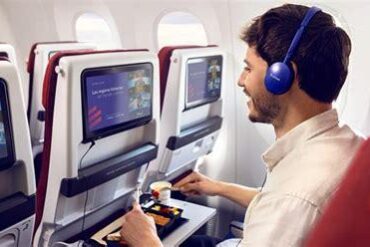
TUI Airline has taken a bold leap into the future of air travel by introducing a seamless digital inflight experience that redefines passenger expectations and significantly outpaces what legacy carriers like Lufthansa, British Airways, Emirates, and Singapore Airlines currently offer. With an all-in-one platform that blends real-time messaging, personalized entertainment, and destination activity booking, TUI isn’t just updating its services—it’s reinventing the very essence of flying.
A Seamless Integration of Connectivity, Entertainment, and Experience
Unlike traditional inflight entertainment systems that only offer a handful of movies or Wi-Fi at a premium, TUI’s platform integrates Iridium Certus satellite connectivity to deliver uninterrupted WhatsApp messaging from takeoff to landing. This real-time communication channel positions TUI as the first European leisure airline to offer such continuous connectivity, outpacing even tech-savvy competitors like JetBlue or Emirates.
While most carriers offer basic browsing or paid social media access, TUI’s inclusion of WhatsApp as a standard feature makes communication simple and universally accessible. This platform-wide access removes the dependency on costly onboard Wi-Fi packages and connects passengers to the outside world using a service that is already embedded in their daily digital routines.
Booking Excursions at 30,000 Feet: The TUI Musement Advantage
What truly sets TUI apart is its deep integration with TUI Musement, a digital marketplace that features more than 1,500 curated experiences across 3,000 global destinations. Whether it’s booking a guided tour through Rome, securing last-minute theater tickets in London, or reserving a culinary experience in Bangkok, passengers can now plan and reserve their excursions mid-flight. This is a level of inflight interactivity that competitors such as Qatar Airways or Delta Air Lines have yet to match.
By transforming the flight into an extension of the destination experience, TUI breaks down the traditional boundary between travel logistics and leisure. The holiday begins not at arrival, but the moment passengers step onboard—a powerful shift in how travelers engage with their journeys.
Rich, Multilingual Entertainment for Every Passenger
TUI’s inflight entertainment system doesn’t just check the box; it reimagines content accessibility for a global audience. With over 100 titles including blockbuster movies, international TV shows, curated podcasts, and immersive games, all offered in multiple languages, the system reflects a deliberate design to cater to diverse demographics.
This breadth of content significantly enhances the onboard experience for non-English speakers, positioning TUI as more inclusive than carriers like Air France or British Airways, whose offerings can often be limited by region or language preferences. In a leisure-driven airline model, customized, engaging, and culturally relevant content is not just a perk—it’s a necessity.
Personalization at Scale: How TUI Redefines the Passenger Journey
Where legacy airlines focus on amenities like lie-flat seats and gourmet meals in business class, TUI shifts its attention to personalization and passenger control. The inflight platform encourages users to curate their own experiences by recommending activities based on their destination, previous travel habits, and interests.
This type of engagement mirrors the algorithms seen in services like Netflix or Spotify, but instead of entertainment, the focus is on holistic travel planning. It reflects a changing expectation in digital behavior: today’s passengers want immediacy, relevance, and control, and TUI delivers all three.
TUI vs. the Titans: How the New Platform Compares
While Emirates may offer opulent onboard lounges and Singapore Airlines showcases top-tier service, neither currently integrates activity booking, real-time messaging, and dynamic content personalization into a single unified digital environment. Lufthansa, Qatar Airways, and Cathay Pacific do offer internet and solid IFE systems, but they lack the destination-focused interactivity that TUI now provides as standard.
Moreover, by focusing on WhatsApp integration, TUI taps into a universal, low-friction communication tool, rather than locking users into proprietary apps or web portals. This focus on familiar platforms dramatically increases user adoption and satisfaction.
The Economic Ripple: Impact on Tourism and Local Markets
TUI’s innovation is not just an airline upgrade—it’s a boost for the global tourism economy. By facilitating pre-arrival bookings, the platform reduces decision fatigue and encourages travelers to explore lesser-known attractions and local businesses that may otherwise be overlooked.
This digitally assisted pre-planning could help drive tourism to rural, regional, and sustainable locations, enabling more equitable distribution of tourism revenue. It also aligns perfectly with post-pandemic trends where travelers favor authentic, customizable, and socially conscious experiences.
Furthermore, by offering access to excursions before landing, TUI reduces stress for travelers arriving in unfamiliar destinations, while also supporting last-mile tourism operators through seamless, direct bookings.
Future-Ready and Scalable: A Platform Built to Evolve
Currently available on 59 aircraft, TUI’s digital platform is rapidly being expanded across the airline’s entire fleet. Its modular design and cloud-based architecture allow for future integration of emerging tech, such as AI-driven recommendations, biometric authentication, and even augmented reality previews of destinations.
This infrastructure flexibility ensures that TUI can evolve alongside traveler preferences and technological advancements. As 5G satellites and next-gen inflight connectivity roll out, the airline is well-positioned to offer high-speed video streaming, real-time multi-language translation, and more personalized services in the near future.
A Challenge to the Industry: Will Other Airlines Keep Up?
TUI’s innovation places direct pressure on legacy carriers to modernize their inflight ecosystems. Airlines like Delta, Air France, and British Airways must now reconsider what it means to provide a connected experience—not just in bandwidth, but in passenger empowerment.
As passengers come to expect these services as the new norm, airlines that fail to adapt risk losing relevance. The traditional inflight entertainment model, focused solely on content consumption, may soon feel outdated next to TUI’s full-spectrum approach that fuses travel utility with entertainment and real-time interaction.
The competitive gap is clear. While Emirates dazzles with luxury, and JetBlue innovates with free Wi-Fi, neither currently offers the destination-layered personalization that TUI has made fundamental to its service offering.
A New Era of Travel Experience Begins in the Sky
TUI’s digital inflight platform is more than an upgrade—it’s a redefinition of travel in the digital age. It allows travelers to stay connected, plan experiences, and enjoy personalized content with unprecedented ease. In doing so, it extends the vacation experience beyond the destination itself, reimagining the flight as an immersive part of the holiday.
This bold move sets a new industry benchmark, particularly at a time when travelers are demanding smarter, more responsive, and more empowering journeys. As more airlines consider how to match or exceed this offering, a digital transformation race in aviation is officially underway.
TUI has not only taken flight—it has taken the lead.