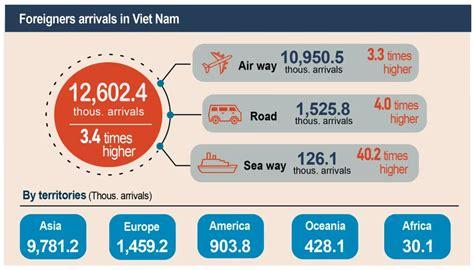
Vietnam’s tourism industry has achieved an unprecedented milestone in the first five months of 2025, welcoming over 9.2 million international visitors. This remarkable figure marks a 21.3% increase compared to the same period in 2024, showcasing Vietnam’s growing appeal among global travelers. The surge in visitor numbers has been primarily driven by a significant rise from neighboring countries such as China, India, and various nations across Southeast Asia. As the world emerges from the pandemic, Vietnam’s proactive strategies in expanding air connectivity, easing visa access, and intensifying promotional efforts have positioned it as one of Asia’s most dynamic travel destinations.
The month of May 2025 alone saw approximately 1.53 million foreign tourists arriving in Vietnam, reflecting a notable 10.5% increase compared to May 2024. This growth underscores the nation’s strong recovery trajectory and its rising status as a favored destination for both leisure and business travelers.
Air travel remains the dominant mode of entry for international visitors, with around 85.2% arriving by air between January and May 2025. Land routes contributed 12.9%, while sea travel accounted for the remaining 1.9%. Vietnam’s strategic location in Southeast Asia, coupled with an expanding network of international flight connections, continues to enhance its accessibility to travelers worldwide.
Among the top contributing markets, China retained its position as the largest source of international tourists to Vietnam, with 2.36 million visitors, representing 25.7% of the total arrivals. South Korea followed closely, sending more than 1.9 million visitors, which accounted for 20.7% of all international arrivals. Other noteworthy contributors included Taiwan (533,000), the United States (375,000), Japan (342,000), Cambodia (325,000), India (272,000), Australia (241,000), Malaysia (221,000), and Russia (210,000). Notably, Russia emerged as Vietnam’s top European market, signaling a growing interest from the region despite ongoing geopolitical challenges.
Vietnam’s tourism sector has also benefited from remarkable growth in several Southeast Asian markets. The Philippines experienced the most substantial increase, with visitor numbers soaring by 104.3%. This was followed by Cambodia with 64.8% and Laos with 39.8%. Neighboring countries like Indonesia (11.6%), Thailand (4.1%), Malaysia (2.9%), and Singapore (2.6%) have also recorded steady growth, highlighting the resilience and vitality of intra-ASEAN tourism. Meanwhile, India continued its upward trajectory, cementing its position as one of Vietnam’s most promising tourism markets with a 38.3% increase in arrivals.
Australia also posted a solid growth rate of 13.1%, while Japan and the United States saw moderate gains of 18.3% and 7.2%, respectively. However, South Korea experienced a slight decline of 2.4%, indicating the need for renewed engagement in that market.
Visa policies have played a crucial role in driving tourism to Vietnam. Countries benefiting from the unilateral visa exemption program have shown steady growth. For instance, France recorded a 19.8% rise in visitors, while the United Kingdom noted a 19.5% increase. Other European markets also performed well, with Germany up 16.1%, Italy 24.7%, Spain 10.3%, Denmark 10.9%, Sweden 15.1%, and Norway 14.3%. Russia’s resurgence was particularly striking, with a 121.1% jump in visitor numbers compared to the same period in 2024, reaffirming its importance in Vietnam’s tourism recovery from Europe.
To capitalize on this momentum, the Vietnam National Authority of Tourism (VNAT) has intensified its global outreach. In May 2025, VNAT launched promotional campaigns in France, Italy, and Switzerland, aiming to enhance the country’s visibility in European markets. These initiatives were complemented by Vietnam’s participation in the prestigious Cannes Film Festival, where the nation showcased its tourism offerings and cinematic landscape to a global audience. The promotional campaign is set to continue in June 2025, with Vietnam organizing events in Poland, the Czech Republic, and Germany, targeting a diverse range of visitors seeking culture, nature, and authentic experiences.
The outlook for the remainder of 2025 appears bright for Vietnam’s tourism industry. Favorable visa policies, targeted international promotions, and rising demand from Asian and European markets are likely to sustain this growth trend. With an increasing number of flight connections, improved infrastructure, and a diverse range of tourism offerings, Vietnam is firmly establishing itself as one of Asia’s most attractive travel destinations. As global travel patterns continue to evolve, Vietnam’s ability to adapt and innovate in its tourism strategies will be pivotal in maintaining its status as a premier destination for international travelers.