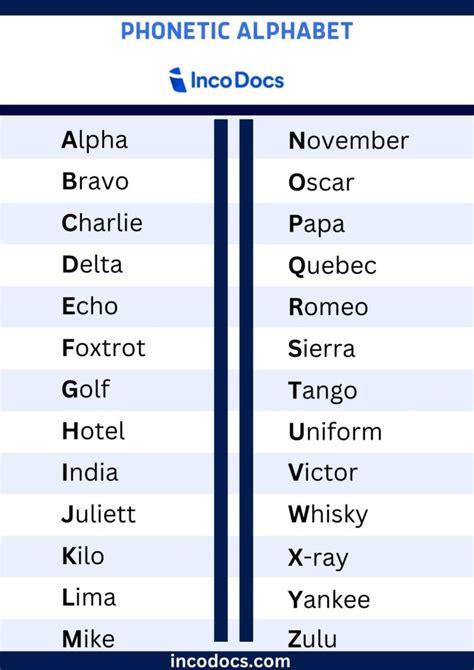
The NATO Phonetic Alphabet, also widely recognized as the Alpha Bravo Charlie code, is an internationally standardized system designed to eliminate ambiguity and enhance clarity in voice communication. Developed to reduce errors in transmission—especially over radio or telephone—the alphabet assigns distinct code words to each letter from A to Z. These code words, such as Alpha for A and Zulu for Z, are carefully selected to avoid confusion, even in high-stress or noisy environments. Used globally in aviation, maritime transport, military, emergency services, and international trade, this alphabet remains a cornerstone of clear and effective communication.
The Architecture of Accuracy: Why Code Words Matter
The design of the NATO Phonetic Alphabet is rooted in precision. Each code word is phonetically unique to prevent misinterpretation. For instance, ‘Mike’ and ‘November’ sound distinctly different, minimizing the risk of overlap. The words are also globally pronounceable, supporting seamless use across different languages and dialects. This structure is critical not only in aviation and military contexts but increasingly in global commerce, where one misheard letter in a cargo code or port identifier can cause significant delays and financial loss.
Decoding the 26 NATO Code Words: A Pronunciation Blueprint
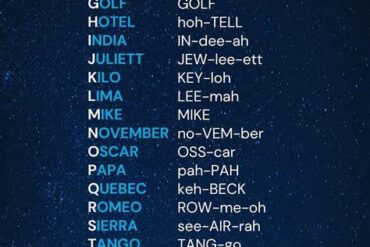
Understanding the NATO Phonetic Alphabet begins with learning each of its 26 code words. Pronunciation consistency is key, and the list below shows the phonetic representation of each letter:
- A – Alpha (AL-fah)
- B – Bravo (BRAH-voh)
- C – Charlie (CHAR-lee)
- D – Delta (DELL-tah)
- E – Echo (ECK-oh)
- F – Foxtrot (FOKS-trot)
- G – Golf (Golf)
- H – Hotel (hoh-TELL)
- I – India (IN-dee-ah)
- J – Juliett (JEW-lee-ett)
- K – Kilo (KEY-loh)
- L – Lima (LEE-mah)
- M – Mike (Mike)
- N – November (no-VEM-ber)
- O – Oscar (OSS-cah)
- P – Papa (pah-PAH)
- Q – Quebec (keh-BECK)
- R – Romeo (ROW-me-oh)
- S – Sierra (see-AIR-rah)
- T – Tango (TANG-go)
- U – Uniform (YOU-nee-form)
- V – Victor (VIK-tah)
- W – Whiskey (WISS-key)
- X – X-ray (ECKS-ray)
- Y – Yankee (YANG-key)
- Z – Zulu (ZOO-loo)
Each word is used in situations where spelling out a term precisely matters—such as giving a serial number, confirming a shipment, or verifying a flight plan.
The Strategic Backbone of Aviation and Maritime Safety
The International Civil Aviation Organization (ICAO) standardized this alphabet in 1951 after extensive testing. It became essential for air traffic controllers and pilots across different nations to avoid fatal miscommunication, especially in distress calls or poor radio conditions. By 1956, NATO formally adopted the system, ensuring uniformity across all allied military forces.
The International Maritime Organization (IMO) and the International Air Transport Association (IATA) soon followed. This widespread adoption solidified the NATO Phonetic Alphabet as the global benchmark for safe and effective communication in transportation industries.
The Role of the Phonetic Alphabet in Global Trade
In today’s hyperconnected trade environment, the NATO Phonetic Alphabet is indispensable. When confirming documentation such as product serial numbers, tracking codes, or port destinations, it eliminates the chances of misinterpretation. For example, “BGL123” becomes “Bravo Golf Lima One Two Three,” clearly conveying each element without ambiguity.
In customer service, especially in global call centers or freight forwarding, agents rely on the alphabet to spell out names, references, and addresses accurately. Logistics coordinators use it to communicate loading instructions or dock locations across multinational crews and departments.
From Able and Baker to Alpha and Bravo: A Brief History
The journey of the phonetic alphabet began well before NATO’s involvement. In the 1920s, the “Able Baker” alphabet served aviation communication, naming letters like A for “Able” and B for “Baker.” This early system, however, faced limitations when crossing linguistic barriers. During World War II, inconsistencies between Allied forces further emphasized the need for a unified approach.
The ICAO conducted extensive research, testing different words with native and non-native English speakers. Their aim was to choose words that sounded clear and were unlikely to be confused with one another. Words like “Alfa” (spelled with an ‘f’) and “Juliett” (with two ‘t’s) were deliberately modified to enhance pronunciation across languages such as Spanish and French. These small yet critical changes laid the foundation for a system still in use today.
Modern-Day Utility in Non-English-Speaking Countries
One of the NATO Phonetic Alphabet’s strengths lies in its international intelligibility. Even in countries where English is not the primary language, such as China, professionals across aviation, logistics, and export-import sectors employ the alphabet. It serves as a linguistic bridge, allowing seamless interaction with partners, vendors, and regulatory bodies worldwide.
For example, a Chinese cargo handler communicating with a U.S. freight forwarder would refer to the container code “XKT983” as “X-ray Kilo Tango Nine Eight Three,” making each detail unmistakably clear. This ability to transcend language barriers makes the NATO Phonetic Alphabet an essential tool for global interoperability.
The Alphabet in Digital Communication and Security
With the rise of cybersecurity protocols and encrypted systems, the NATO Phonetic Alphabet has also found its place in digital communication. Tech support teams use it to spell out passwords, server IDs, and product keys. It helps minimize user error and enhances data entry accuracy. In military-grade encrypted environments, where access keys must be relayed verbally without fail, the alphabet remains a trusted standard.
It also plays a vital role in emergency services. Dispatchers and first responders use it to spell out addresses or patient information over static-filled radios. This clarity can be life-saving in critical moments.
The Alphabet’s Enduring Global Legacy
Despite the emergence of more sophisticated technologies and communication tools, the NATO Phonetic Alphabet retains its timeless utility. It embodies a universal language of clarity, transcending geopolitical borders, industry silos, and cultural divides. From airports in Dubai to naval bases in San Diego, from container ships in Rotterdam to warehouses in Shanghai, this alphabet ensures one simple thing: understanding.
Its resilience and adaptability affirm its place not only in our communications systems but also in the operational DNA of international cooperation. As globalization deepens, and cross-border communication becomes more frequent and complex, the NATO Phonetic Alphabet continues to prove its relevance—word by word, letter by letter.
Frequently Asked Questions
What is the NATO Phonetic Alphabet?
The NATO Phonetic Alphabet, also known as the International Radiotelephony Spelling Alphabet or the Alpha Bravo Charlie code, is a communication tool that assigns unique code words to each letter of the English alphabet. It ensures clarity in voice communication across various sectors.
When was the NATO alphabet adopted and why?
The alphabet was officially adopted by NATO in 1956, following its standardization by ICAO in 1951. The objective was to create a consistent system for global communication, replacing multiple conflicting versions used by different countries.
How is it used in non-English-speaking countries?
In countries like China, the alphabet supports international trade, aviation, and logistics. It helps professionals communicate codes and references clearly, regardless of language barriers.
Can you provide a usage example?
Certainly. A serial like “AK29” would be spelled out as “Alpha Kilo Two Nine.” This method eliminates confusion, particularly over noisy channels or with heavy accents.
Are there other phonetic alphabets?
Yes, earlier versions like the “Able Baker” system existed. However, the NATO/ICAO version is now the most universally recognized and employed spelling alphabet worldwide.
What’s the main purpose of the NATO Phonetic Alphabet?
Its primary function is to facilitate accurate verbal communication where clarity is crucial. This includes military operations, aviation control, maritime navigation, global logistics, emergency services, and customer support.
Conclusion
The NATO Phonetic Alphabet is not just a relic of military code or aviation protocol—it is a living, global standard for precision in human communication. Whether navigating airspace, tracking a shipping container, or spelling out login credentials, this alphabet empowers individuals and institutions to speak clearly and be understood—no matter the distance, noise, or urgency.