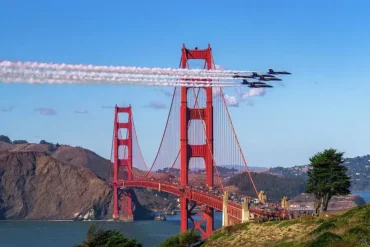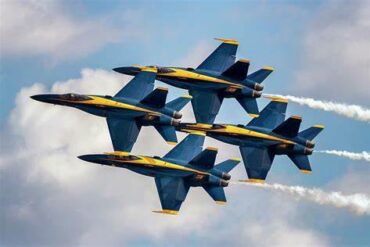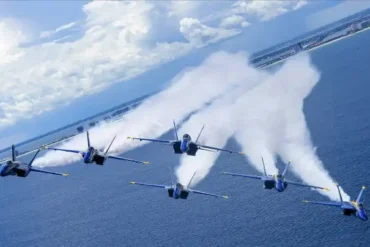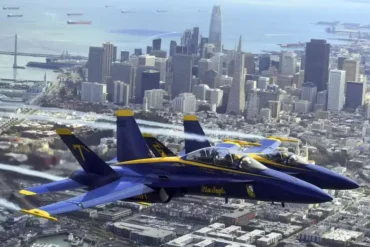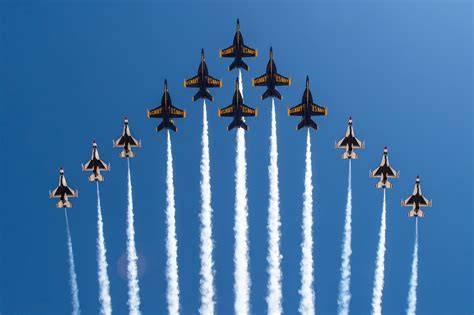
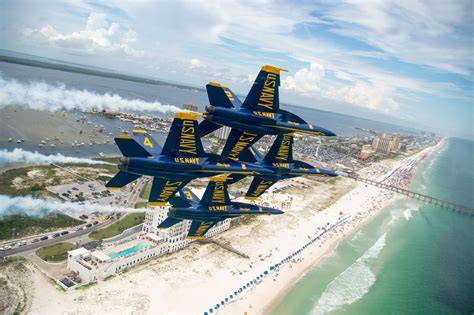
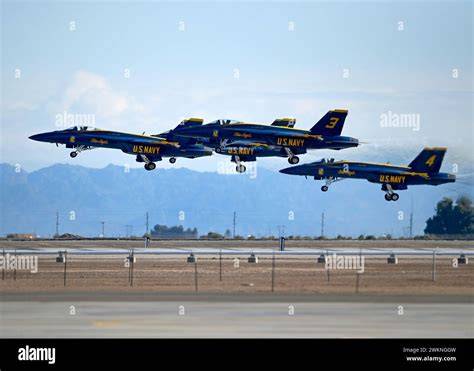
The four Boeing F/A-18 Super Hornets sweep across the Florida Panhandle in a perfect diamond, their wingtips trembling less than the length of a ruler from the canopies beside them, and to the crowd below the formation looks less like four separate aircraft than a single machine with four engines and four beating hearts. What the spectators cannot see is the immense physical and mental discipline that makes that illusion possible: pilots bracing their forearms against their thighs, breathing through clenched abdominal muscles, and fixing their eyes on a single rivet while the world blurs past at hundreds of miles per hour. The ability to fly at high speed just 12 to 18 inches (30 to 45 cm) apart is not a product of onboard computers or autonomous flight systems; it is the result of decades of institutional knowledge, custom-built flight controls, and an almost monastic devotion to repetition. Inside the cockpit there is no autopilot holding the formation together, only human beings making constant micro-adjustments to a machine that wants, like every aircraft, to wander.
The Visual Geometry of the Blue Angels Diamond Formation
The core principle of Blue Angels formation flying is deceptively simple: the wingmen do not fly their own aircraft in any conventional sense, and they spend almost no time scanning their instruments. Instead, every wingman and the slot pilot fix their gaze on the flight leader’s aircraft and hold it in a precise position relative to a hyper-specific visual marker, often a single rivet on the lead jet’s fuselage, a particular paint stripe, or the angle at which the leader’s canopy intersects the wing line. When the marker drifts, the pilot moves the stick; when it holds, the aircraft is in position. This technique, which veteran team members describe as “flying the leader” rather than flying a jet, converts an impossibly complex three-dimensional problem into a manageable visual one. The wingman’s peripheral vision is trained to absorb altitude and closure rate without ever looking away, because glancing down at an airspeed indicator for even a fraction of a second at 400 knots could close an 18-inch gap entirely.
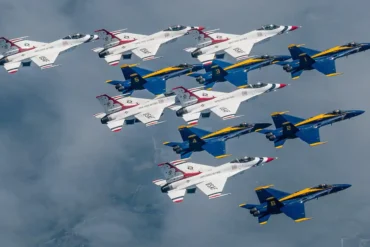
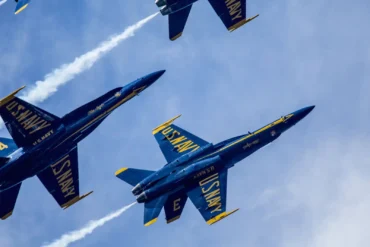
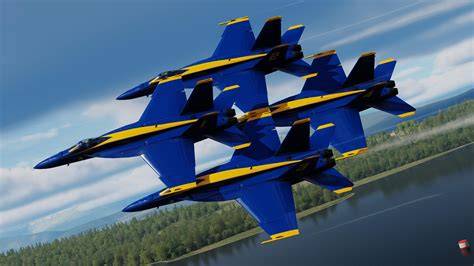
The formation geometries themselves are unforgiving. In the classic diamond, the lead aircraft flies straight ahead while two wingmen hold station off each wing and the slot pilot tucks in behind and below, each aircraft offset from the leader’s reference points by mere feet. The delta and echelon formations demand similar precision but different visual cues, and the famous six-plane delta at the end of a show compresses all six jets into a wedge so tight that the outermost aircraft appear to be flying through the leader’s exhaust. None of this is assisted by formation-keeping avionics; the Super Hornets carry modern glass cockpits, but the pilots deliberately ignore the flight director and head-up symbology that might tempt them into a machine-managed solution.
The Custom Control Stick Spring That Makes Precision Possible
One of the least known and most consequential modifications to the Blue Angels’ aircraft is a custom, extremely heavy spring built into the control stick. Standard fleet Super Hornets have a stick that moves relatively freely, a design choice that favors aggressive maneuvering in combat. The Blues’ jets, by contrast, are fitted with a stiff spring that requires substantial force to displace the stick from center, and that resistance serves a vital purpose: it ensures that brief bursts of air turbulence, wake vortices from the leader’s jet, or the jolt of a formation transition cannot inadvertently jar the flight control surfaces. In a formation where a fraction of an inch of stick travel translates into feet of wingtip movement, a soft stick is a liability.
To master this heavy spring, pilots adopt a distinctive physical posture. They press their right forearm firmly against their right thigh, using the leg as a rigid brace that converts the arm into a stable platform rather than a free-floating limb. This technique is not a stylistic flourish; it is a biomechanical necessity. With the forearm locked against the thigh, the pilot’s hand can make tiny, controlled inputs while the larger muscles of the shoulder and torso absorb turbulence, and the constant resistance of the spring gives the hand a reference force to work against. The spring’s analog feel, a tactile feedback loop that Boeing engineers preserved deliberately when the team transitioned to the Super Hornet, allows pilots to sense the aircraft’s response through their fingertips in a way that digital fly-by-wire systems alone cannot replicate. Because the spring also applies constant nose-down pressure, the pilot is always pushing forward slightly, and that steady counterforce dampens minor hand tremors that would otherwise be amplified at close range.
Why the Blue Angels Fly Without Inflatable G-Suits
Perhaps the most counterintuitive element of the team’s operating procedures is its exemption from standard inflatable G-suits, the leg-bladder garments that fighter pilots throughout the fleet wear to force blood toward the brain during high-G maneuvers. The Blue Angels fly under a strict Department of Defense waiver permitting them to operate without the suits, and the reason is directly tied to the formation posture described above. When a standard G-suit inflates, its leg bladders swell and press outward against the pilot’s thigh; with the pilot’s right forearm braced against that same thigh, any sudden inflation could nudge the arm and produce an uncommanded stick input. In a combat squadron, a small stick deflection is an inconvenience. In an 18-inch diamond, it could be catastrophic.
Without the suit’s assistance, the Blues rely instead on an intense anti-G straining maneuver, a muscle-straining breathing technique in which pilots clench their legs, glutes, and abdominal muscles while executing timed, forceful exhalations to manually keep blood flowing to the brain. This routine is physically grueling, far more demanding than the automatic assistance a G-suit provides, and it must be performed while the pilot is simultaneously holding a visual reference, bracing an arm, and managing the aircraft’s energy state. Because the team knows the entire show routine by heart, every turn, bank, climb, and dive can be anticipated precisely, allowing pilots to synchronize their bracing and breathing with the choreography. That anticipation is the real protection, but it also means flight safety depends entirely on human execution, with no hardware backstop to catch a lapse.
The Three Sets: How the Blue Angels Control Formation Spacing
The team does not fly at a single separation distance throughout the year. Instead, it uses three defined intervals, known as “Sets,” that correspond to the training calendar and the risk posture of each phase. Set One is the widest and most conservative spacing, used during the early weeks of winter training when pilots are reacquainting themselves with the formation after the off-season. Set Two represents the standard public show interval and holds the wingtips just 18 inches (45 cm) from the adjacent canopy, a distance that already seems impossible to most observers. Set Three, known as the Yankee Set, is the ultimate high-precision configuration, compressing the gap to roughly 12 inches (30 cm).
The transition to the Yankee Set is not performed everywhere in the show, because tighter spacing demands conditions in which the aircraft’s behavior is utterly predictable. The Diamond 360, a flat, continuous banked turn, is the showcase for the closest flying precisely because it lacks the extreme vertical climbs, rapid roll changes, and dramatic attitude shifts of more dynamic maneuvers. In that steady turn, the aircraft stays at a constant altitude, speed, and bank angle; the G-forces remain perfectly locked and constant; and the air flowing over the wings is smooth and undisturbed. With the flight leader able to call “take it in” over the radio, the wingmen and slot pilot slide smoothly into the Yankee Set, locking four jets together at the minimum safe distance physics allows. The show’s fastest pass at roughly 700 mph (1,127 km/h) and its slowest at about 120 mph (193 km/h) both belong to the solo pilots, as do the highest and lowest maneuvers; the diamond’s job is steadiness, and the Diamond 360 is where that steadiness pays its highest dividend.
The 2019 Tip Touch Over Naval Air Station Pensacola
On August 14, 2019, during a Diamond 360 practice flight over Naval Air Station Pensacola, the team’s home field, the canopy of the left wing jet made momentary contact with the underside of the lead jet’s outer wing. It was a minor mid-air touch within the exact wingtip-to-canopy geometry that defines the Blues’ signature performance, and no one was injured. The squadron immediately called a precautionary safety stand-down to assess the aircraft, and a post-flight inspection revealed only a minimal surface scratch. The team kept its scheduled weekend appearance at the Chicago Air and Water Show, swapping the two affected legacy Hornets for backup jets while both pilots remained in the active lineup, a rapid turnaround that signaled the squadron’s institutional confidence in its procedures.
The incident occurred during the final years of the legacy F/A-18 Hornet era, just before the team transitioned to the larger F/A-18E/F Super Hornet for the 2021 show season. Former team members spent years modifying the diamond, solo, and delta flight profiles to accommodate the massive new airframe, and pilots flew the Super Hornet diamond for the first time in late November 2020, forcing a much larger aircraft to maintain the same tiny 18-inch gap.
The Rhino in the Diamond: Upgauging Without Giving Up an Inch
The Super Hornet, affectionately known as the “Rhino,” brought the team its first major change of aircraft type in decades and ended a 34-year run by the Blues’ legacy Hornets, which had themselves replaced the A-4 Skyhawk in 1986. Despite sharing a common lineage, the Rhino is larger in every dimension, with a wingspan of 44 feet, 9 inches (13.64 meters) against the legacy Hornet’s 40 feet, 5 inches, and maximum takeoff weight of 66,000 lb (29,937 kg) against 51,900 lb. Its two General Electric F414 turbofans produce substantially more thrust than the legacy F404s, and the airframe’s greater mass changes every aerodynamic reference the pilots had internalized.
That “upgauging” forced the team to adapt the traditional routine, and even with the major airframe upgrade, the legendary 18-inch flight spacing survived. The Super Hornet brought a modernized glass cockpit and updated flight management software, giving pilots quicker access to critical system information while smoothing every control input. Yet to maintain the demanding precision the formation requires, Boeing engineers embedded a custom modification to ensure the familiar heavier control-stick spring feel carried over from the legacy fleet. The nuanced difference in how the aircraft’s analog interface feels to the touch is vital for pilots performing painstakingly choreographed movements at hundreds of miles an hour.
The Human Variable: Building Margins Through Repetition
The 2007 crash near Beaufort, South Carolina, exposed the razor-thin margins of flying without automated life-support hardware. A Navy investigation found that a highly experienced pilot experienced tunnel vision and spatial disorientation under a 6-G load while executing a routine turn, and investigators also discovered that the team’s official G-suit waiver had inadvertently expired. Rather than mandating inflatable garments, the Navy permanently extended the waiver and aggressively raised physical training benchmarks, with heavy emphasis on core abdominal conditioning. The decision treated the incident as a human performance variable, reinforcing that relentless manual repetition must supply the safety margins that equipment does not.
That repetition is built every January during an intense winter training cycle at Naval Air Facility El Centro, California, where the team flies multiple times daily until leadership certifies the squadron as airshow-ready. The 2026 season marks the team’s historic 80th anniversary, celebrating a flight demonstration heritage tracing back to 1946. Yet heightened military security postures drove a sudden schedule shift: in early March 2026, El Centro and Naval Air Station Lemoore canceled their public airshows to meet strict force protection requirements, stripping the squadron of its traditional public debut and forcing the pilots to launch their anniversary season without a live warm-up crowd. The tour is scheduled to conclude with the Homecoming Air Show at Naval Air Station Pensacola on November 6, 2026, where spectators can verify the team’s legendary 18-inch separation by watching where the wingmen’s canopies line up against the lead jet’s wings.
In the end, what separates the Blue Angels from every other demonstration team is not a secret technology but a culture of precision that treats a single rivet, a millimeter of stick travel, and a chest full of strained breath as matters of life and death. The jets are extraordinary, but the margin is human, and that margin is earned over and over again.