India’s largest airline, IndiGo, is accelerating its path toward global aviation prominence through a meticulously crafted expansion strategy that marries international partnerships with robust MRO (Maintenance, Repair, and Overhaul) infrastructure investment. In a bold move that is reshaping the contours of global air travel, IndiGo has inked cooperative agreements with aviation giants like Emirates, Qatar Airways, Lufthansa, and Air France, while simultaneously expanding its network across Europe and Asia. This combination of expansive reach and technical resilience sets a powerful precedent in the competitive low-cost carrier (LCC) segment.
IndiGo Targets High-Growth Global Corridors with Ambitious Route Strategy
At the heart of IndiGo’s global strategy lies a targeted expansion into high-demand travel corridors. The carrier is deploying Boeing 787-9 aircraft via a strategic wet lease arrangement with Norse Atlantic Airways, enabling non-stop long-haul routes to major European hubs like Manchester (MAN) and Amsterdam (AMS). These additions are not random; they are tightly aligned with the forecasted 15% annual growth rate in the India-Europe travel corridor, signaling a calculated bet on market dynamics.
IndiGo’s A321XLR narrow-body fleet is being deployed with surgical precision to destinations where long-haul wide-body jets would be uneconomical. Routes to Athens, Almaty, and Tashkent capitalize on the aircraft’s fuel efficiency and range, enabling profitable service to medium-haul destinations without the heavy operational overhead of larger aircraft.
The airline is also responding to rising demand from India’s burgeoning middle class, who are increasingly traveling for leisure and culture. New routes to Siem Reap and Hanoi cater to the culturally inclined, while direct flights to London and Copenhagen serve both business and leisure travelers during peak travel seasons. By the end of 2026, IndiGo expects to serve more than 50 international destinations, representing a 20% increase in capacity, with ambitions to stretch that to 30–40% by 2030.
Strategic MRO Investments Elevate Operational Resilience
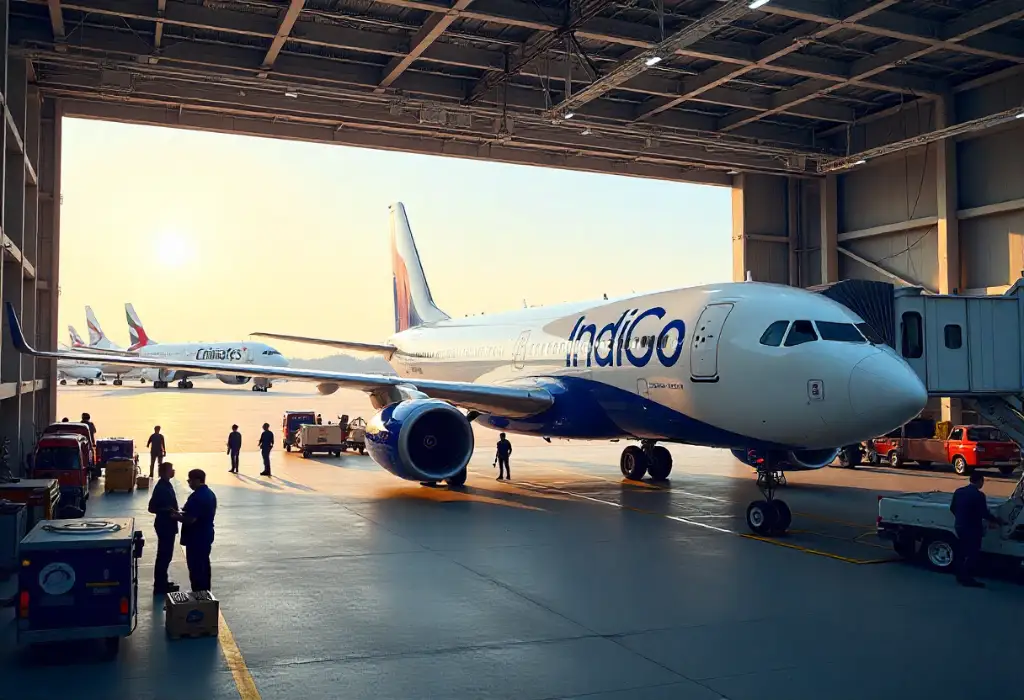
While network growth grabs headlines, IndiGo’s concurrent investment in Maintenance, Repair, and Overhaul (MRO) capability is a quieter yet transformational pillar of its international strategy. The airline’s new 31-acre MRO facility at Kempegowda International Airport (KIAB) in Bengaluru, developed in partnership with Bangalore International Airport Limited (BIAL), is designed to support both narrow- and wide-body aircraft.
This facility is expected to reduce maintenance costs and aircraft downtime, slashing operational expenses by 8–10%. Given that IndiGo takes delivery of nearly one new aircraft per week, this MRO capability is vital to sustaining its ambitious growth without compromising service quality or punctuality.
Complementing its local capabilities, IndiGo has established a strategic MRO partnership with Lufthansa Technik. This includes offshoring base maintenance to facilities in Sofia, Bulgaria, and the Philippines, while leveraging Lufthansa Technik’s Hamburg site for single-component maintenance. This hybridized model diversifies the airline’s technical support network, mitigates supply chain risk, and ensures uninterrupted operations—an indispensable asset in the complex matrix of global aviation.
Financial Strength Underpins Sustainable Growth
Unlike many aggressive airline expansions that come at the cost of profitability, IndiGo’s trajectory is underpinned by strong financial fundamentals. For FY25, the airline reported revenues of INR 841 billion and a net margin of 9%, a notable achievement for a carrier undergoing rapid international scaling.
IndiGo’s fleet acquisition strategy emphasizes wet leasing and smart OEM procurement, which lowers financial exposure and improves cost management. This allows the airline to maintain lean operations even as it adds wide-body aircraft and longer-haul routes to its portfolio.
Alliances with Aviation Titans Multiply Market Reach
IndiGo has tactically built partnerships that give it leverage in regions traditionally dominated by legacy carriers. Alliances with Delta Air Lines, Air France-KLM, and Virgin Atlantic provide IndiGo with vital access to transatlantic and transpacific markets—critical arenas for future growth.
Furthermore, codeshare agreements with Jetstar, Scoot, and Garuda Indonesia bolster IndiGo’s presence in Southeast Asia and Oceania. These collaborations allow the airline to serve destinations in Australia, New Zealand, and Indonesia without making large capital investments, offering network breadth with minimal financial strain.
This architecture of global alliances doesn’t just boost IndiGo’s seat offerings; it provides valuable brand visibility and customer loyalty beyond Indian borders. Passengers traveling through Europe or Asia can now experience seamless transitions between IndiGo and its global partners, amplifying its international credibility.
Risks and Realities in a Global Landscape
Despite its many strengths, IndiGo’s global strategy is not immune to external risks. Geopolitical tensions, such as airspace restrictions over Pakistan, can affect route efficiency and fuel costs. Additionally, the volatility in jet fuel prices and global interest rates can impact profitability. However, IndiGo’s consistent use of hedging mechanisms and preventive financial strategies demonstrate preparedness for such uncertainties.
Its fleet mix, operating model, and growing MRO infrastructure provide a buffer against the fluctuating conditions that often disrupt airline profitability. In this regard, IndiGo is building not just size, but resilience, into its business DNA.
Blueprint for Future Aviation: IndiGo’s Strategic Vision
IndiGo’s future-readiness is defined by a trio of pillars: scalability, operational excellence, and strategic alliances. With over 400 aircraft in operation—including 44 A321neo jets—and a well-structured roadmap to scale further, the airline is building a framework that ensures both capacity growth and service quality.
Its investments in technical infrastructure, both in India and abroad, are setting new industry standards for what low-cost carriers can achieve with the right mix of foresight and execution. These advancements also make IndiGo a bellwether for other LCCs aspiring to expand beyond domestic markets.
What makes IndiGo’s journey particularly compelling is its rare blend of expansion with caution—a strategy that acknowledges the unpredictable nature of aviation but proceeds with informed, data-backed decisions. The result is a sustainable growth model that doesn’t sacrifice margins or service for scale.
Conclusion: A New Global Chapter in Indian Aviation
IndiGo’s sweeping push into global skies is not just a milestone for the airline—it’s a defining moment for Indian aviation. With key alliances across Europe, Asia, and the Americas, and a next-gen MRO backbone to support its operations, IndiGo is establishing itself as a benchmark in international low-cost aviation.
Its ascent is more than a tale of new routes and larger fleets. It’s a testament to the power of operational discipline, visionary leadership, and intelligent collaborations. As IndiGo inches closer to its 2030 ambition of becoming a top-tier global airline, the broader aviation community—investors, analysts, competitors, and consumers—would do well to watch closely.
In a sector long dominated by Western and Middle Eastern carriers, IndiGo is not just joining the ranks—it’s rewriting the playbook.