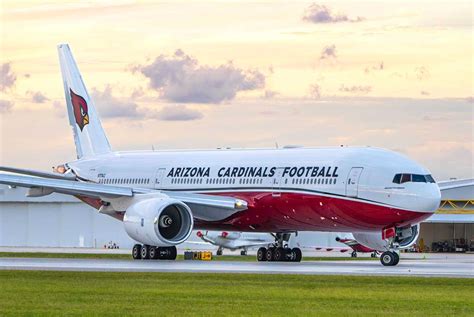
The Arizona Cardinals, one of the NFL’s most historic franchises, have built their legacy not just through generations of football excellence but also through forward-thinking operations off the field. While many fans are familiar with the team’s on-field exploits and iconic players, far fewer understand the sophisticated logistics required to move a full NFL operation from city to city across an 18-week regular season — and potentially beyond, into the playoffs. At the heart of this movement lies a duo of impressive aircraft that the Cardinals utilize: the Dassault Falcon 7X and a specially outfitted Boeing 777.
A Legacy Built on the Ground — and in the Air
The Arizona Cardinals began their journey in 1898, originally founded in Chicago, making them one of only two original NFL charter teams that still exist today, alongside the Chicago Bears. After a six-decade stint in Chicago and nearly three decades in St. Louis, the franchise moved to Phoenix, Arizona in 1988. The name changed to the Arizona Cardinals in 1994 to better represent their state-wide fanbase. Despite a rich history, the team has endured the NFL’s longest championship drought, one it hopes to end soon under the leadership of quarterback Kyler Murray and rising star Marvin Johnson Jr.
Yet while championships are earned on the field, they are made possible by the smooth operation of the many logistical gears that move this franchise. This includes one of the NFL’s most sophisticated private aviation programs.
The Power Pair: Cardinals’ Private Jet Fleet
The Arizona Cardinals currently operate two aircraft that serve very different, yet complementary roles. These are the Dassault Falcon 7X, a nimble, ultra-long-range business jet, and the Boeing 777-200, a widebody commercial aircraft adapted for private charter.
Dassault Falcon 7X – The Executive Workhorse
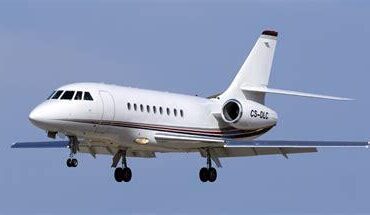
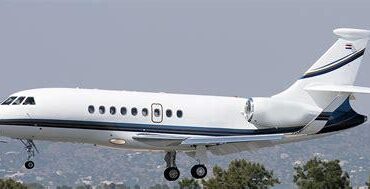
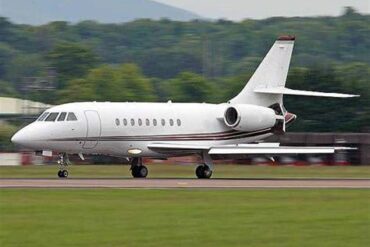
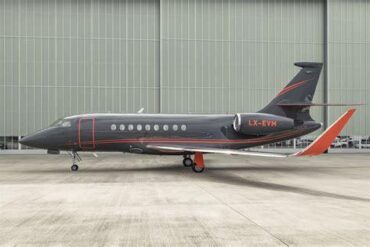
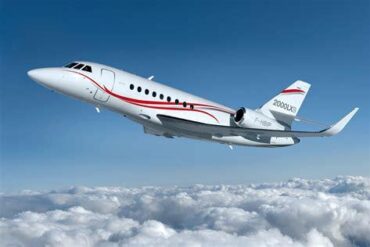
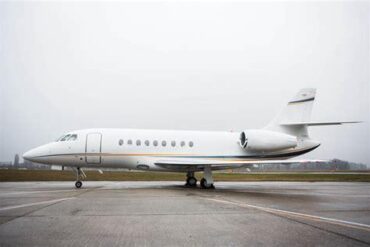
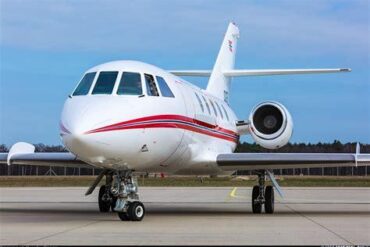
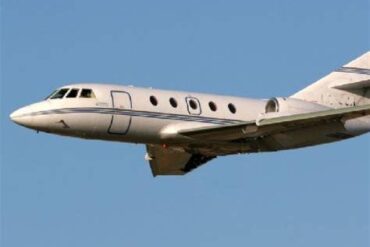
The Cardinals’ Dassault Falcon 7X, registered with the FAA as N1AZ, is a sleek, high-performance business jet tailored for the franchise’s executive and operational staff. Built in 2012, this aircraft has clocked over 100 flight hours in 2024 alone, with frequent visits to Scottsdale Airport (SCF), Washington Dulles (IAD), and Detroit Metro (DTW).
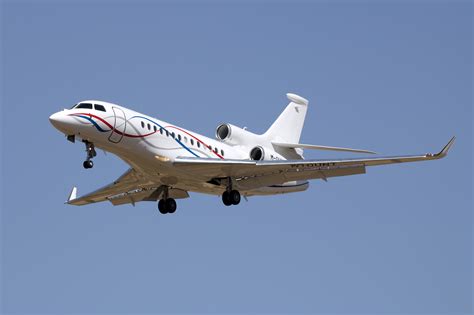
Designed to carry up to 16 passengers, the 7X is equipped with three Pratt & Whitney PW307A engines, giving it exceptional range and speed. Some of its key specs include:
- Range: 5,950 nautical miles
- Cruise Speed: Mach 0.8 (528 mph)
- Max Speed: Mach 0.9 (594 mph)
- Cabin Altitude: Lower than average for added comfort
- Service Ceiling: 51,000 feet
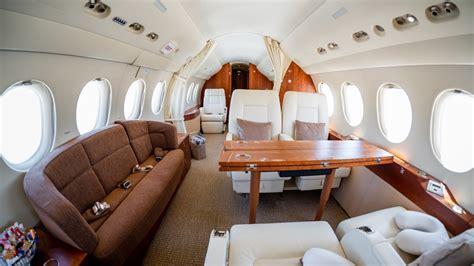
The aircraft’s interior is tailored for executive comfort, complete with lie-flat seating, dedicated workspaces, and cutting-edge communication systems, making it ideal for front-office personnel, scouts, and coaching staff to travel discretely and efficiently across the country.
Boeing 777-200 – The Team’s Flying Fortress
The Cardinals’ latest addition to their aviation arsenal is the Boeing 777-200, registered as N777AZ. Although originally built in 2002, the team only acquired the aircraft in late 2023. Since then, it has logged limited but crucial travel time, totaling 19 flight hours across just 11 flights in 2024. The jet frequently visits Fort Worth Alliance Airport (AFW), Phoenix Sky Harbor (PHX), and Luke Air Force Base (LUF).
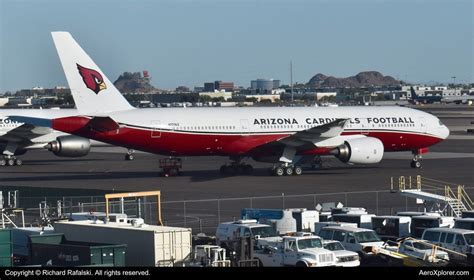
Unlike commercial versions of the 777, which can carry over 400 passengers in a high-density layout, the Cardinals’ variant has been significantly reconfigured. Its spacious layout supports full team travel, including players, coaching staff, medical personnel, and equipment managers.
The aircraft is powered by two Rolls-Royce Trent 800 turbofan engines, each capable of generating over 77,000 pounds of thrust, propelling this twin-engine giant at:
- Max Takeoff Weight: 545,000 lbs
- Cruise Speed: Mach 0.84 (552 mph)
- Range: 5,240 nautical miles
- Wingspan: 199 ft 11 in
- Service Ceiling: 43,000 ft
Inside, the aircraft has been optimized for performance and recovery. Spacious seating, dedicated sleeping areas, hydrotherapy options, and full-service nutritional kitchens ensure the players are not just transported, but physically prepared for competition upon arrival.
The Strategic Importance of Owning Jets
For most franchises, player transport relies heavily on charters or leases. The New England Patriots, for example, operate a pair of Boeing 767s, while the Indianapolis Colts use a mix of Boeing and Gulfstream aircraft. But owning and customizing private jets provides an edge in reliability, comfort, and branding — particularly for a team located in Arizona, where direct commercial options to distant markets can be limited.
The Cardinals’ decision to invest in a fleet mirrors their broader organizational ambition: build long-term stability and autonomy. With ownership of aircraft comes full control over:
- Scheduling and logistics
- Aircraft branding and customization
- In-flight services and recovery protocols
- Data privacy and team security
Beyond Transport: A Flying Brand Statement
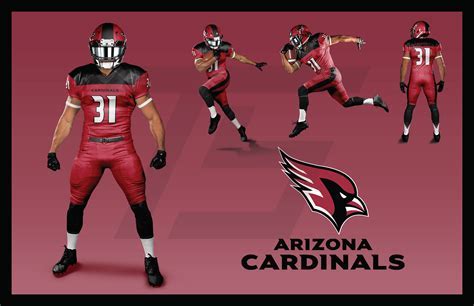
These jets are more than just vehicles; they are mobile billboards for the franchise’s identity and ambition. The exteriors often feature the Cardinals’ iconic red and black livery, complete with the unmistakable bird-head logo. Inside, upholstery, lighting, and fixtures reflect team colors and values.
For recruits and new signings, a ride on the Cardinals’ Boeing 777 or Falcon 7X sends a clear message: this is a team that invests in excellence from top to bottom. The psychological and reputational impact of such assets cannot be understated. For free agents and potential staffers, these jets underscore a franchise that’s deeply committed to competitive performance — on the ground and in the air.
Performance and Planning in Perfect Harmony
Modern NFL operations involve far more than playbooks and physical drills. Nutrition, recovery, sleep science, and mental wellness now factor into every aspect of team logistics. Owning customized jets like the Falcon 7X and Boeing 777 allows the Cardinals to integrate these priorities into their travel operations.
Players can hydrate and receive treatments during flights. Coaching staff can review film mid-air on secure networks. General managers and scouts can coordinate schedules with minimal disruption. This synergy between air travel and football operations is especially valuable during back-to-back away games or coast-to-coast travel demands.
Looking Ahead: Building for the Future
The Cardinals are entering a promising new chapter, with a young core built around Kyler Murray and Marvin Johnson Jr. To match their potential on the field, the team has made strategic moves off it — including aviation infrastructure that could rival any in the league.
The aircraft not only support day-to-day operations but also act as long-term assets that could serve for years. And should the team push into postseason runs or international matchups, the 777’s transcontinental range and flexibility offer seamless mobility.
Final Descent
In a league where the margins of victory are razor-thin, any operational edge matters. For the Arizona Cardinals, private aviation is not just a perk — it is an essential component of a strategy centered on performance, preparation, and prestige. As the team continues its rise, these aircraft stand as quiet, high-altitude sentinels, supporting every victory and every mile.
Whether soaring over deserts or descending into a rival’s city, the Cardinals are flying smarter, faster, and more prepared than ever before — a statement of intent written across 200-foot wingspans and in the roar of twin jet engines.