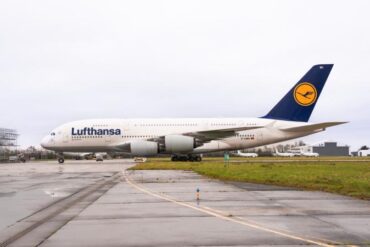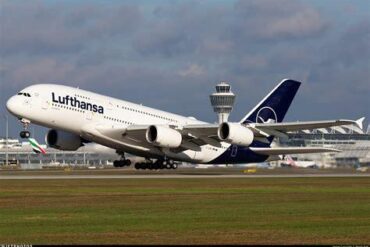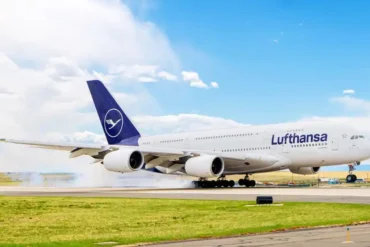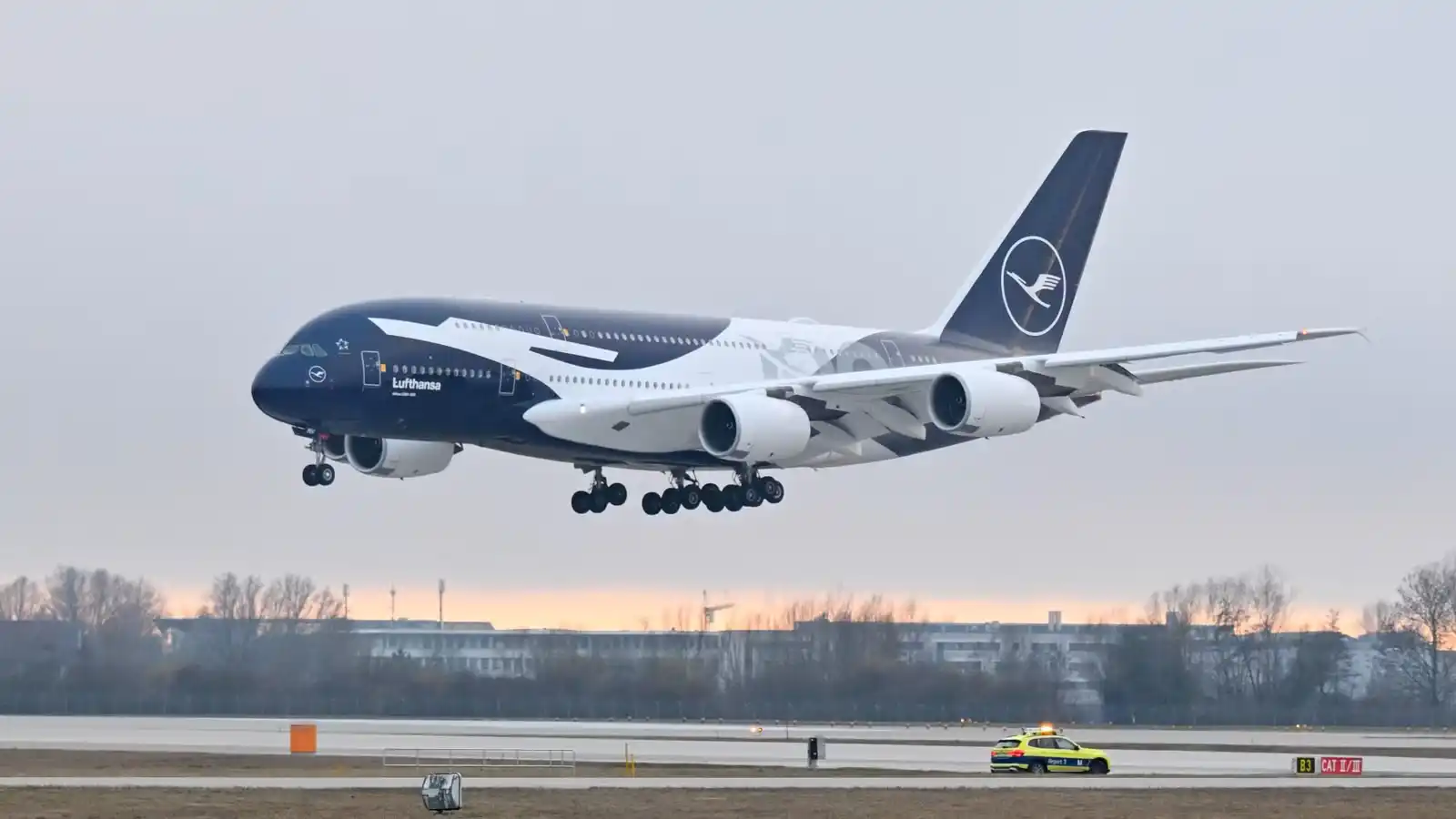
Lufthansa’s celebration of a century in aviation has taken on its most dramatic form yet, as the airline’s Airbus A380-800 in special centennial colors returned to Munich after a 34-day stay in Shannon, Ireland. The superjumbo, registered D-AIMH, now stands as the most visually commanding tribute to the carrier’s 1926–2026 milestone, combining heritage symbolism with the unmistakable presence of the world’s largest passenger aircraft.
The aircraft landed back at Munich Airport (MUC) on Wednesday, February 25, concluding a month-long transformation that required meticulous repainting across more than 4,000 square meters of surface area. A team of 35 specialists worked to apply the celebratory livery, which features a deep blue fuselage adorned with an oversized white crane stretching an astonishing 47 meters along the aircraft’s body. On the port side, the bold number “100” declares the anniversary, while the starboard side carries the historic marker “1926 | 2026.”
At 15 years old, D-AIMH is no newcomer to Lufthansa’s long-haul network. Its last commercial mission took it from Delhi to Munich on January 20, before it was withdrawn from service for its transformation. Despite its return to base, the aircraft will not resume scheduled operations until March, ensuring final checks are completed before the centennial flagship rejoins intercontinental routes.
A Superjumbo as a Centennial Statement
Choosing the Airbus A380 as the most prominent canvas for Lufthansa’s 100-year tribute is more than aesthetic symbolism. The A380 remains an aviation icon, a double-deck flagship representing scale, ambition, and long-haul connectivity. Among the seven aircraft selected to wear the commemorative design, none commands attention quite like the A380.
The airline initially operated 14 examples of the type but has since reduced its fleet to eight active superjumbos after retiring six during the pandemic-era restructuring. These remaining aircraft are now firmly positioned as long-term assets. Lufthansa has confirmed that all eight will undergo cabin retrofits featuring new premium products by mid-2027, reinforcing the A380’s role in its future strategy.
In January, Lufthansa announced that D-AIMC would be the first A380 to begin its interior modernization program, receiving new business class seating. This signals that the centennial livery is not merely nostalgic pageantry; it is paired with tangible investment in passenger experience.
The Growing Centennial Fleet
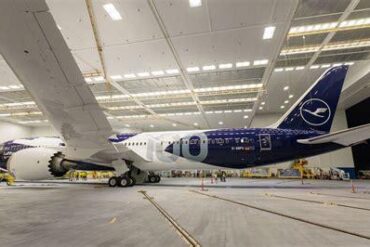
The A380 is the fourth aircraft to receive the 100th anniversary livery. It joins a Boeing 787-9 (D-ABPU) and an Airbus A320neo (D-AING) based in Frankfurt, as well as an Airbus A350-900 (D-AIXL) stationed in Munich. Another A320neo is expected to arrive in Munich shortly, already dressed in centennial colors.
Ultimately, seven aircraft across Lufthansa’s fleet will showcase the commemorative design. The selection spans narrowbody, widebody, and next-generation long-haul platforms, symbolizing both continuity and evolution within the fleet.
Two additional aircraft will elevate the anniversary display even further: a Boeing 747-8 and Lufthansa’s first-ever Airbus A350-1000. The 747-8, already iconic as one of the last passenger variants still flying globally, will gain additional visual impact under the centennial scheme. Lufthansa remains one of the largest operators of the passenger 747-8, and its inclusion underscores the airline’s enduring association with aviation’s most recognizable silhouettes.
The Airbus A350-1000, scheduled for delivery in October, will arrive directly from the manufacturer already wearing the anniversary livery. This approach minimizes downtime and repainting costs, demonstrating operational foresight. Unlike the 747 or A380, the A350-1000 represents Lufthansa’s forward-looking strategy—fuel-efficient, technologically advanced, and positioned as a cornerstone of future long-haul operations.
Munich at the Center of the A380 Revival
Lufthansa’s A380 operations are now concentrated exclusively in Munich. From this Bavarian hub, the superjumbo connects Germany to key global markets. January scheduling data shows year-round A380 service to Delhi and Los Angeles, reinforcing the aircraft’s deployment on high-demand, premium-heavy routes.
Seasonally, the aircraft serves Boston, Denver, Washington Dulles, and Mumbai during the summer peak. San Francisco sees A380 operations from January through October. These routes highlight Munich’s strategic importance as Lufthansa’s A380 base, a shift from earlier years when Frankfurt also hosted regular superjumbo services.
At its peak A380 utilization, Lufthansa operated certain routes with up to two daily A380 frequencies. Today’s leaner fleet of eight aircraft reflects a more measured deployment strategy, balancing capacity with profitability. Yet the airline’s decision to retrofit and retain these jets confirms they are far from symbolic relics.
A Century Framed by the Crane
The crane emblem has long been Lufthansa’s defining symbol. On the centennial A380, the crane expands to XXL proportions, becoming a sweeping visual anchor across the fuselage. Its scale is intentional. Few aircraft provide the surface area necessary for such dramatic branding, and the A380’s vast double-deck structure turns heritage into spectacle.
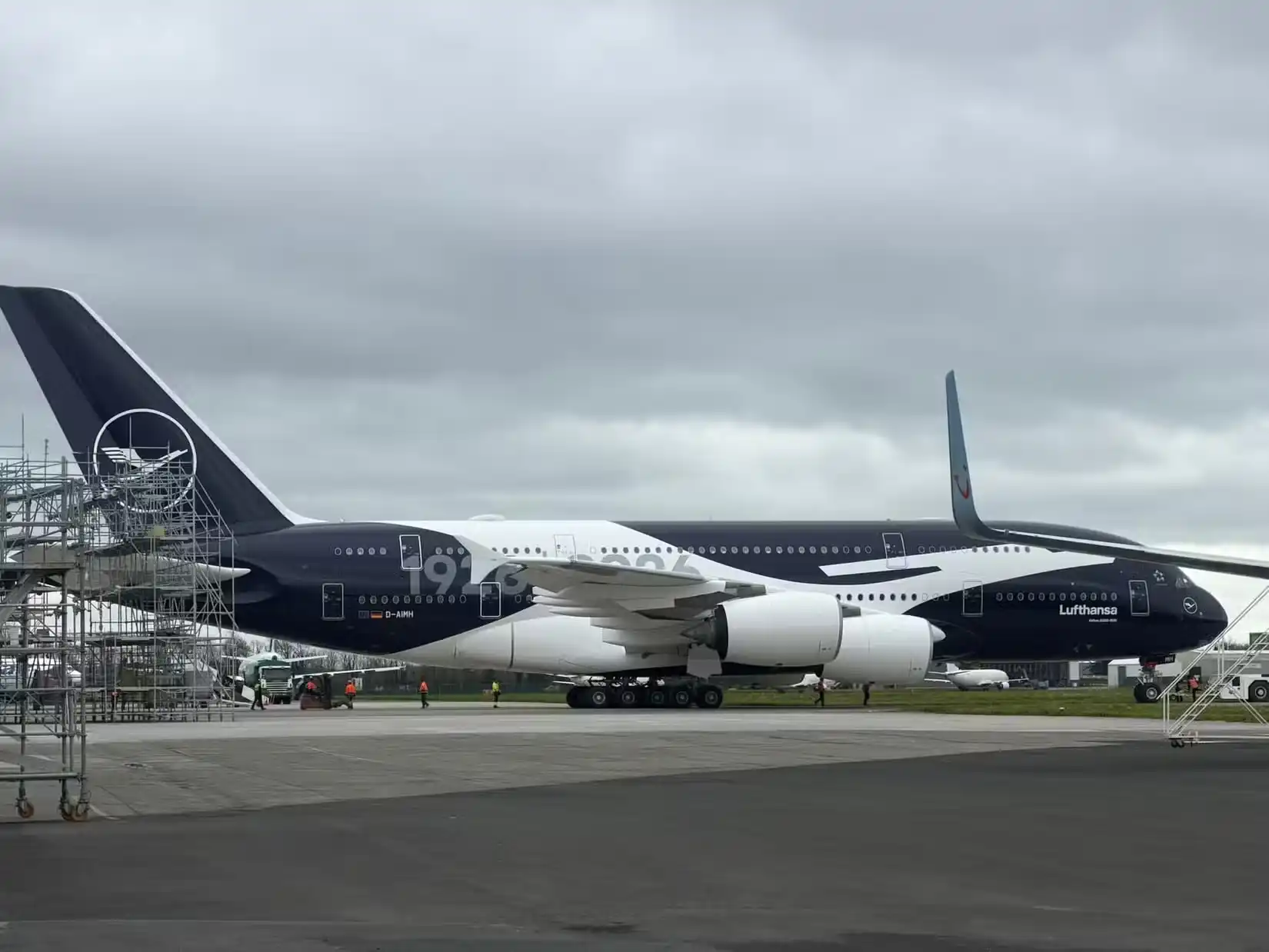
The design also connects past and future. The “1926 | 2026” marking does more than indicate dates; it signals continuity through geopolitical upheaval, technological revolutions, and industry transformation. Lufthansa’s journey has included fleet modernization cycles, global alliances, restructuring phases, and now a renewed emphasis on premium long-haul travel.
Strategic Symbolism Beyond Paint
Special liveries often function as marketing instruments, but in Lufthansa’s case, the centennial program integrates fleet strategy, brand identity, and product investment. By distributing the design across aircraft types ranging from the A320neo to the A350-1000 and 747-8, the airline communicates both legacy and modernization.
The A380’s return from Shannon is therefore not just a repaint milestone. It is a visual declaration that Lufthansa intends to honor its history while committing resources to future competitiveness. With cabin retrofits underway, new-generation aircraft arriving, and Munich positioned as the superjumbo’s operational heart, the centennial livery becomes a traveling ambassador.
When D-AIMH reenters service in March, it will not merely transport passengers. It will carry a century of aviation history across continents, its 47-meter crane cutting through the sky as a reminder that scale, heritage, and forward momentum can coexist on the same wing.