Magnetic Variation
Declination Defined
Magnetic declination is the angle between true north and magnetic north at a specific location. This angle is measured in degrees and minutes, indicating whether magnetic north lies east or west of true north. Nathanial Bowditch, in his book The American Practical Navigator, described variation as the angle between magnetic and geographic meridians.
In simpler terms, magnetic variation, often called declination outside of aviation and nautical contexts, is how far magnetic north deviates from true north on a horizontal plane. This angle changes based on your location on Earth and can also vary over time. If your compass points right of true north, declination is positive (east). Conversely, if it points left, declination is negative (west).
Typically, a compass needle will aim toward the North Geographic Pole, but it rarely points directly north due to the Earth’s complex magnetic field. The compass aligns with the horizontal component of this magnetic field, known as magnetic north. True north, however, directs you to the North Geographic Pole. Many believe that a compass needle points straight to the North Magnetic Pole, but that’s not entirely accurate. Following the needle will lead you there, but not in the most direct manner.
Adding to the complexity, the magnetic poles are not stationary; they shift over time, and the Earth’s magnetic field fluctuates due to various factors, including extraterrestrial magnetic storms. The NOAA’s Historical Magnetic Declination map illustrates these changes over the last 400 years.
Terminology
Three main terms describe the angle between magnetic north and true north: declination, variation, and deviation.
-
Declination: Often termed “magnetic declination,” this is the preferred word among those studying the Earth’s magnetic field. It’s widely used by land navigators, geocachers, and surveyors.
-
Variation: This term is favored by mariners and pilots. It’s important to note that “declination” also refers to celestial navigation, which measures the angle of stars or planets above the celestial equator.
-
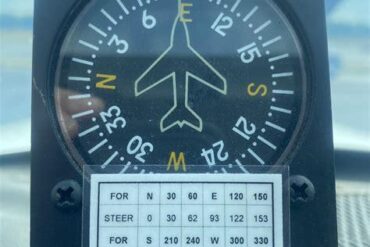
Deviation: In aircraft or ships, a compass is influenced not just by the Earth’s magnetic field, but also by the magnetism of the vehicle’s materials. This creates an error called “deviation.” Many mistakenly use deviation when they mean declination.
An isogonic line is where magnetic declination remains constant, while an agonic line is where declination equals zero.
Heading Relationships
In aviation, three headings are essential to understand direction:
-
Compass heading: The reading on a basic magnetic compass.
-
Magnetic heading: The compass heading adjusted for deviation.
-
True heading: The magnetic heading corrected for variation (declination).
Aircraft standby compasses can be adjusted for deviation through a process called a “compass swing.” If adjustment isn’t possible, a compass deviation card is usually mounted near the instrument to indicate necessary adjustments. Most primary directional instruments can be calibrated to eliminate deviation. To find true heading from magnetic heading, pilots must adjust for variation. Helpful rhymes like “variation east, magnetic least” and “variation west, magnetic best” assist in remembering how to apply variation correctly.
Navigation
Magnetic variation is crucial in aircraft navigation. Runway headings, AWOS, ATIS, tower-reported winds, VOR alignment, approach, and airway tracks all reference magnetic north. In contrast, VFR charts, TAF, METAR, and enroute winds are based on true north. Therefore, pilots must grasp the relationship between these two norths, know where to find relevant variation values, and apply them accurately for successful navigation.