Next Generation Air Transportation System, or NextGen, refers to the ongoing transformation of the National Airspace System (NAS) in the United States, planned from 2012 to 2025. At its core, NextGen is about shifting from a ground-based air traffic control system to a satellite-based management system. This shift utilizes aviation-specific applications built on widely-used technologies like GPS, alongside innovations in weather forecasting, data networking, and digital communications. With NextGen, more aircraft can safely fly closer together on direct routes, which helps reduce delays and has positive effects on the environment and economy by lowering carbon emissions, fuel use, and noise.
The move to NextGen is made possible by smarter, satellite-based technologies and new procedures that aim to make air travel more convenient, predictable, and eco-friendly. As the airspace in the U.S. becomes busier, NextGen is expected to enhance safety, cut delays, save fuel, and lower exhaust emissions from aircraft. Implementing NextGen involves complex activities, including developing concepts and deploying new capabilities across the NAS.
NextGen consists of five key elements. First, there’s Automatic Dependent Surveillance-Broadcast (ADS-B). This technology uses GPS signals to provide air traffic controllers and pilots with accurate information, ensuring safe separation of aircraft in the sky and on runways. Aircraft transponders receive GPS signals to determine their precise location, broadcasting this data to other aircraft and air traffic control. Once fully operational, both pilots and controllers will share real-time traffic displays, enhancing safety. The FAA will require specific avionics for implementing ADS-B.
Next, we have Next Generation Data Communications. Currently, communication between aircrew and air traffic control mainly relies on voice. With the introduction of data communications, an additional means for two-way communication will be available, allowing for better delivery of air traffic control clearances and instructions. As more aircraft are equipped with data links, routine messages can be exchanged more efficiently, improving controller productivity and overall safety.
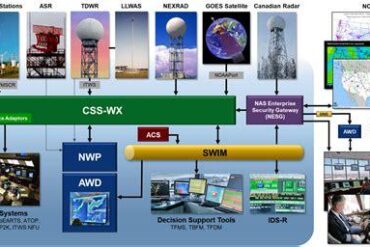
The third element, Next Generation Network Enabled Weather (NNEW), addresses the fact that weather causes 70% of NAS delays each year. NNEW aims to halve these weather-related delays by integrating tens of thousands of global weather observations into a single national system, updated in real-time. This will create a comprehensive weather picture across the national airspace, aiding decision-making in air transportation.
System Wide Information Management (SWIM) is another critical component. It will offer a unified infrastructure to deliver data to multiple users and applications. By streamlining interfaces and systems, SWIM will minimize data redundancy and improve information sharing, enabling better decision-making through easier access to information. Lastly, the NAS voice switch (NVS) will replace the outdated voice switching systems currently in use with a modernized air/ground and ground/ground communications system.
NextGen brings several benefits, particularly through Trajectory Based Operations. Aircraft will share precise information about when they will cross key points along their flight paths, allowing pilots and air traffic controllers to operate with the same accurate data. This collaboration is vital for successful trajectory-based operations.
NextGen also aims to reduce the impact of weather on flights. Improved information sharing, advanced technology to sense weather conditions, better forecasts, and integrated automation will enhance decision-making and minimize airspace limitations. In busy metropolitan areas, such as around Chicago, New York, Dallas/Fort Worth, and Los Angeles, NextGen will implement new procedures to improve airport surface movements, manage flows in and out of busy airspace, and maximize the use of high-demand airports.
Finally, NextGen recognizes the importance of flexible terminals and airports. Instead of focusing solely on the busiest airports, it aims to uncover untapped capacity across the system. During peak traffic periods, NextGen will enable aircraft to fly precise routes into and out of various airports, increasing overall throughput.