
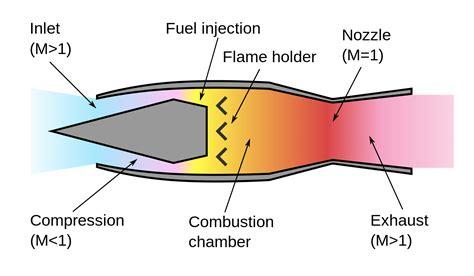
A ramjet is a type of air-breathing jet engine that operates without a rotary compressor. Instead, it relies on the forward motion of the aircraft to compress incoming air. Because of this, a ramjet cannot start at zero speed, meaning it can’t power an aircraft throughout all phases of flight. To function properly, a ramjet-equipped aircraft needs another propulsion system to help it reach the necessary speed for the ramjet to generate thrust.
Theoretically, a ramjet can begin operating at speeds as low as 100 knots. However, it doesn’t produce significant thrust until the airspeed hits around Mach 0.5. Even then, its efficiency remains low until it reaches supersonic speeds, ideally around Mach 3, where peak efficiency occurs. It’s important to note that ramjet engines are limited to a maximum speed of about Mach 6 due to pressure loss caused by shockwaves when slowing intake air to subsonic speeds.
In its simplest form, a ramjet features very few moving parts, which has led to it being nicknamed the “flying stovepipe.” The engine comprises three main components: an air intake, a combustor, and an exhaust nozzle. As a high-speed object moves through the air, it creates a high-pressure region in front of it. The ramjet’s intake captures this high dynamic pressure air and, using shockwaves generated by its design, slows the air to subsonic speed before it enters the combustion chamber.
Inside the combustor, fuel is mixed with the compressed air and ignited, allowing the exhaust to reaccelerate to supersonic speeds. As the exhaust gases exit the engine, they are further accelerated by the shape of the exhaust nozzle. This process highlights the efficiency and simplicity of ramjet technology.