
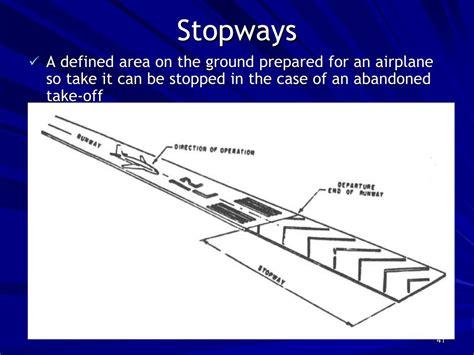
In aviation, a stopway (SWY) plays an important role in runway safety. It refers to the area beyond the runway that helps an aircraft decelerate if a takeoff is aborted. For a stopway to be effective, it needs to meet specific criteria. First, it should be at least as wide as the runway itself. Second, it must be centered along the extended centerline of the runway. Additionally, the stopway must be strong enough to support the aircraft during an aborted takeoff without causing any structural damage.
Airport authorities designate stopways specifically for this purpose. They are marked clearly with large yellow chevrons at both ends of the main runway, making them easy to spot. When a stopway is present, it contributes to what is known as the Accelerate Stop Distance Available (ASDA). This means that when calculating ASDA, the length of the runway combined with the stopway equals the total distance available for safely stopping the aircraft. Understanding stopways is crucial for ensuring safe operations at airports.