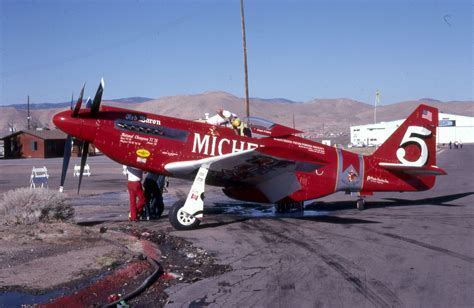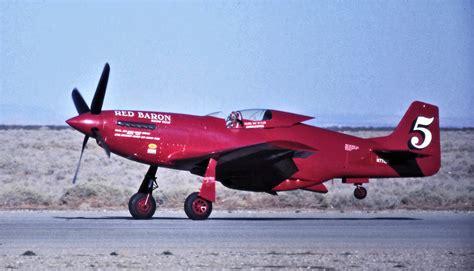
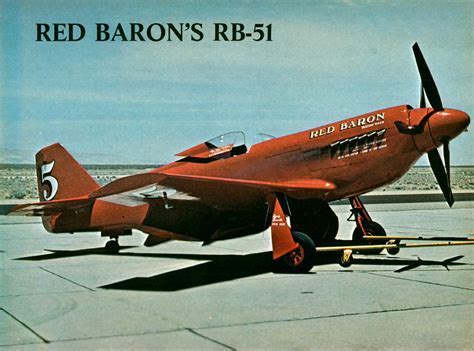
The Red Baron RB-51 Mustang remains one of the most iconic and heavily modified racing aircraft in aviation history. Originally born as a North American P-51D-25-NT Mustang with the serial number 44-84961, this machine underwent an extraordinary transformation that turned it into a dominant force in the Unlimited Air Racing circuit during the 1970s. Its journey from a wartime fighter to a record-breaking racer encapsulates the relentless pursuit of speed and precision engineering.
Origins and Early Racing Career
The aircraft first took to the skies in 1966 under various names, including Miss R.J. and Roto-Finish Special. It quickly gained recognition for its performance, culminating in a prestigious win at the Unlimited Gold in 1972. However, its true metamorphosis began when Ed Browning of the Red Baron Flying Service purchased the aircraft in 1974. Browning’s vision was to create a racing powerhouse, and he enlisted the expertise of Lockheed engineers Pete Law and Bruce Boland, along with a team of specialists, to bring this vision to life.
Engineering Marvel: Radical Modifications
Transforming the RB-51 into a world-class racer demanded audacious modifications. One of the most significant changes was replacing the original Packard-built Merlin engine with a Rolls-Royce Griffon 57, a V-12 liquid-cooled piston engine capable of delivering 3,000 horsepower. This engine, sourced from an Avro Shackleton, brought immense power but also unprecedented challenges.
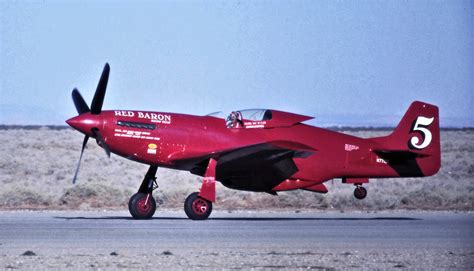
To harness the Griffon’s capabilities, the team installed contra-rotating propellers, a sophisticated setup designed to counteract torque effects and improve thrust. However, these propellers introduced new stability issues, necessitating a substantial increase in the aircraft’s fin area. The modifications were not merely cosmetic; they redefined the airframe’s core structure, particularly the engine compartment, to accommodate the larger powerplant and propeller assembly. This ambitious overhaul cost Browning over $300,000—a staggering investment that paid off in dominance on the race circuit.
Reign on the Racing Circuit
With its new configuration, the Red Baron RB-51 emerged as an unstoppable competitor. Initially piloted by Mac McClain and later Daryl Greenamyer, the aircraft soon found its legendary pilot: Steve Hinton. In 1976, Hinton, at the recommendation of Greenamyer, took the helm and carved his name into the annals of air racing history. Hinton’s mastery of the RB-51 was unparalleled—he won four consecutive Unlimited races in a single year, an achievement that has never been replicated.
The RB-51’s most celebrated moment came on August 14, 1979, when Hinton set the piston-driven aircraft 3-kilometer world speed record at 499.018 mph in Tonopah, Nevada. The team had aimed to break the 530 mph barrier, counting on high desert temperatures to maximize engine performance. However, cooler-than-expected conditions limited their speed, but the record stood unchallenged for a decade, cementing the Red Baron’s legacy.
Catastrophic Finale: The 1979 Crash
Tragedy struck just weeks later, on September 16, 1979, during the Reno Air Races. Mid-race, a capacitor in the magneto failed, causing the engine to operate on only half of its spark plugs. Unaware of the exact fault, Hinton pushed the engine to full throttle, which placed enormous strain on the supercharger. The supercharger’s failure set off a chain reaction, ultimately leading to a shaft break that controlled both the oil pump and propeller pitch. The propellers went flat, transforming into massive air brakes that forced the plane down.
The RB-51 crashed just short of the runway, shearing its wings and erupting in flames. Miraculously, the cockpit was flung clear of the fireball, saving Hinton’s life despite severe injuries including a broken back, leg, and ankle. Engineer Pete Law later credited the survival to reinforced cockpit braces and a roll bar, innovations that had been added as precautionary safety measures.
Awards and Accolades
During its racing career, the Red Baron RB-51 amassed numerous accolades, reflecting its engineering brilliance and competitive spirit. Among its major wins were:
- 1974: First Place, Mojave
- 1976: First Place, Mojave
- 1977: First Place, Reno; National Champion
- 1978: First Place, Mojave; First Place, Reno; National Champion
- 1979: First Place, Mojave; First Place, Miami Homestead; World Record, 3 km piston-driven aircraft
These achievements underscore the Red Baron’s status as an aviation legend, unmatched in its era for both speed and innovation.
Technical Specifications of the RB-51 Red Baron
While the RB-51 was a highly customized aircraft, some key technical details include:
- Crew: 1
- Engine: Rolls-Royce Griffon V-12 liquid-cooled piston engine, producing 3,000 hp (2,200 kW)
- Propellers: 6-bladed Rotol contra-rotating propeller
- Maximum Speed: Approximately 500 mph (800 km/h)
These specifications highlight the sheer power and complexity of the machine, a testament to the engineering feats accomplished by Browning’s team.
Legacy and Rebirth
Although the original RB-51 was destroyed, its spirit lived on. Steve Hinton’s company, Fighter Rebuilders, salvaged the aircraft’s dataplate and registration number NX7715C, transferring them to another P-51D, serial number 44-73053, known as Wee Willy II. This act ensured that the Red Baron’s lineage continued in the racing world, honoring its legacy of innovation and daring.
The story of the Red Baron RB-51 is more than just a tale of speed—it is a narrative of human ambition, technological prowess, and resilience. From its humble origins as a wartime fighter to its status as a record-shattering racer, the RB-51 embodies the relentless pursuit of excellence that defines the spirit of aviation.