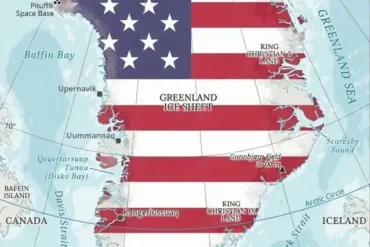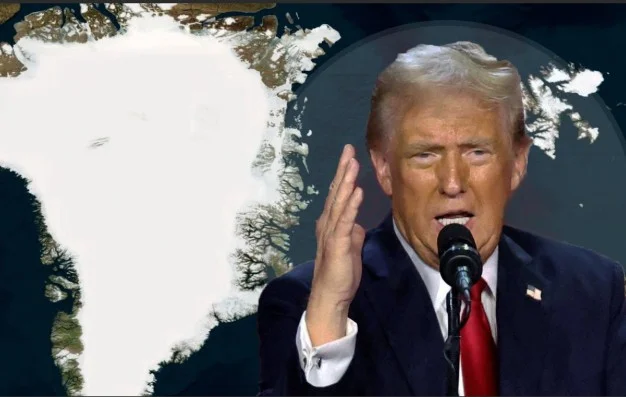
The modern world likes to imagine that empire ended with the lowering of flags and the signing of independence documents. Yet every so often, a single statement tears through that comforting illusion and exposes how much of today’s global order still rests on ancient, violent legal fictions. Donald Trump’s insistence that Denmark has no rightful claim to Greenland because “a boat went there 500 years ago and then left” is one such moment. What sounds like a crude real-estate quip is, in reality, a destabilizing argument that threatens the legal foundations of not just Denmark’s sovereignty over Greenland, but also the very legitimacy of the United States and other settler colonial states.
Trump’s logic appears deceptively simple. If discovery by arrival does not confer ownership, then historical claims rooted in early European landings collapse under their own weight. Yet that same logic, if applied consistently, unravels the entire architecture of Anglosphere nationhood—from North America to Australia and New Zealand. For centuries, Western legal systems have upheld the idea that landing first, planting a flag, and declaring possession granted permanent sovereignty. Trump’s rejection of that principle in Greenland opens a door that Indigenous peoples have been knocking on for over four hundred years.
The irony is sharp enough to draw blood. The same doctrine Trump casually dismisses has been the backbone of American territorial expansion, validated by courts, sanctified by religion, and enforced by armies. By questioning Denmark’s claim, Trump inadvertently resurrects the most uncomfortable question of all: if discovery is meaningless, what gives the United States the right to exist in its current form?
The Dangerous Simplicity of Trump’s Greenland Claim
Trump’s remarks about Greenland were not a one-off rhetorical slip. Repeated on multiple occasions, they reflect a deliberate framing: Denmark’s claim, he argues, rests on a flimsy historical technicality. The implication is that sovereignty requires more than an early landing—it demands ongoing control, relevance, or power. In isolation, this might sound like a modern, pragmatic critique of colonial-era thinking.
Yet international law does not operate in isolation. The principle Trump dismisses has been foundational since the Age of Exploration, shaping borders, treaties, and court decisions across the globe. Rejecting it selectively is not reform; it is legal arson. Once the match is struck, the fire does not stop at Greenland. It spreads to Canada’s Arctic, Australia’s interior, New Zealand’s islands, and the continental United States itself.
This is where Trump’s argument becomes existential. The United States is not an ancient civilization-state with uninterrupted sovereignty. It is a settler colonial entity whose legal title to land was built upon the very idea that discovery by Europeans extinguished Indigenous sovereignty. Remove that pillar, and the structure above it trembles.
The Doctrine of Discovery: Empire Codified as Law
The intellectual engine behind five centuries of colonial expansion was the Doctrine of Discovery, also known as the Doctrine of Christian Discovery. Emerging in the fifteenth century, it was not merely a political convenience but a theological decree. Papal bulls issued by the Vatican declared that Christian rulers had the divine right to claim lands discovered by their explorers, provided those lands were not governed by Christians.
Under this doctrine, land occupied by Indigenous peoples was routinely classified as terra nullius—empty land. The presence of millions of human beings did not matter if they did not conform to European concepts of sovereignty or Christianity. This was not ignorance; it was legalized dehumanization.
The doctrine granted exclusive rights to the first European power to arrive, overriding all Indigenous claims and barring rival European states. It was the legal magic trick that transformed invasion into ownership, conquest into civilization, and genocide into governance.
Terra Nullius and the Fiction of Empty Lands
The concept of terra nullius stands as one of the most morally bankrupt ideas in legal history. It allowed European empires to look at densely populated, culturally rich lands and declare them empty because their inhabitants did not meet a racialized definition of humanity.
When James Cook arrived in Australia in 1770, the continent was home to up to 750,000 Aboriginal people with societies dating back over 65,000 years. Yet Cook claimed the land for the British Crown by declaring it terra nullius. In doing so, he did not just seize territory; he erased personhood.
In Aotearoa, British authorities applied the same logic to Te Waipounamu, declaring it empty in 1840 despite centuries of Māori occupation. Across the Americas, advanced civilizations were dismissed as obstacles rather than nations. Terra nullius was not a mistake—it was a deliberate legal weapon.
Papal Bulls and the Sanctification of Conquest
The authority behind the Doctrine of Discovery was not subtle. In 1452, Pope Nicholas V issued Dum Diversas, explicitly authorizing the enslavement and dispossession of non-Christians. Three years later, Romanus Pontifex extended this mandate, granting Portugal sweeping rights to conquer lands in Africa and beyond.
In 1493, Pope Alexander VI went further, dividing the non-Christian world between Spain and Portugal as though it were an unclaimed estate. These decrees did not merely justify colonization; they normalized it as a sacred duty. Many historians correctly identify these bulls as foundational texts for the Atlantic slave trade and global racial hierarchy.
Though France, England, and Holland later challenged papal authority, they did not reject the underlying premise. Instead, they refined it, arguing that possession—not just discovery—completed ownership. The logic evolved, but the outcome remained the same: Indigenous peoples lost everything.
How America Turned Discovery into Supreme Law
After independence, the United States did not abandon Europe’s colonial legal framework. It adopted it wholesale. In 1792, Thomas Jefferson affirmed that the Doctrine of Discovery applied to the new republic. This position was cemented in 1823 by the Supreme Court in Johnson v. McIntosh, one of the most consequential property cases in history.
The Court ruled that discovery gave European powers—and their successors—ultimate title to land, reducing Indigenous nations to mere occupants. They could live on their land but not own it in a way recognized by American law. Sovereignty was diminished the moment Europeans arrived.
This ruling remains good law today. It underpins federal Indian policy, land ownership, and resource control. It is cited in courts across Canada, Australia, and New Zealand. In short, it is the legal spine of settler colonialism.
Indigenous Dispossession as State Policy
The consequences of Johnson v. McIntosh were not abstract. They were brutally concrete. Under President Andrew Jackson, the Indian Removal Act forcibly displaced entire nations, dissolving Indigenous sovereignty east of the Mississippi. The Trail of Tears was not an aberration; it was the logical outcome of a legal system that denied Indigenous peoples full humanity.
The United Nations has since described the Doctrine of Discovery as “the driver of all Indigenous dispossession.” This is not rhetorical exaggeration. It is a factual assessment of how law was weaponized to erase civilizations.
Trump’s Contradiction: Rejecting Discovery While Reenacting It
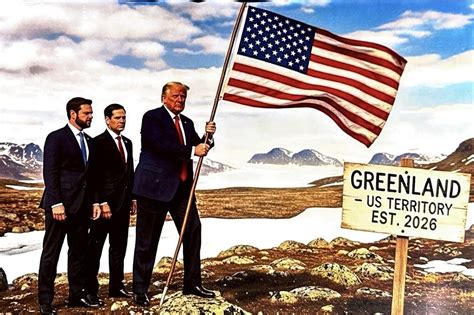
Trump’s Greenland comments might suggest a rejection of this dark legacy. But his actions tell a different story. On the same day he questioned Denmark’s claim, Trump shared an image depicting himself and senior officials planting a US flag on Greenland, declaring it American territory.
This image is not satire; it is colonial theater. It reenacts the very ritual Trump claims is meaningless. Planting a flag has no legal power—unless one believes in the Doctrine of Discovery. Trump cannot dismiss the doctrine with one hand while grasping its symbolism with the other.
Greenland and the Limits of Colonial Comparison
Greenland’s history complicates the narrative. Norse settlers arrived over a thousand years ago, establishing colonies in what was, at the time, genuinely uninhabited. Unlike Australia or the Americas, Greenland did not involve mass Indigenous dispossession at the point of European arrival.
Yet today, Greenland is home to a distinct population with political rights, cultural identity, and self-governance within the Danish realm. Trump’s imagined flag planting ignores not only Danish sovereignty but Greenlandic self-determination. Colonial logic, once unleashed, rarely stops where intended.
The Anglosphere on Shaky Ground
If Trump’s reasoning were applied consistently, it would destabilize the legal foundations of Australia, Canada, and New Zealand. All three rely on doctrines that downgraded Indigenous sovereignty based on discovery, settlement, and Christian dominance. Rejecting those doctrines invites a reckoning long overdue.
This is why Trump’s comments matter beyond Greenland. They expose a contradiction at the heart of Western nationhood: you cannot reject colonial logic selectively. Either discovery confers legitimacy, or it does not. There is no safe middle ground.
A Question America Cannot Avoid Forever
In 2023, the Vatican formally repudiated the Doctrine of Discovery, admitting it was used to justify cultural destruction and dispossession. This was a symbolic act, but symbols matter. They signal that the moral authority behind colonial law has collapsed.
Trump’s Greenland gambit unintentionally aligns with this repudiation, even as he clings to its imagery. The result is a moment of profound legal and moral exposure. The question now confronting the United States is unavoidable: can a nation built on discovery survive the rejection of discovery itself?
History suggests that denial only delays reckoning. Indigenous peoples have asked this question for centuries. Trump has merely shouted it onto the global stage, unaware that the echo returns not at Denmark—but at America itself.