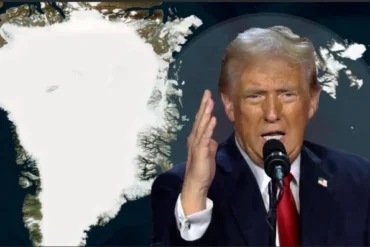
The Arctic is no longer a distant, frozen frontier. It has become a central arena of great-power competition, where geography, technology, and mistrust between allies intersect. When Donald Trump openly declared that Greenland is “vital” to the United States’ Golden Dome missile defense system, he stripped away years of diplomatic euphemisms and revealed the hard logic driving Washington’s renewed Arctic push. This was not rhetorical excess or political theater. It was a strategic admission that the future of American security, especially in space and missile defense, runs directly through the High North.
Trump’s statement marked a turning point. For years, U.S. officials framed interest in Greenland in abstract terms—national security, countering China, and deterring Russia. Now, the linkage is explicit: Greenland is indispensable to America’s emerging, multi-layered missile shield and its broader dominance in space-based warfare. Behind this shift lies a deeper reality—a growing distrust of Europe’s reliability as a long-term security partner, particularly when it comes to safeguarding the most sensitive infrastructure of the twenty-first century.
Greenland and the Golden Dome: Geography as Destiny
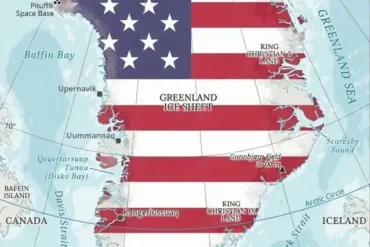
Greenland’s strategic value begins with its location, but it does not end there. Sitting between North America and Eurasia, the island occupies one of the most critical corridors on the planet for intercontinental ballistic missiles. Any missile launched from Russia toward the continental United States would almost certainly pass over or near Greenland. In the logic of missile defense, that makes Greenland not optional, but essential.
The Golden Dome—a $175 billion, multi-layered missile defense initiative often compared to Israel’s Iron Dome but vastly more complex—relies on early detection, rapid tracking, and interception across land, sea, air, and space. Greenland offers an unparalleled platform for radar systems, space surveillance, and interceptor deployment. Without it, the system’s northern coverage would be incomplete, leaving a critical vulnerability in America’s defensive shield.
Trump’s blunt language reflects this reality. Control over Greenland is not about prestige or expansionism in the traditional sense. It is about closing the Arctic gap in U.S. missile defense and ensuring that no adversary can exploit the shortest route between continents.
Debunking the Ship Narrative and the Real Strategic Threat
Trump has repeatedly claimed that Greenland is surrounded by Russian and Chinese ships, presenting an image of an Arctic teeming with hostile activity. Yet NATO intelligence briefings and statements from Nordic diplomats sharply contradict this portrayal. There is little evidence of sustained Russian or Chinese naval presence near Greenland itself.
But focusing on ships misses the point. The real contest in the Arctic is not about surface vessels—it is about missiles, satellites, and data dominance. Russia already views its Arctic coastline as a continuous strategic missile corridor. China, though not an Arctic state, has declared itself a “near-Arctic power” and is investing heavily in infrastructure, logistics, and research that support long-term strategic access.
From Washington’s perspective, Greenland is less about countering immediate naval threats and more about future-proofing American defense against high-speed, space-enabled weapons that could render traditional deterrence obsolete.
The Deep Military Roots of U.S. Presence in Greenland
American involvement in Greenland is not new. During World War II, when Nazi Germany occupied Denmark, Greenland became a U.S. protectorate, allowing Washington to establish bases and patrols across the island. This laid the foundation for a long-term military footprint that only deepened during the Cold War.
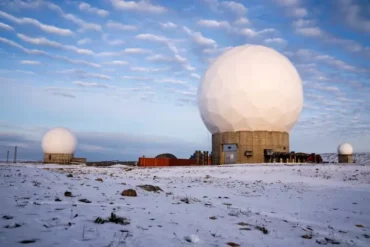
The construction of Thule Air Base—now known as Pituffik Space Base—cemented Greenland’s role in defending North America against Soviet missiles. Built in secrecy in the early 1950s, the base became a cornerstone of U.S. early warning systems and strategic air operations. Today, under the U.S. Space Force, Pituffik has taken on renewed importance as a hub for space surveillance and missile tracking.
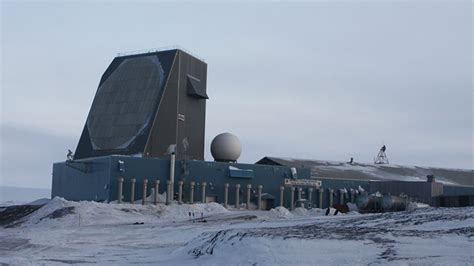
Less known, but equally revealing, was Camp Century, a covert Cold War project that housed nuclear-capable missiles beneath Greenland’s ice as part of Project Iceworm. Though ultimately abandoned due to the instability of ice sheets, the project underscored how far the U.S. was willing to go to leverage Greenland’s geography for strategic dominance.
These historical precedents explain why Trump’s current stance is not a radical departure, but rather an intensification of a long-standing American logic.
Rare Earths, Energy, and the Hidden Economic Dimension
Beyond missiles and radars lies another layer of strategic value: resources. Greenland is rich in rare earth elements, uranium, lithium, cobalt, and potentially vast reserves of oil and gas. These materials are essential for everything from smartphones and electric vehicles to advanced weapons systems and satellites.
China currently dominates global rare earth supply chains, a dependency that Washington sees as a national security risk. Greenland represents one of the few viable alternatives capable of reducing that reliance. Control—or at least decisive influence—over Greenland’s resource development would give the United States a powerful lever in both economic and technological competition with Beijing.
This economic dimension amplifies Greenland’s importance within the Golden Dome framework. Missile defense systems, space assets, and advanced sensors all depend on secure access to critical minerals. In this sense, Greenland is not just a shield—it is also a supply line.
China’s Arctic Ambitions and the Greenland Gateway
China’s interest in Greenland is neither accidental nor symbolic. Over the past decade, Beijing has steadily increased investments in Arctic infrastructure, scientific research, and resource exploration. Greenland, with its small population and growing autonomy from Denmark, has been seen by Chinese strategists as a potential gateway to Arctic influence.
When Chinese companies attempted to acquire or develop former military installations and airports in Greenland, alarm bells rang in Washington and Copenhagen alike. Denmark intervened repeatedly to block these deals, underscoring how sensitive the territory has become.

For the United States, preventing China from gaining a foothold in Greenland is not just about regional influence. It is about denying Beijing access to critical nodes in the emerging Arctic and space infrastructure network. In a future defined by satellite constellations and polar orbits, even limited Chinese presence in Greenland could have outsized strategic consequences.
Space Warfare and the High North Advantage
Space is now the ultimate high ground. Modern warfare depends on satellites for navigation, communication, intelligence, and targeting. Anti-satellite weapons, cyber interference, and electronic warfare are rapidly becoming central to military planning.
The Arctic—and Greenland in particular—plays a unique role in this domain. Satellites in polar orbits pass over the High North far more frequently than over equatorial regions. This makes Arctic ground stations indispensable for maintaining constant contact with satellite constellations.
Experts like Dr. Pippa Malmgren argue that places such as Greenland offer unmatched advantages for space operations. However, reliance on European infrastructure, such as Norway’s Svalbard, introduces vulnerabilities. Subsea cables and shared governance structures can be targeted or disrupted by adversaries.
Greenland’s Pituffik Space Base, closer to the United States and easier to defend, provides a more secure alternative. Within the Golden Dome architecture, it serves as a critical node linking missile defense, space surveillance, and command-and-control systems.
Distrust of Europe and the Sovereignty Question
Perhaps the most controversial aspect of Trump’s Greenland stance is not the military logic, but the political implication: a profound lack of trust in Europe. Despite Denmark’s NATO membership and long-standing cooperation, voices within the U.S. strategic community increasingly question whether European allies can reliably protect infrastructure that underpins America’s survival in a future conflict.
From this perspective, sovereignty matters. As long as Greenland remains under Danish control, ultimate authority rests outside Washington. Trump’s rhetoric—suggesting that anything less than U.S. control is “unacceptable”—reflects a belief that shared control equals shared risk.
This does not mean Europe is seen as an adversary. Rather, it is viewed as insufficiently hardened for the brutal realities of space and missile warfare against peer competitors like China and Russia. In a world where minutes can decide outcomes, ambiguity is a liability.
Russia, Alaska, and the Arctic Continuum
Greenland’s importance is inseparable from Alaska’s vulnerability. The narrow Bering Strait places U.S. territory within striking distance of Russia’s Far East forces. As Arctic ice melts and military activity increases, the need for integrated surveillance and response across the entire northern flank becomes more urgent.
Russia already treats the Arctic as a continuous strategic theater, conducting large-scale exercises and deploying advanced missile systems along its northern coast. Greenland anchors the eastern end of America’s Arctic defense line, creating a geostrategic bridge between Alaska and the North Atlantic.
Without Greenland fully integrated into U.S. defense planning, that bridge remains incomplete.
A Bipartisan Arctic Consensus Takes Shape
What makes Trump’s Greenland push particularly significant is the quiet bipartisan support it enjoys. While methods and rhetoric may differ, there is growing agreement in Washington that the Arctic will define the next phase of global security competition.
Greenland sits at the intersection of missile defense, space warfare, resource security, and alliance politics. The Golden Dome has merely crystallized these threads into a single, unmistakable priority. Trump’s blunt admission did not create this reality—it simply exposed it.
As the Arctic transforms from frozen periphery to strategic core, Greenland emerges not as a bargaining chip, but as a keystone of American power. In the calculus of twenty-first-century defense, control of the High North may well determine who controls the future.