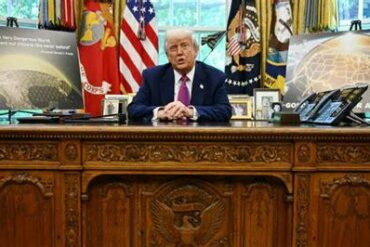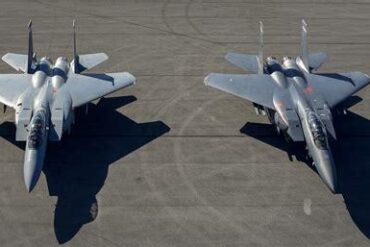
In May 2025, President Donald Trump unveiled the framework for a bold and controversial defense initiative—the Golden Dome Missile Defense System. This ambitious project, ordered into development by the Pentagon earlier in January 2025, aims to create a multilayered defense network that operates across land, sea, air, and space. Resembling Israel’s Iron Dome, the Golden Dome aspires to deliver a comprehensive shield capable of intercepting missiles at every phase of flight—from launch to terminal descent.
Unlike previous missile defense strategies, the Golden Dome marks a historic turning point as it will be the first U.S. defense system to incorporate weapons in space, reviving strategic concepts long thought infeasible since the Reagan-era Strategic Defense Initiative, often dubbed Star Wars. According to Space Force General Michael Guetlein, this system will be built on a scale comparable to the Manhattan Project, symbolizing not just a technological leap, but a full-blown redefinition of American strategic deterrence.
Building on an Existing Arsenal
Before the Golden Dome, America had invested heavily in several layers of missile defense. The foundation comprises 44 silo-launched three-stage rockets based at Fort Greely, Alaska, and Vandenberg Air Force Base, California, designed to intercept ballistic missiles during their mid-course phase. These ground-based interceptors rely on radar guidance and infrared tracking to launch exoatmospheric kill vehicles, a sophisticated but limited shield primarily intended to protect overseas bases and allies—not the continental U.S.
Additionally, the Navy’s Aegis Ballistic Missile Defense (BMD) system plays a critical role, with 56 cruisers and destroyers equipped with interceptor missiles and advanced SPY radar arrays. These vessels patrol crucial international waters, particularly near Asia and Europe. By 2030, another 13 ships are expected to join the Aegis fleet.
Complementing the naval forces are THAAD (Terminal High Altitude Area Defense) launchers and Patriot Advanced Capability-3 missile systems—mobile, land-based platforms deployed for last-stage intercepts. However, as of July 2025, the U.S. possesses only a quarter of the Patriot missile inventory necessary to meet operational goals, underscoring the need for systemic upgrades and expansion.
How the Golden Dome Would Work
The Golden Dome system expands upon these assets by introducing space-based interceptors, directed energy weapons, and a global seabed-to-space surveillance network. Its mission is simple yet daunting: detect and neutralize threats from anywhere in the world, across all potential vectors, and at every stage of missile flight.
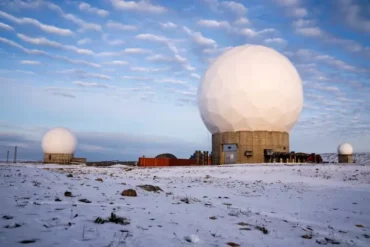
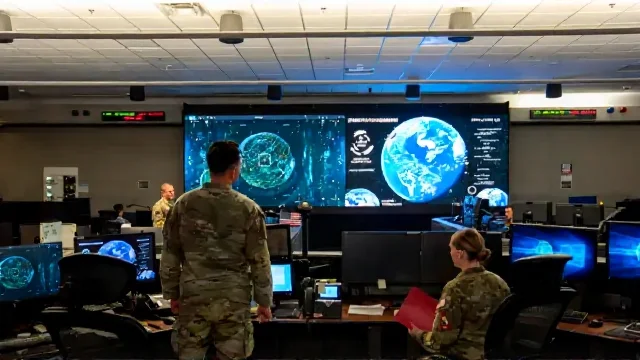
Detection is the first pillar. Under the command of General Gregory Guillot of U.S. Northern Command, the system will adopt a “domain awareness layer“—a massive network of satellites, undersea sensors, airborne radar platforms, and ground tracking systems. This will form a digital mesh capable of identifying threats originating from land-based silos, mobile launchers, submarines, or even orbital platforms.
The second pillar is interception, which will likely be achieved via a mix of space-based kill vehicles, laser platforms, and perhaps even microwave weapons. Particularly critical is the ability to strike during the boost phase—when missiles are slowest and most vulnerable. By engaging threats before they reach full speed or deploy decoys, the Golden Dome seeks to neutralize them before they can become a greater threat.
The Role of the Private Sector and Cutting-Edge Technology
To fulfill its far-reaching goals, the Golden Dome will depend heavily on commercial partnerships. With surveillance capabilities potentially spread across thousands of satellites, the Pentagon is expected to license or contract private constellations. Key players include SpaceX, Palantir, and Anduril. SpaceX, in particular, has a decisive role as the world’s largest satellite operator. However, its involvement remains controversial due to CEO Elon Musk’s fluctuating political ties.
Palantir may contribute its AI and big-data capabilities to help manage the real-time influx of information from hundreds or even thousands of sensors. Microsoft and other cloud computing giants could be enlisted to help process and automate decision-making at unprecedented speed.
Yet even these technological marvels face limitations. Simulations suggest that intercepting just 10 intercontinental ballistic missiles (ICBMs) could require as many as 16,000 satellites working in tandem—a scale never before attempted.
Where the Program Stands Now
By mid-2025, the Pentagon had completed a draft architecture priced at $175 billion. The project is under the stewardship of General Michael Guetlein, Space Force’s Vice Chief of Space Operations. The preliminary funding package allocates $24.4 billion, but Congress remains divided over the additional $150 billion needed to meet development deadlines by 2028.
While the White House is bullish on the initiative, many lawmakers remain skeptical, pointing to unproven technology, ballooning costs, and the risk of intensifying global arms competition. Nevertheless, defense contractors such as Lockheed Martin, Northrop Grumman, and Boeing are actively lobbying to secure roles in the program. The political calculus is shifting, and commercial interest may ultimately outweigh Congressional hesitation.

A Trillion-Dollar Question
The Congressional Budget Office (CBO) paints a far grimmer fiscal picture. It estimates that the space-based portion alone could exceed $542 billion over 20 years, dwarfing the president’s $175 billion forecast. Even this projection assumes a focus on lesser nuclear powers, not peer adversaries like Russia or China. A more realistic scope, according to CBO, would push the bill closer to $831 billion, or possibly over one trillion dollars.
This staggering figure does not include the parallel $946 billion already committed to modernizing America’s nuclear arsenal—raising alarms about long-term sustainability and opportunity costs.
Strategic Risk: Escalation Over Deterrence?
Many experts argue that far from bolstering security, the Golden Dome may undermine it. By attempting to neutralize an opponent’s strategic missile capabilities, it erodes the logic of mutual deterrence—a cornerstone of global nuclear stability since the Cold War.
History offers cautionary tales. When Reagan proposed the Strategic Defense Initiative, Russia responded by developing new missile systems capable of overwhelming U.S. defenses. The Golden Dome might provoke a similar arms race. Already, in March 2025, China tested orbital dogfighting satellites, while Russia is believed to be developing space-based nuclear countermeasures.
The Role of Allies and the International Response
Another layer of complexity involves U.S. allies, particularly Canada and NATO. To make the Golden Dome operational, Canadian airspace and radar coverage are crucial. Yet Canada’s participation remains uncertain. President Trump has extended a $61 billion invitation, but domestic opposition is strong. Prime Minister Markey Carney engaged in high-level talks in May 2025, but no formal agreement has been reached.
If Canada opts out, the burden may fall to European allies, many of whom are ill-equipped to participate in such a high-cost, high-risk endeavor. This places Article 10 of the NATO treaty, which guarantees mutual defense, under strategic strain. In essence, the Golden Dome could divide alliances as easily as it shields them.
The Technical Hurdles Remain Daunting
Even if the political and fiscal hurdles are overcome, the technical challenge remains colossal. To intercept modern missiles—particularly hypersonic glide vehicles and maneuverable ICBMs—requires not just global tracking but near-instantaneous response. From launch detection to final strike, defense systems must act within minutes, if not seconds.
That level of synchronization demands AI-assisted threat analysis, predictive modeling, and fault-tolerant communication links between satellites, radar arrays, and interceptor platforms. The U.S. would need to sustain and replace satellites annually, a logistical feat unprecedented in modern aerospace.
Conclusion: Shield or Mirage?
The Golden Dome represents a paradigm shift in U.S. defense policy—a shift from reactive deterrence to proactive denial. Yet in aiming to be invincible, the system may actually invite greater risk. The costs are staggering. The technological path is unproven. And the geopolitical implications are immense.
Still, as the global balance of power evolves and threats become more sophisticated, doing nothing may no longer be an option. Whether the Golden Dome becomes a shield against annihilation or a spark that ignites a new Cold War, will depend not just on engineering and funding—but on wisdom, diplomacy, and foresight.