Air Transat is making a decisive move to reshape its long-haul network, announcing an ambitious expansion that introduces eight new transatlantic routes for the summer 2026 season. The Canadian leisure carrier is not merely adding destinations—it is strategically redrawing the map of accessible travel between Canada, Europe, and Africa. With a mix of returning services, entirely new city pairs, and underserved international links, the airline is positioning itself at the forefront of a rapidly evolving transatlantic market.
This expansion reflects a deeper transformation underway within the industry, where smaller, fuel-efficient aircraft are unlocking routes once considered commercially unviable. For Air Transat, this is not just growth—it is calculated precision.
A Network Expansion That Breaks Traditional Boundaries
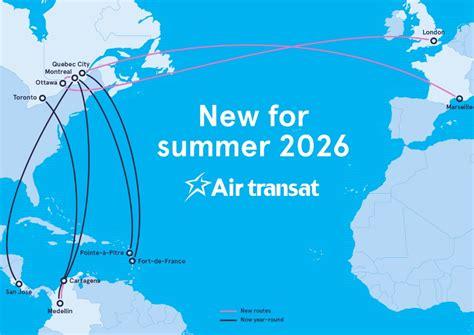
Air Transat’s latest rollout spans a diverse geographic footprint, connecting Canada with destinations in the United Kingdom, France, Iceland, Morocco, Senegal, and Albania. The breadth of this expansion is striking, but what makes it particularly compelling is its focus on routes that have historically lacked nonstop service.
From Ottawa to London Gatwick, Quebec City to Marseille and Nantes, and Montreal to Agadir and Dakar, the airline is targeting both leisure travelers and diaspora communities. This dual-demand strategy allows the airline to fill seats with a blend of tourism and visiting-friends-and-relatives (VFR) traffic—one of the most resilient segments in aviation.
The return of Ottawa–London Gatwick is especially symbolic. Previously operated between 2011 and 2014, the route’s revival signals renewed confidence in demand from Canada’s capital region. Meanwhile, Quebec City gains direct access to southern and western France without the need to connect through Paris, dramatically improving travel convenience.

Full List of New Routes for Summer 2026
The expansion includes a carefully curated set of routes designed to maximize reach while minimizing risk. Each route reflects a deliberate choice based on demand patterns, cultural ties, and competitive gaps.
- Ottawa (YOW) – London Gatwick (LGW): 3x weekly from May 15
- Quebec City (YQB) – Marseille (MRS): Weekly from May 21
- Quebec City (YQB) – Nantes (NTE): Weekly from June 2
- Montreal (YUL) – Agadir (AGA): Weekly from June 12
- Montreal (YUL) – Dakar (DSS): 2x weekly from June 17
- Montreal (YUL) – Keflavik (KEF): 2x weekly from June 16
- Toronto (YYZ) – Tirana (TIA): Weekly from June 18
Several of these routes stand out as industry firsts. Montreal–Agadir will become North America’s first nonstop link to the Moroccan coastal city, while Montreal–Dakar introduces a rare direct connection between Canada and West Africa. Toronto–Tirana, meanwhile, opens an entirely new corridor between North America and Albania.
Why These Routes Are More Than Just Additions
This expansion is not about volume—it is about precision targeting. Air Transat is deliberately focusing on underserved or completely unserved routes, where competition is minimal and demand is often latent rather than visible.
Montreal’s new African routes highlight this strategy perfectly. Both Senegal and Morocco have deep cultural and linguistic ties with Quebec’s French-speaking population. Until now, travelers often had to endure long layovers in Europe to reach these destinations. Nonstop flights eliminate that friction, effectively stimulating demand rather than simply capturing it.
Similarly, Quebec City’s new links to Marseille and Nantes bypass Paris entirely, offering a more direct connection to regional France. This not only saves time but also enhances the overall travel experience—particularly for leisure travelers seeking convenience.
Even Iceland enters the picture with Air Transat’s first-ever service to Keflavik. This move taps into Iceland’s enduring popularity as a nature-driven destination while also leveraging its geographic position as a transatlantic midpoint.
The Aircraft Powering the Expansion
At the heart of this expansion lies the Airbus A321LR, a long-range narrowbody aircraft that has fundamentally changed the economics of transatlantic travel. Air Transat will deploy this aircraft on most of its new routes, enabling it to operate efficiently on thinner, long-haul sectors.
The A321LR’s extended range and lower operating costs make it ideally suited for connecting mid-sized cities with secondary international destinations. Instead of relying on larger widebody aircraft that require high passenger volumes, the airline can match capacity more precisely with demand.
This shift represents a broader industry trend. Routes that once required 250- to 300-seat aircraft can now be served with smaller jets without sacrificing profitability. For passengers, the benefits remain largely intact—modern cabins, long-haul comfort, and nonstop convenience.

For higher-demand routes, such as Toronto–Tirana, Air Transat will continue to deploy the Airbus A330-200. This ensures that capacity aligns with expected passenger volumes, particularly on routes with strong diaspora traffic.
A Strategic Focus on Secondary Cities
One of the most notable aspects of Air Transat’s expansion is its emphasis on cities beyond Canada’s primary hubs. Ottawa and Quebec City play a central role in this strategy, gaining direct international connections that were previously unavailable or limited.
This approach reflects a growing recognition that demand is not confined to major metropolitan areas. By offering nonstop flights from secondary cities, the airline reduces reliance on connecting hubs and enhances accessibility for a broader range of travelers.
It also creates a competitive advantage. While larger carriers often concentrate on high-density routes, Air Transat is carving out a niche in markets where direct service is scarce. This allows the airline to operate with less direct competition while building strong customer loyalty.

Reshaping the Transatlantic Travel Landscape
Air Transat’s expansion is emblematic of a larger shift in global aviation. The combination of new-generation aircraft and evolving travel demand is enabling airlines to rethink traditional route networks.
Where once only major city pairs justified nonstop service, airlines can now explore a wider range of connections. This opens up new travel possibilities—not just for tourists, but for families, businesses, and communities spread across continents.
The introduction of routes like Montreal–Dakar and Toronto–Tirana underscores this transformation. These are not incremental additions; they are entirely new links that redefine connectivity between regions.
A Calculated Bet on the Future of Leisure Travel
Air Transat’s strategy is rooted in a clear understanding of its core market: leisure travelers seeking direct, convenient, and affordable long-haul options. By focusing on destinations with strong cultural ties or untapped tourism potential, the airline is positioning itself to capture demand that others have overlooked.
This is not expansion for its own sake. It is a calculated bet on the future of transatlantic travel—one where flexibility, efficiency, and targeted connectivity matter more than sheer scale.
As summer 2026 approaches, Air Transat is not just adding routes. It is redefining what is possible in the transatlantic market, proving that with the right aircraft and the right strategy, even the most overlooked routes can become powerful connectors between continents.