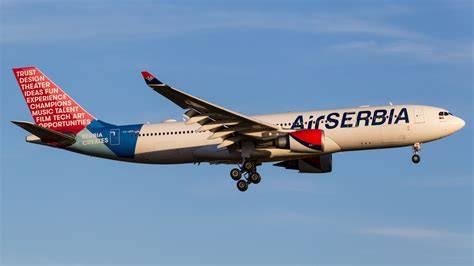
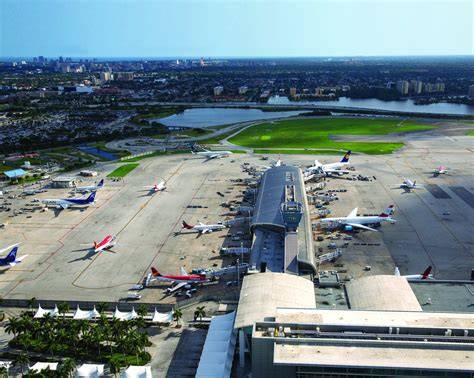
Air Serbia will connect Belgrade and Florida nonstop for the first time, launching twice-weekly Airbus A330-200 service between Belgrade Nikola Tesla Airport (BEG) and Miami International Airport (MIA) on May 20, 2027. At roughly 5,471 miles (8,805 km), the new link becomes the Serbian flag carrier’s longest scheduled route, edging past its Shanghai service by about 230 miles and adding a third US gateway alongside New York JFK and Chicago O’Hare. Tickets went on sale on October 20, one day after chief executive Jiří Marek confirmed the plan in an interview with Serbian broadcaster RTS, and the service will operate every Thursday and Sunday. The announcement converts a destination that has sat on the airline’s drawing board for years into a firm date, and it does so at a moment when Belgrade is preparing to host Expo 2027, a global exhibition that Air Serbia expects to generate roughly 500,000 additional air passengers between May 15 and August 15.
Why Miami Has Been Air Serbia’s Most Talked-About Unserved Market
The commercial case rests on traffic the airline has been watching arrive through other people’s hubs. According to EX-YU, nearly 20,000 passengers flew between Belgrade and Miami on connecting, single-ticket itineraries in 2025, making Miami the busiest unserved US market from the Serbian capital, and that volume grew about 40% year over year even without a nonstop option. Those passengers currently funnel through European gateways such as Frankfurt, Munich, Vienna or Istanbul, or through North American hubs such as New York and Chicago, paying for a second connection and adding hours to the journey. A nonstop departure removes that friction entirely, and Air Serbia can plausibly stimulate demand rather than simply capture it, since shorter elapsed times tend to pull in travelers who previously ruled the trip out on convenience grounds.

The opportunity is bigger than one city pair. Historical estimates put approximately 120,000 annual indirect passengers between Miami and a catchment spanning the former Yugoslavia, Albania, Bulgaria, Romania and Greece. Belgrade’s geography lets Air Serbia gather that traffic through Sarajevo, Zagreb, Skopje and Tirana, feeding passengers into a single transatlantic departure, and Florida’s Serbian and wider Balkan diaspora gives the route a dependable visiting-friends-and-relatives core. Those figures describe a potential market rather than a guaranteed passenger count, and converting them depends on fares, schedule convenience and the willingness of travelers to choose a single-carrier itinerary through Belgrade over a two-stop routing through a legacy hub.
The Miami Timetable, Aircraft and Cabin Configuration
Flight JU502 leaves Belgrade at 1:50 PM on Thursdays and 11:30 AM on Sundays, landing in Miami after a 12-hour block time. The return, JU503, departs Miami at 10:30 PM Thursday and 7:00 PM Sunday, taking about 10 hours and 30 minutes and arriving in Serbia the following afternoon. Air Serbia will deploy its Airbus A330-200 fleet, which carries business and economy cabins; its two newest widebodies are fitted with 22 business class and 240 economy class seats, though configurations vary across the four-aircraft fleet. The westbound block time reflects headwinds over the Atlantic, while the eastbound leg benefits from tailwinds, a pattern familiar on transatlantic flying.
Roughly a Decade of Courting South Florida
Miami has been under consideration since at least 2023, when the carrier held discussions with Miami International Airport and government officials, and in April 2024 airport representatives publicly confirmed that talks were underway. Expectations of a 2025 launch and then a 2026 launch both failed to materialize, and in June 2025 Marek acknowledged that Miami was a more complicated commercial proposition than the airline’s established US services, citing aircraft availability and the need to build demand across several passenger segments at once. “Miami is different,” he said. “It may be a logical market, but it’s the first destination where success would rely on combining multiple market segments. So we are particularly pleased to introduce these new flights, Air Serbia’s third destination in the United States.”
Leisure, Cruises and the American Airlines Interline
Miami’s leisure draw could prove as valuable as the diaspora traffic. The city pulls international vacationers and cruise passengers, and American Airlines runs a major hub there with extensive connections into Latin America and the Caribbean. Air Serbia already holds an interline agreement with American, which broadens its reach on paper, although convenient connections and codeshare benefits are not assured and depend on how the two carriers structure their cooperation. The Florida service is Air Serbia’s fourth North American destination following the launch of Toronto flights in May 2026, and the airline’s intercontinental network now stretches from a single transatlantic route in 2016 to destinations across North America and Asia.
Miami’s Place in a Six-Destination Airbus A330 Network
The expansion traces back to June 2016, when Air Serbia launched Belgrade–New York JFK and restored nonstop links between Serbia and the United States after a 24-year absence. Chicago followed in May 2023, Guangzhou Baiyun International Airport (CAN) in September 2024 and Shanghai Pudong International Airport (PVG) in January 2025, with Toronto becoming the fifth scheduled intercontinental destination in May 2026 and Miami set to make six. Miami’s 5,471 miles top Shanghai’s 5,241 miles, Guangzhou’s 5,232 miles, Chicago’s 4,982 miles, Toronto’s 4,594 miles and New York’s 4,497 miles. Supporting that network with just four Airbus A330-200s presents a genuine operational challenge. Air Serbia introduced its third widebody in October 2024 and its fourth in February 2025, but one aircraft, registered YU-ARC, was initially expected to leave the fleet when its lease expired in late 2026. Marek later revealed that the airline was working to extend the lease because keeping the jet was economically preferable to securing a replacement, a decision that matters when six long-haul destinations depend on a fleet this small. Balancing aircraft utilization against spare capacity and operational reliability will test the carrier’s scheduling discipline.
Further growth remains on the agenda. Longer-term plans have previously envisaged a fleet of up to eight widebody aircraft, though no additional A330 acquisitions have been confirmed, and the airline has announced four aircraft arriving in 2027, including two A320s, an Embraer E195 and another Airbus still under negotiation. Those will support new services to Helsinki, Yerevan, Cluj-Napoca, Chișinău and Menorca. Miami’s inaugural flight falls just five days after Expo 2027 opens in Belgrade, and the exhibition gives the airline an early chance to prove that the Serbian capital can function as a genuine international aviation hub rather than a point-to-point origin.