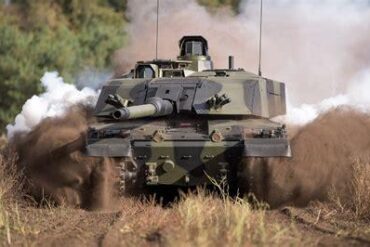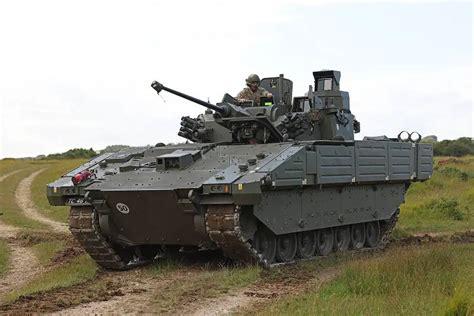
The British Army is undergoing a historic transformation as it reshapes its 3rd (UK) Division into an all-tracked armored formation, centralizing its combat capabilities around the advanced Challenger 3 Main Battle Tank (MBT) and the Ajax family of tracked combat vehicles. This strategic reorganization, confirmed by defense analyst Nicholas Drummond in June 2025, marks a significant leap in Britain’s approach to high-intensity land warfare, aligning with NATO’s evolving battlefield doctrines and the British Army’s “Future Soldier” modernization agenda.
The structural reconfiguration aims to optimize battlefield lethality, survivability, and tactical cohesion in contested environments. Designed for front-line operations against near-peer adversaries, the new tracked force will offer superior off-road mobility, better armor protection, and unified digital integration across its platforms.
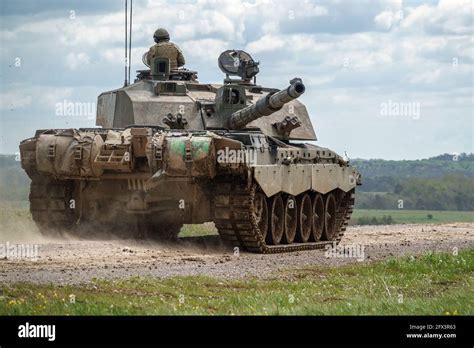
The Core of the Tracked Force: Challenger 3 MBT
At the heart of the 3rd Division lies the formidable Challenger 3, produced by Rheinmetall BAE Systems Land. Representing a radical overhaul of the previous Challenger 2 platform, the Challenger 3 integrates a suite of advanced battlefield technologies, tailored to match or exceed the capabilities of peer NATO main battle tanks.
The tank’s centerpiece is the 120mm L55A1 smoothbore gun, compatible with NATO-standard kinetic energy rounds and programmable munitions. This allows the Challenger 3 to deliver lethal firepower against a range of armored threats. The gun is stabilized and digitally integrated into a new fire control system, delivering high first-hit probability even on the move.
Challenger 3’s survivability is significantly enhanced by modular armor systems and the Trophy Active Protection System (APS), which can detect and neutralize incoming anti-tank missiles and rockets. These layers of protection are vital in modern warfare, where drone-guided and precision anti-tank weapons proliferate. A new digitized turret, improved thermal sights, and an upgraded powerpack featuring a more reliable engine ensure that the tank remains operational under intense conditions.
Ajax Family: Reconnaissance, ISTAR, and Armored Versatility
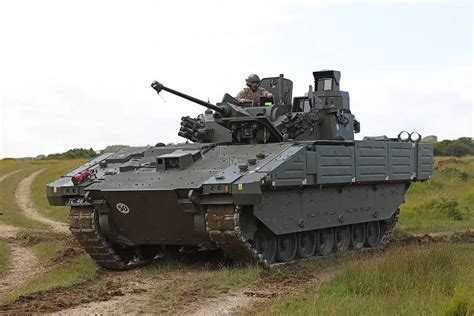
Complementing the Challenger 3 is the Ajax family, a versatile range of tracked armored vehicles developed by General Dynamics UK. The Ajax platform provides a high-mobility, sensor-rich, and digitally networked vehicle suite, fulfilling reconnaissance and ISTAR (Intelligence, Surveillance, Target Acquisition, and Reconnaissance) missions within the armored force.
The primary Ajax variant is armed with a 40mm CTAS (Cased Telescoped Armament System) cannon, offering compact ammunition storage and high-velocity firepower. This gun is capable of engaging lightly armored threats with exceptional precision. The vehicle features stabilized optics, a panoramic commander’s sight, and a digital backbone that allows seamless integration into joint force networks. This allows real-time battlefield data sharing, enhancing coordination and decision-making across units.
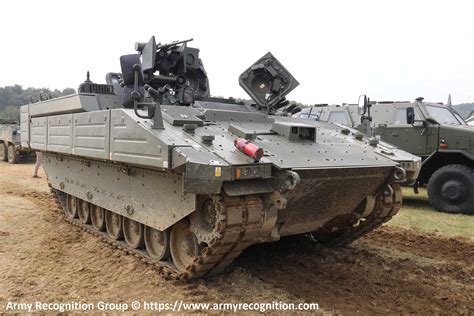
Ares APC: The Warrior Replacement
Of particular note in the British Army’s restructuring is the repurposing of the Ares variant from the Ajax family. Originally designed as a protected mobility vehicle, Ares is now being converted into a heavy armored personnel carrier (APC), marking the retirement of the legacy Warrior Infantry Fighting Vehicle (IFV) after decades of service.
Ares is equipped with STANAG Level 4 armor, offering protection against 14.5mm armor-piercing rounds, artillery shell fragments, and mine blasts. It carries a section of eight fully equipped infantry soldiers, and is powered by a 600hp MTU engine with hydro-pneumatic suspension, granting exceptional cross-country mobility. Its integration into the tracked team enables consistent pace and protection standards across combat formations. The switch to Ares not only boosts protection and mobility but also creates logistical and operational synergy with the rest of the Ajax fleet.
1st Division and the Boxer Expeditionary Force
While the 3rd Division consolidates into a heavy, tracked formation, the 1st (UK) Division is evolving into a wheeled expeditionary force, centered on the Boxer 8×8 modular armored vehicle. The Boxer’s design prioritizes strategic mobility, enabling rapid deployment across theaters from Europe to the Middle East.
Boxer’s modular architecture allows it to be reconfigured for various roles including infantry transport, command and control, ambulance, and fire support. It provides STANAG Level 4 protection, like its tracked counterparts, and is designed for air transportability by A400M Atlas and C-17 Globemaster aircraft.
Boxer will be fielded in several new variants equipped with 30mm or 40mm remote-controlled turrets, anti-tank guided missile (ATGM) launchers, and integrated counter-drone systems, making it highly adaptable for hybrid and asymmetric threats.
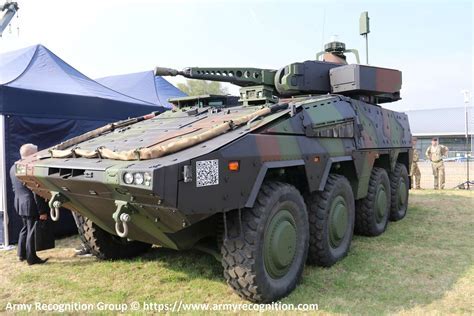
Precision Fire Support: RCH 155 on Boxer Chassis
To ensure operational self-reliance and long-range strike capability, the British Army is assessing the RCH 155 self-propelled howitzer as a possible addition to the Boxer-based firepower arsenal. Mounted on the same Boxer chassis, the RCH 155 features a 155mm L52 gun, capable of firing NATO-standard shells beyond 40 kilometers. The system includes automatic loading, a fully enclosed turret, and is designed for high rates of fire during shoot-and-scoot operations.
RCH 155 offers unmatched mobility-firepower synergy in wheeled formations, maintaining pace with front-line Boxer units while delivering critical long-range precision fires. If adopted, it would dramatically increase the expeditionary lethality of the 1st Division, aligning British artillery with NATO standards in mobility and range.
Strategic Rationale: Two Distinct Warfighting Divisions
The British Army’s reconfiguration into two specialized, capability-driven divisions is a calculated response to the evolving character of warfare. The 3rd (UK) Division, now all-tracked, is tailored for direct engagement with near-peer adversaries, offering armored dominance, high survivability, and deep battlefield penetration. Its tracked nature supports operations across rugged terrain, urban battlespaces, and heavily contested zones.
Conversely, the 1st (UK) Division provides the UK with a high-readiness, rapid-deployment expeditionary force. Its wheeled mobility ensures swift reaction across global hotspots, enabling stabilization missions, deterrence patrols, and humanitarian interventions. With Boxer vehicles, it combines strategic airlift compatibility with modern protection and firepower, suiting the demands of modern asymmetric and hybrid warfare.
Together, these divisions reflect a dual-track approach to national and alliance defense. One division is structured for attritional, high-end warfare; the other for mobility-centric expeditionary operations. Both are interoperable with NATO allies, digitally integrated, and underpinned by cutting-edge British and allied defense technologies.
Future Outlook: Toward a Digitally Integrated Combat Force
This restructuring is not merely about platforms—it signals a deeper shift toward network-centric warfare. Both divisions will emphasize digital command architecture, AI-assisted targeting, multi-domain coordination, and information superiority. Enhanced data-sharing between Challenger 3, Ajax, Ares, and Boxer vehicles is expected to significantly improve command and control, intelligence fusion, and kinetic precision.
The Challenger 3 program is currently undergoing field testing, with initial operational capability expected before 2027. Full fielding is scheduled into the early 2030s, alongside parallel Ajax and Ares deployments. Boxer variants are already entering service under the Mechanised Infantry Vehicle (MIV) program.
As threats evolve from mechanized warfare to AI-enabled and drone-intensive combat zones, the British Army’s new structure stands at the frontier of modern military transformation. It delivers a flexible, powerful, and survivable force posture, reinforcing the UK’s credibility within NATO and its capacity to respond to crises worldwide.
With the British Army now dividing its land warfare capability between heavy-tracked and agile-wheeled divisions, the force emerges not just more modern—but more mission-focused, future-proof, and lethal than ever before.