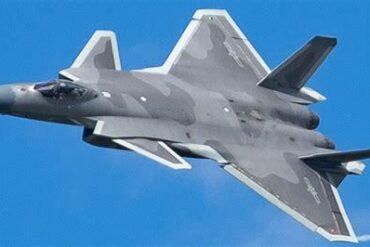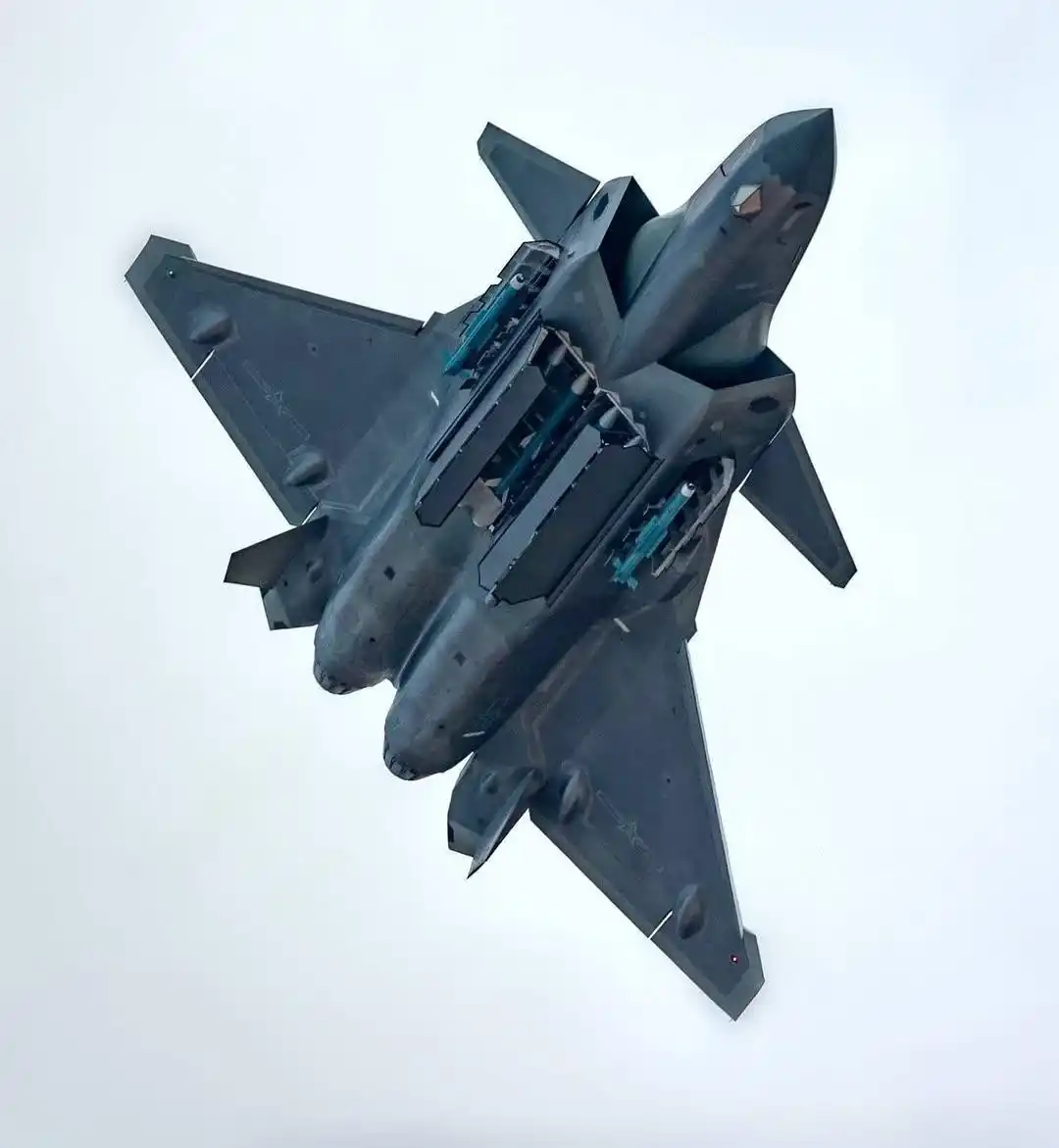
The Chengdu J-20, China’s premier stealth fighter, represents a significant leap in design philosophy and technological execution. While much attention typically centers around its stealth shaping and advanced radar systems, recent imagery and expert discussions have illuminated the intricate engineering behind its compartment doors, guide ways, and internal weapons bay mechanisms. These often-overlooked components play a critical role in maintaining stealth, ensuring aerodynamic efficiency, and maximizing weapons carriage.
J-20 Weapons Bay Architecture and Compartment Door Design
The J-20 features a primary central weapons bay, flanked by two lateral side bays positioned near the engine nacelles. What distinguishes the J-20’s compartment doors from comparable systems on American fifth-generation fighters like the F-22 Raptor and F-35 Lightning II is the use of complex multi-panel doors. Each door panel operates on dedicated guide ways, allowing synchronized actuation during opening and closing sequences. This ensures minimal radar cross-section exposure during brief weapon launches.
The bottom-mounted compartment doors are of particular note. These doors open downward rather than sideways, exploiting gravitational assistance for faster operation. Their curved, segmented form maintains the stealth contour when closed, while during deployment, the doors avoid interfering with airflow underneath the fuselage. The door hinges are reinforced, allowing rapid cycles without structural fatigue – essential during high-stress combat scenarios.
Precision Guide Ways: Engineering for Reliability and Stealth
The J-20’s guide ways, visible in recent high-resolution imagery, serve as controlled tracks for the compartment doors. Rather than simplistic hinge attachments, the J-20 utilizes multi-rail linear guide ways with embedded shock absorbers. This permits silent and vibration-free movement of the doors – a critical stealth requirement. These guide ways also prevent panel misalignment, which could compromise radar cross-section and structural integrity.
At rest, the guide ways are almost imperceptible, contributing to the smooth underbelly of the J-20. The visible black rubberized sealing edges, although criticized for aesthetics by some enthusiasts, perform essential thermal and vibrational insulation tasks, preventing both infrared signature spikes and acoustic leakage.
Interior Bay Space Optimization: PL-15 and PL-16 Integration
Historically, the J-20’s internal bay has accommodated four PL-15 long-range air-to-air missiles. However, advancements showcased through the PL-15E and newly developed PL-16 indicate China’s determination to push weapons carriage capacity further without sacrificing stealth.
- PL-15: Standard variant using a boost-sustain solid propellant motor.
- PL-15E: Export variant designed for higher missile density without altering external dimensions.
- PL-16: A completely new missile with compressed folding-fin architecture, similar conceptually to the American AIM-260 JATM.
The PL-16’s reduced cross-sectional area and folding fins allow six missiles to fit within the J-20’s main bay, according to insights from IISS and FlightGlobal sources. This compressed carriage capability hinges not only on the missile’s design but also on adaptive modifications to the J-20’s internal bay fixtures. Stacked missile arrangements are now feasible, as indicated by imagery showing potential free space between loaded munitions.
Missile Truck Configuration and Future Load-Out Strategies
The People’s Liberation Army Air Force (PLAAF) appears to be experimenting with a “missile truck” configuration for the J-20. This concept, hinted at by photographs of J-20s carrying up to six internal and eight external missiles, suggests a doctrinal shift toward saturation strikes against enemy formations. External pylons compromise stealth but significantly enhance firepower, enabling the J-20 to function as a standoff platform when stealth is less critical.
Interestingly, discussions on forums like r/WarplanePorn and confirmed sightings from February 2025 reveal that these high-load configurations may pertain to the J-20S variant, a rumored twin-seat derivative optimized for cooperative engagement missions with unmanned wingmen.
Implications of Compartment Mechanisms for J-20 Operational Doctrine
The meticulous engineering of the compartment doors and guide ways reflects more than just a desire for stealth aesthetics. These components are central to the J-20’s operational effectiveness:
- Minimized Radar Cross Section: Multi-panel compartment doors reduce radar returns during weapon deployment phases.
- Enhanced Missile Density: Optimized internal bay designs support advanced missiles like the PL-16, expanding engagement capacity without external pylon usage.
- Silent Actuation: Precision guide ways ensure minimal mechanical noise during door movement, preserving acoustic stealth.
- Rapid Deployment: Downward-opening doors, aided by gravitational force, shorten the cycle from target acquisition to missile launch.
Such features position the J-20 not only as a stealth interceptor but also as a heavy strike platform capable of adapting to changing air combat environments.
The Role of Stabilizing Fins and Visual Signature
One aesthetic feature often noted by enthusiasts is the presence of lower stabilizing fins. While contributing little to stealth or weapons carriage, these fins impart a distinctive visual signature, enhancing both stability and the aggressive silhouette that many observers associate with the J-20’s futuristic look. Removal of these fins, as one observer speculated, would indeed diminish the fighter’s visual appeal, though the structural impact would likely be minimal given the jet’s advanced fly-by-wire system.
Conclusion: The Hidden Complexity Behind Stealth Performance
The Chengdu J-20 exemplifies the hidden complexity behind modern stealth fighter engineering. While external shaping and radar-absorbing materials capture public fascination, it’s the nuanced, often invisible systems like compartment doors, precision guide ways, and internal bay optimization that enable the fighter to fulfill its operational mandate. As China continues refining both airframe and weapons systems, attention to these details underscores a comprehensive approach to stealth warfare, where every component, no matter how small, contributes to air superiority.