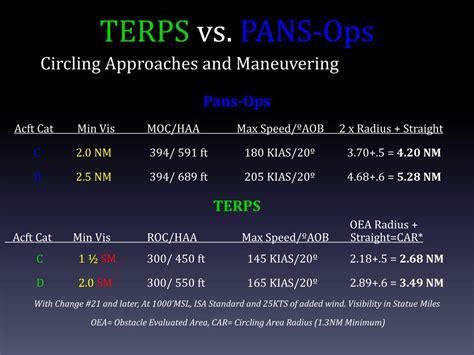
Circling Approaches: A Comparison of ICAO PANS-OPS and US TERPS
When it comes to aerodrome operating minima (AOM), operators rely on information from national authorities found in their Aeronautical Information Publications (AIPs). This information includes approach and departure procedures that help ensure safe distances between aircraft and obstacles near the flight path. These procedures follow international standards for obstacle clearance.
Two primary sets of procedures are in use: the International Civil Aviation Organization (ICAO) Procedures, detailed in ICAO Doc 8168 (PANS-OPS), and the United States Standard for Terminal Instrument Procedures (TERPS), as outlined in FAA Order No 8260.3C. While PANS-OPS is the international norm adopted widely in Europe and other nations, US TERPS is specifically applied in the United States and a few other countries, including Canada, Korea, Saudi Arabia, and Taiwan. Some NATO military procedures also align with US TERPS standards.
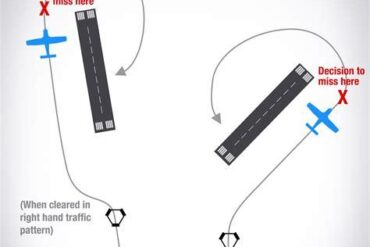
Pilots must recognize the differences in obstacle clearance criteria between ICAO PANS-OPS and US TERPS, particularly concerning Circling Approaches. These differences become evident in the assumed radius of turn and minimum obstacle clearance values.
Minimum Visibility Requirements
Both PANS-OPS and US TERPS define minimum visibility needed for pilots at the lowest obstacle clearance altitude (OCA). However, the methods of calculating these values differ, leading to variations in AOM. The table below illustrates the minimum visibility for each method:
| Aircraft Category | A | B | C | D | E |
|---|---|---|---|---|---|
| Minimum Visibility (PANS-OPS) | 1.9 km | 2.8 km | 3.7 km | 4.6 km | 6.5 km |
| Minimum Visibility (US TERPS) | 1.6 km | 1.6 km | 2.4 km | 3.2 km | 3.2 km |
Minimum Obstacle Clearance (MOC)
PANS-OPS utilizes a variable MOC that increases with aircraft category, as shown below:
| Aircraft Category | A | B | C | D | E |
|---|---|---|---|---|---|
| Obstacle Clearance (PANS-OPS) | 295 ft | 295 ft | 394 ft | 394 ft | 492 ft |
The FAA has adjusted the criteria for circling approach areas under TERPS 8260.3C, enlarging the circling approach area for better obstacle protection. Consequently, circling minima at various airports may see significant increases. The criteria for circling approach areas are based on the radius distances depicted below, which vary with aircraft category and account for true airspeed increase with altitude:
| Circling MDA in feet MSL | CAT A | CAT B | CAT C | CAT D | CAT E |
|---|---|---|---|---|---|
| 1000 or less | 1.3 | 1.7 | 2.7 | 3.6 | 4.5 |
| 1001 – 3000 | 1.3 | 1.8 | 2.8 | 3.7 | 4.6 |
| 3001 – 5000 | 1.3 | 1.8 | 2.9 | 3.8 | 4.8 |
| 5001 – 7000 | 1.3 | 1.9 | 3.0 | 4.0 | 5.0 |
| 7001 – 9000 | 1.4 | 2.0 | 3.2 | 4.2 | 5.3 |
| 9001 and above | 1.4 | 2.1 | 3.3 | 4.4 | 5.5 |
As of May 2, 2013, the FAA began releasing new instrument approach plates that include a broader segment of airspace to safeguard aircraft during circling approaches. This expanded airspace provides extra obstacle clearance, considering the aircraft’s altitude above the MDA, which impacts true airspeed. The protected airspace boundaries for circling approaches are determined by arcs drawn from each runway threshold. Faster aircraft require larger arcs. For instance, the previous 1.7 nm radius for Category C aircraft will now increase by 65% to 2.7 nm.
Chart providers like U.S. Terminal Procedures and Jeppesen will introduce new symbols to highlight these updated approaches. Government plates will display an inverse “C” in a black box in the approach minima section, while Jeppesen will use a “C” inside a black diamond. Charts lacking this new designation will still follow the older, smaller-radius criteria. Jeppesen charts reflecting these updates will be marked with the symbol
Radius of Circling Domain
Both ICAO and US systems have a radius for the circling domain—Obstacle Evaluation Area for US TERPS and Visual Manoeuvring Area for PANS-OPS. This radius grows with aircraft category and depends on true airspeed (TAS) and bank angle. Both systems factor in a constant wind component of 25 knots, regardless of wind direction. Aircraft categories are determined by threshold Indicated Airspeed (IAS), as indicated in the table below:
| Aircraft Category | A | B | C | D | E |
|---|---|---|---|---|---|
| Threshold IAS | <91 | 91-121 | 121-141 | 141-165 | ≥166 |
For PANS-OPS, TAS is influenced by aircraft altitude and visual maneuvering IAS (Circling IAS), which is shown below:
| Aircraft Category | A | B | C | D | E |
|---|---|---|---|---|---|
| Circling IAS | 100 | 135 | 180 | 205 | 240 |
In contrast, US TERPS calculates TAS based on altitude and appropriate threshold IAS. PANS-OPS assumes a 20° bank angle for all aircraft categories, whereas US TERPS applies a varying bank angle, never below 20°, as illustrated:
| Aircraft Category | A | B | C | D | E |
|---|---|---|---|---|---|
| Bank Angle (degrees) | 25 | 25 | 20 | 20 | 22 |
Due to a higher IAS used for TAS calculations and a lower assumed bank angle in US TERPS, the radius of the circling area in PANS-OPS is generally larger. This disparity means that obstacles within the PANS-OPS circling area might not be considered hazardous in US TERPS calculations. This difference played a role in a tragic accident in Busan, Korea, in 2002, which resulted in significant loss of life. Moreover, pilots unaware of the increased bank angle in US TERPS could inadvertently stray beyond the circling area due to the larger radius.
In conclusion, circling procedures based on US TERPS provide significantly lower safety margins compared to those following ICAO PANS-OPS. Therefore, it’s crucial for pilots to understand these differences and the basis for calculations at all airfields they operate, including alternates. The calculation basis for minima is typically noted on the approach plate.