Cornwall Council’s decision to withdraw funding for the Public Service Obligation (PSO) route between Cornwall Newquay Airport (NQY) and London Gatwick (LGW) marks a pivotal moment for regional aviation in the Southwest. With the subsidy set to end on May 31, the daily link to the capital will cease, leaving Cornwall without its only direct government-backed air bridge to London. The move follows a reduction in central government support from 66.7% to 50%, shifting a greater financial burden onto the local authority—one it has now concluded it cannot carry.
For Cornwall, this is not merely the cancellation of a flight. It represents the dismantling of a policy instrument designed to preserve connectivity in regions where commercial viability alone cannot sustain air services. The PSO framework exists precisely for routes like Newquay–Gatwick: strategically important, yet financially fragile. Without subsidy support, Skybus—the current operator—has confirmed it cannot operate the service commercially.
The financial arithmetic is stark. Maintaining the route over the next four years would require between £14 million and £16 million ($19.1 million to $21.8 million). With no alternative tenders meeting PSO regulations and reduced central funding, Cornwall Council voted to end the contract. The result is a structural gap in connectivity that few believe can be easily replaced.
The Strategic Importance of the Newquay–Gatwick Air Link
The Newquay–London corridor has long served as Cornwall’s fastest connection to the UK’s economic core. While rail links exist, journey times can exceed five hours. The one-hour flight to Gatwick compresses geography and makes same-day business travel feasible—an essential factor for inward investment, tourism flows, and public-sector mobility.
Unlike larger regional airports with diversified route portfolios, Cornwall Newquay Airport operates with limited connectivity. Its network consists mainly of domestic UK destinations, Dublin, and a handful of Spanish leisure routes. The London service functioned as an anchor route, offering both prestige and practical value.
A PSO route is not intended to be profitable in conventional commercial terms. It is designed to deliver social and economic value where market forces alone fall short. The withdrawal of subsidy exposes the underlying commercial weakness of the route but does not diminish its strategic relevance.
Financial Pressures and the Council’s Calculation
The council’s decision reflects fiscal reality rather than aviation policy preference. When the UK government reduced its contribution from 66.7% to 50%, the cost-sharing model shifted dramatically. Covering the shortfall would have required Cornwall Council to allocate millions more annually—funds competing with public services such as housing, healthcare, and infrastructure.
Crucially, no compliant alternative operator submitted a viable tender under PSO regulations. This absence underscores the route’s economic fragility. The market has effectively signaled that, without subsidy, the service is unsustainable.
Skybus Managing Director Jonathan Hinkles publicly expressed “grave concerns” about the consequences, particularly for employment within Cornwall’s aviation sector and the broader viability of Newquay Airport. His remarks highlight the interconnected nature of regional aviation economics: when one route disappears, ripple effects extend beyond ticket revenue.
Operational Profile: Skybus and the Dash 8-Q400
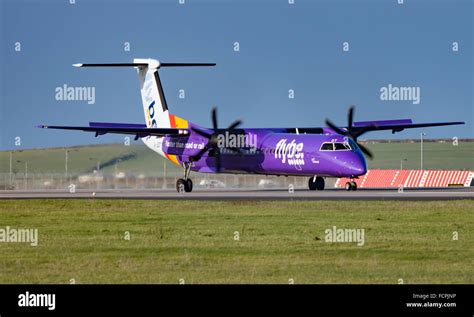
Since Eastern Airways’ collapse in late 2025, Skybus has operated the route using Universal Air’s De Havilland Dash 8-400 (Q400) turboprop aircraft. The Q400, configured in a 2–2 cabin layout with up to 78 seats, offers a range of approximately 1,100 nautical miles (2,037 km), making it well-suited for short domestic sectors.
The service operated daily, with morning departures on Mondays, Tuesdays, and Saturdays, and afternoon departures on other days. Though modest in frequency, the schedule supported both leisure and business travel patterns.

The aircraft choice reflects a broader truth about regional aviation economics. Turboprops like the Q400 are optimized for fuel efficiency on short sectors, yet even their lower operating costs cannot compensate for insufficient passenger yield when demand remains limited.
The Economic Impact on Newquay Airport
Airports generate revenue through landing charges, passenger fees, retail concessions, and infrastructure usage. When a core route disappears, the impact extends beyond lost ticket sales. Reduced passenger throughput affects commercial tenants, ground handling services, and fixed operational overheads.
For a regional airport such as Newquay, the Gatwick route likely contributed disproportionately to annual passenger numbers. Its cancellation may reduce overall traffic to a level that strains financial sustainability. Heavy discounts to attract replacement commercial service would undermine the airport’s own revenue base, creating a paradox: incentives needed to attract airlines could erode the airport’s ability to function.
Beyond the airport perimeter, local businesses stand to feel the impact. Tourism—one of Cornwall’s economic pillars—relies on convenient access. While many visitors arrive by road or rail, the psychological value of a direct London air link signals accessibility to international travelers connecting through Gatwick.
Regional Connectivity Versus Market Reality
The end of the PSO raises broader questions about the future of subsidized regional aviation in the UK. As public budgets tighten, policymakers must weigh connectivity against cost. Yet connectivity is not easily quantified in quarterly financial statements. It influences investment decisions, employment prospects, and regional competitiveness.
Cornwall’s geography compounds the challenge. Located at the southwestern extremity of mainland Britain, it is physically distant from major population centers. Air links compress that distance in a way rail cannot replicate in equivalent timeframes.
However, the market’s reluctance to sustain the route without subsidy indicates limited year-round demand at commercially viable fares. That tension—between strategic necessity and market insufficiency—defines the dilemma facing regional airports nationwide.
A Critical Juncture for Newquay Airport
Newquay Airport now confronts a transitional phase. Without the London PSO, its route map narrows further. Future viability will depend on its ability to attract leisure carriers, diversify revenue streams, or secure alternative forms of public support.
Regional airports often operate as hybrid entities, balancing commercial operations with public-service functions. When one pillar weakens, structural vulnerabilities become visible. The withdrawal of the London subsidy does not guarantee decline, but it undeniably intensifies financial and strategic pressure.
Cornwall’s decision signals a recalibration of priorities under fiscal constraint. Whether Newquay Airport can adapt—through innovation, partnerships, or new market opportunities—will determine if this moment represents contraction or transformation. For now, the runway between Cornwall and London grows quiet, and the region’s aviation future enters uncertain airspace.