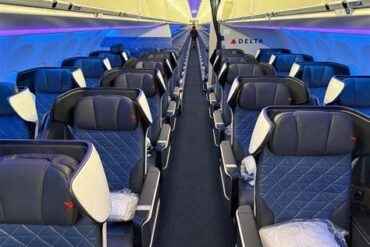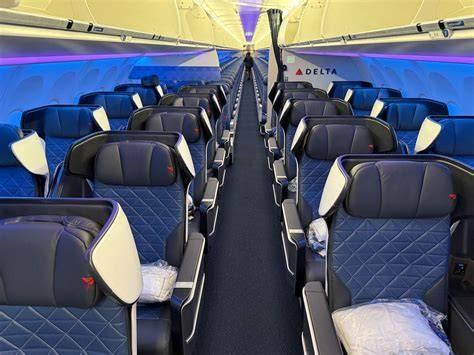
Delta Air Lines has stumbled into an intriguing experiment that could reshape the way it designs its domestic aircraft. Seven Airbus A321neos are currently flying with an extraordinary 44 Delta First seats, more than double the first class capacity found on the airline’s standard A321neo. The configuration was not part of Delta’s original strategy. Instead, it emerged from a problem involving the certification of the Safran VUE seats intended for the aircraft’s premium transcontinental operation.
Those aircraft were originally planned to offer a much more sophisticated premium product, including Delta One lie-flat seats and Premium Select. When certification problems prevented the intended Delta One seats from entering service, the A321neos were left in storage with their forward cabins effectively unusable. Keeping expensive aircraft parked indefinitely was hardly an attractive option, particularly when demand for premium seats was strengthening across the US airline industry.
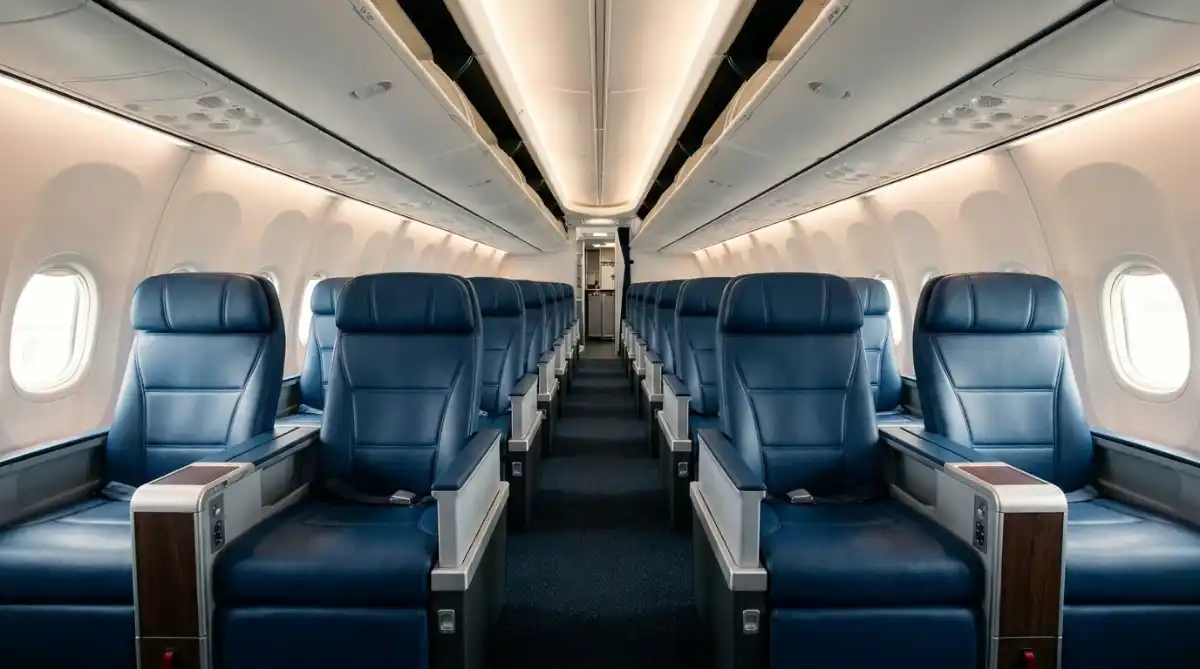
Delta therefore adopted an unusual temporary solution. The rear portions of the aircraft remained essentially unchanged, while the space intended for the premium transcontinental cabin was filled with additional recliner-style seats. The resulting aircraft, identified by Delta’s 3NP configuration, contains 44 Delta First seats, 54 Comfort seats, and 66 Main Cabin seats, for a total of 164 passengers. What began as an operational workaround has quickly become one of the airline industry’s most interesting experiments in premium capacity.
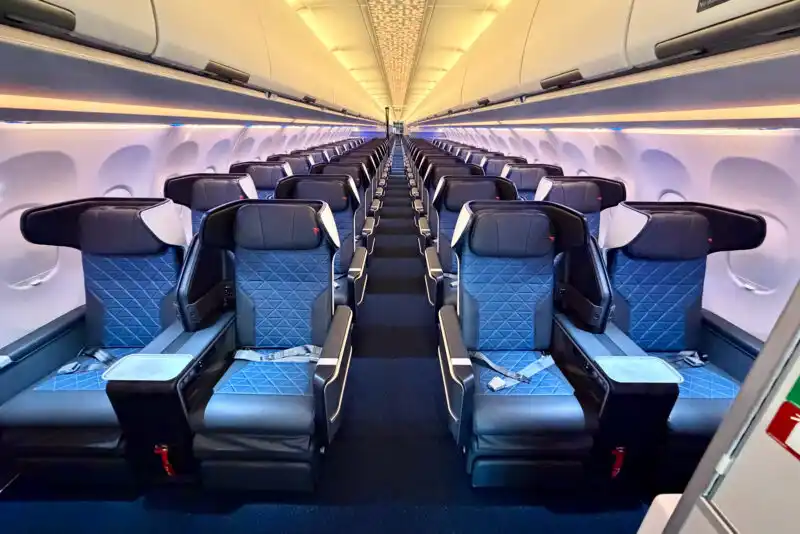
The numbers are particularly striking when placed alongside Delta’s normal domestic fleet. A standard A321 or A321neo carries 20 first class seats, while the larger Boeing 757-300 has 24. Smaller aircraft such as the Airbus A220, Airbus A319, and Boeing 717 typically carry 12, while the Airbus A320 and Boeing 737-800 have 16. Against that established pattern, a 44-seat first class cabin looks less like a modest adjustment and more like a fundamental rethink of domestic premium travel.
Delta Air Lines’ 44-Seat First Class Cabin Is a Massive Experiment
The most important aspect of Delta’s 3NP A321neos is that the airline is not simply offering a few extra premium seats. Nearly 27% of the entire 164-seat aircraft is dedicated to Delta First. That is an unusually high proportion for a narrowbody aircraft operating domestic routes, especially because these seats do not provide the lie-flat experience that customers would normally associate with a premium transcontinental cabin.
The decision makes more sense when the aircraft’s deployment is considered. Delta is using these A321neos on routes where demand for premium seating can be exceptionally strong but where a lie-flat product may not be essential. Atlanta to Los Angeles, San Francisco, San Diego, and Seattle are natural examples. These are long domestic flights connecting major business and leisure markets with Delta’s enormous Atlanta hub.
The airline’s traditional 20-seat first class cabin can create a capacity constraint on such routes. If a large number of customers are willing to pay more for extra space, priority boarding, better service, and greater comfort, limiting the premium cabin to 20 seats means leaving potential revenue on the table. The 3NP aircraft essentially asks a simple question: how much additional premium demand exists if Delta makes significantly more seats available?
The answer so far is revealing, although it is not quite as spectacular as the headline might suggest. Delta Chief Commercial Officer Joe Esposito has indicated that the airline is selling approximately 80% of the 44 first class seats on these aircraft. That translates to roughly 35 seats occupied on an average flight if the reported percentage is interpreted straightforwardly.
An 80% sales rate sounds impressive because the cabin itself is so large. Yet there is an important qualification. Delta typically sells close to 90% of its first class seats across the network. The 3NP aircraft are also not being randomly distributed across the network. They are being assigned to routes where Delta presumably expects some of the strongest untapped premium demand.
That means the experiment has not demonstrated that Delta can fill 44 first class seats everywhere. Instead, it has demonstrated that there are selected markets where the airline can profitably support a dramatically larger premium cabin than its conventional fleet planning would suggest.
Why the “Accidental” A321neo Could Influence Delta’s Future Fleet
There is another reason this experiment matters: the 3NP aircraft were effectively a way for Delta to turn a costly problem into a revenue opportunity. The airline had aircraft sitting in storage while it waited for its intended premium seats and certification process to progress. Those parked aircraft represented substantial financial inefficiency.
Rather than allow the aircraft to remain idle, Delta installed additional recliner seats and put them to work. The unusual configuration therefore has two purposes. It provides additional premium capacity on routes where demand exists, while also allowing Delta to generate revenue from aircraft that otherwise would have remained on the ground.
That makes the 44-seat A321neo less of a conventional fleet decision and more of a real-world market test. Delta can observe booking behavior, fares, upgrades, customer response, and route performance without immediately committing its entire narrowbody fleet to a new layout.
This is particularly valuable because airline cabin configuration decisions normally last for years. An aircraft can remain in service for a decade or longer, and changing its interior repeatedly is expensive and operationally disruptive. Delta therefore has an opportunity that it might not otherwise have had: test the limits of domestic first class demand using aircraft that already required an unusual solution.
Esposito has indicated that the results will influence future layouts. Importantly, that does not necessarily mean Delta plans to fill future A321neos with 44 first class seats. The more likely outcome is a search for a middle ground between today’s 20-seat standard and the 44-seat experimental cabin.
The airline appears to be discovering where that middle ground might sit.
Delta’s Boeing 737 MAX 10 Will Have 24 First Class Seats
The clearest evidence of Delta’s changing philosophy is already visible in its Boeing 737 MAX 10 plans. When Delta initially announced its configuration, the aircraft was expected to feature 20 first class seats within a 182-seat layout. That would have been broadly consistent with the airline’s established approach to large narrowbody aircraft.
The plan has since changed. Delta’s 737 MAX 10 is now expected to have 24 first class seats, adding one complete row to the premium cabin. That number is significant because it matches the first class capacity of Delta’s 757-300, the largest narrowbody in the airline’s current fleet.
The timing is also revealing. Delta’s original MAX 10 planning occurred before the dramatic acceleration in premium travel demand that followed the pandemic. By the time the aircraft’s cabin strategy evolved, customer behavior had changed considerably. Travelers demonstrated a greater willingness to spend on comfort, premium leisure experiences became more important, and airline loyalty programs increasingly encouraged customers to pursue elite status and premium upgrades.
The additional four first class seats may therefore represent more than a minor configuration adjustment. It suggests that Delta believes 20 seats are no longer necessarily the correct default for every large domestic narrowbody.
There is an important distinction, however. The 737 MAX 10 and 3NP A321neo programs should not automatically be viewed as one single cabin project. The MAX 10 decision was likely made independently using Delta’s booking and revenue data, while the 44-seat A321neo provides a separate experiment into the upper limits of premium capacity.
Together, however, they point in the same direction.
The End of the 20-Seat Domestic First Class Standard?
For much of the 2010s, the major US airlines developed relatively predictable domestic premium cabin patterns. Large narrowbodies generally carried around 20 first class seats, while smaller aircraft carried fewer. The logic was straightforward: premium seats generate attractive margins, but airlines must avoid creating so much premium capacity that fares and yields collapse.
That balance is becoming harder to maintain because the definition of the premium customer has changed.
Business travelers remain important, but they are no longer the only source of premium demand. Premium leisure travel has expanded, while affluent travelers have shown a stronger willingness to pay for better seats even when traveling for personal reasons. At the same time, economy cabins have become increasingly segmented, making the difference between a basic economy experience and a premium seat more significant.
Loyalty programs have amplified the trend. Delta, American, and United have spent years encouraging customers to concentrate their spending within their networks. Once customers become accustomed to upgrades, premium credit-card benefits, elite recognition, and better seats, airlines have an incentive to make more premium inventory available.
The traditional 20-seat cabin can therefore become a bottleneck.
American Airlines and United Airlines are reaching similar conclusions. All three major US legacy carriers have ordered the Boeing 737 MAX 10, and all are moving toward larger first class cabins than the industry might once have expected. Delta has confirmed 24 seats, American is also moving toward 24 first class seats on its MAX 10s, and United is widely expected to adopt a similar arrangement.
American has gone even further by indicating that it plans additional premium capacity on future Airbus A321neo deliveries and intends to reconfigure some aircraft already in its fleet. The exact number of first class seats for every A321neo remains less clear, leaving open the possibility of an even more aggressive approach.
Delta Is Expanding Premium Capacity Beyond Narrowbodies
The transformation is not limited to domestic narrowbodies. Delta’s broader fleet strategy shows that the airline is increasingly willing to allocate more of its aircraft to high-value premium customers.
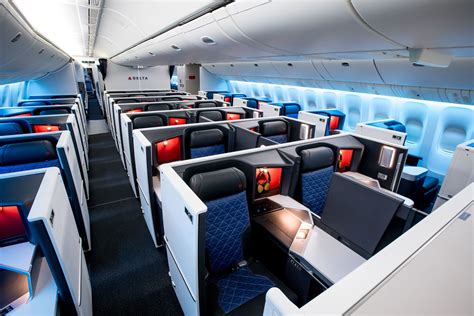
The airline is retrofitting some Airbus A350 aircraft with 40 Delta One suites instead of 32, increasing the number of premium flagship seats. Its incoming Airbus A350-1000 aircraft are expected to go even further, with 53 Delta One suites alongside 48 Premium Select seats.
That represents a fundamental change in how airlines think about aircraft economics. Historically, airlines often treated premium cabins as relatively small spaces designed primarily around business travel. Now, premium seating is becoming a much larger component of the revenue strategy.
Other US carriers are moving in the same direction. American’s newer Boeing 787 deliveries have featured substantially more business class capacity than older configurations, while United’s newest 787 aircraft have also increased the number of Polaris seats.
The common thread is that airlines are not simply adding luxury for marketing purposes. They are responding to the economics of a market in which a relatively small number of premium customers can contribute disproportionately to revenue.
That does not mean airlines can fill half an aircraft with premium seats on every route. The challenge is finding the right capacity for each market. Delta’s 44-seat A321neo is useful precisely because it shows where the upper limit may begin to appear.
Why 44 First Class Seats Probably Won’t Become the New Normal
Despite the attention surrounding the 3NP A321neos, there are strong reasons to believe that 44 first class seats will remain an exception rather than become Delta’s standard A321neo configuration.
The first is the 80% sales figure itself. Filling approximately 35 of 44 seats on selected high-demand routes is encouraging, but it does not establish that the same cabin could work throughout Delta’s network. If a 44-seat cabin struggles to maintain high load factors even on routes specifically chosen for strong premium demand, deploying that configuration broadly would risk diluting yields.
Premium inventory is valuable partly because it remains limited.
If too many first class seats are available, airlines may need to discount them, offer more upgrades, or accept weaker revenue per seat. The objective is therefore not to maximize the number of premium seats. It is to maximize the financial return generated by premium capacity.
That is why the 24-seat configuration planned for the 737 MAX 10 may be more important than the spectacular 44-seat experiment. It represents a plausible new baseline. Delta can increase premium capacity enough to capture additional demand without creating an enormous first class cabin that would only make sense on a small number of routes.
Esposito’s suggestion that the domestic first class “sweet spot” could fall somewhere between 24 and 44 seats is particularly revealing. It suggests Delta is no longer asking whether it should expand premium cabins. It is asking how far that expansion should go.
What Delta’s Experiment Means for Future Aircraft Interiors
The biggest legacy of the 44-seat A321neo may therefore be invisible to passengers. The temporary aircraft configuration could influence cabin plans for aircraft that have not yet entered service.
Delta now has real operational evidence about how customers respond when first class capacity increases dramatically. The airline can study which routes absorb the additional seats, how much customers pay, how many seats are occupied by upgrades, and whether increased premium inventory affects overall yields.
That information can then influence future aircraft orders and interior designs.
The result could be a fleet in which first class cabin sizes become more closely matched to route economics rather than dictated by a simple aircraft-size formula. A large narrowbody might receive 24, 28, or perhaps more premium seats depending on its expected mission, while smaller aircraft could receive proportionally different configurations.
This would represent a significant evolution from the relatively standardized layouts of the previous decade.
It could also influence the competitive landscape. If Delta can demonstrate that larger first class cabins generate strong returns, American and United have little reason to ignore the trend. The three carriers compete heavily for corporate contracts, affluent travelers, and elite loyalty-program members, so premium capacity can become a competitive weapon.
Budget and hybrid carriers are also beginning to explore premium seating, further broadening the market.
Delta’s “Accidental” Cabin Could Become a Strategic Turning Point
The irony of Delta’s 44-seat A321neo experiment is that it began with a problem. The aircraft were not supposed to enter service in this configuration. Certification difficulties involving the intended Safran VUE seats forced Delta to improvise, turning a stranded fleet asset into an unusual domestic premium aircraft.
Yet that improvisation has produced valuable information.
The aircraft have shown that there is meaningful demand for far more domestic first class capacity than Delta historically offered, particularly on long, high-value routes. At the same time, the approximately 80% sales rate indicates that there are limits to how far the airline can push the concept.
That combination may be more useful than a runaway success would have been. Delta does not need evidence that customers like first class. It needs to know exactly how much premium capacity the market can absorb before economics begin to deteriorate.
The 44-seat A321neo is providing that data.
Delta’s decision to increase the 737 MAX 10 to 24 first class seats suggests the first practical result is already emerging. The airline appears to be moving beyond the assumption that 20 seats should be the standard for a large domestic narrowbody.
The future is unlikely to consist of fleets filled with 44-seat first class cabins. Instead, larger premium cabins will probably become a permanent feature of US airline fleet planning, with 24 seats increasingly looking like a starting point rather than an upper limit.
For Delta, an aircraft that was supposed to be a temporary workaround may ultimately become something much more valuable: a flying laboratory. And if the airline’s interpretation of the results is correct, the most important change will not be the unusual 44-seat cabin itself. It will be the realization that the traditional boundaries of domestic first class were probably drawn too conservatively in the first place.