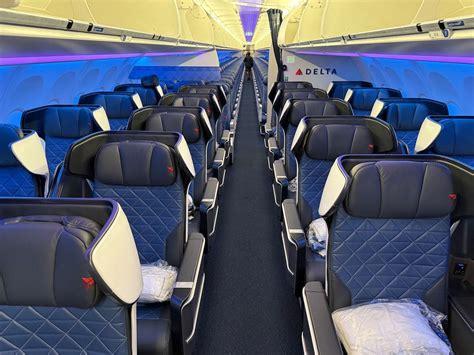
Delta Air Lines is preparing to launch one of the most unconventional narrowbody premium cabin configurations ever seen in the United States airline industry. At first glance, the airline’s newest Airbus A321neo layout almost sounds like a typo: 44 domestic First Class seats on a single-aisle aircraft and only one dedicated forward lavatory for premium passengers. Yet this unusual setup is very real, and it reveals far more than a temporary seating arrangement. It exposes the mounting pressure facing major US airlines as they race to modernize premium transcontinental flying while navigating supply chain disruptions, certification delays, and rapidly evolving passenger expectations.
For years, premium transcontinental travel within the United States has been transforming into a battleground for airline prestige. Airlines are no longer simply competing on schedules and loyalty programs. Instead, carriers are investing aggressively in onboard luxury, private suites, upgraded dining, and lie-flat seating that increasingly resembles international business class.
JetBlue disrupted the market with Mint. American Airlines introduced the Airbus A321T. United Airlines is now preparing its premium-focused A321neo “Coastliner” aircraft. Delta had every intention of entering this competitive segment with its own next-generation lie-flat Delta One-equipped A321neo fleet. But delays to the delivery and certification of those premium suites forced the Atlanta-based airline into an unexpected workaround.
Rather than parking expensive new aircraft indefinitely, Delta chose a highly creative — and highly controversial — temporary solution.
The result is a narrowbody aircraft unlike anything currently flying in domestic US service.
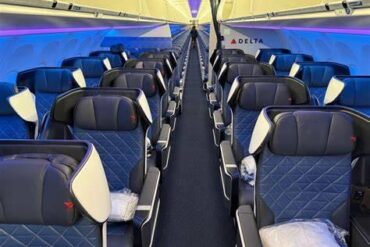
After years of anticipation surrounding Delta’s next-generation premium transcontinental strategy, the airline is now deploying brand-new Airbus A321neos fitted with a massive recliner-style First Class cabin that stretches across the first eleven rows of the aircraft.
Delta’s Airbus A321neo Cabin Configuration Changes the Traditional Narrowbody Formula
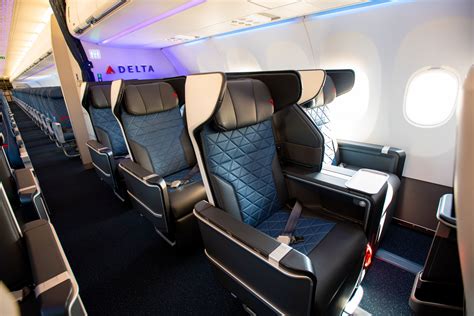
The temporary configuration dramatically alters the economics and passenger dynamics onboard the Airbus A321neo. Most domestic narrowbody aircraft operated by US airlines prioritize high-density economy seating with a relatively modest premium section at the front. Delta’s new layout flips that formula entirely.
The aircraft now features:
- 44 First Class seats
- 54 Delta Comfort+ seats
- 66 Main Cabin seats
- 164 total seats
By comparison, Delta’s standard Airbus A321neo configuration normally includes only 20 First Class seats and nearly twice as many economy seats.
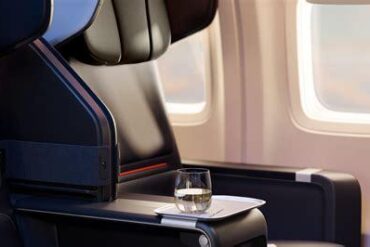
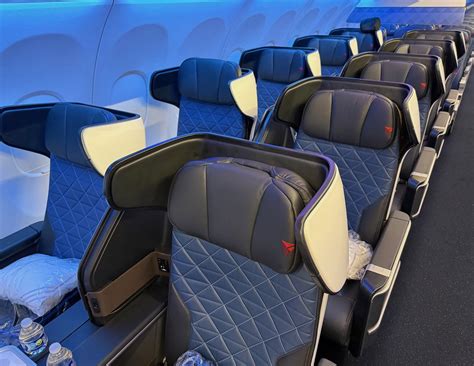
The enlarged premium cabin occupies the first eleven rows in a 2-2 layout using customized RECARO CL4710 seats. These are not international lie-flat suites, but they are among the most sophisticated domestic recliner seats currently installed on a US narrowbody aircraft. Each seat includes enhanced privacy wings around the headrest, personal entertainment screens, USB charging ports, power outlets, and privacy dividers designed to create a more secluded environment for passengers flying coast-to-coast.
Delta executives insist the arrangement is not a permanent product strategy. Instead, it is a temporary operational bridge until the delayed Delta One suites become available later in the decade.
Still, temporary or not, the aircraft instantly became one of the most talked-about premium cabin experiments in North American aviation.
Why Delta Air Lines Was Forced Into This Unusual Premium Configuration
The explanation behind the 44-seat First Class layout highlights the wider challenges currently affecting the aviation industry. Airlines around the world continue to face supply chain instability, delayed aircraft interiors, certification bottlenecks, and production slowdowns that have disrupted fleet planning for years.
Delta originally intended these Airbus A321neos to replace aging Boeing 757 aircraft on premium-heavy transcontinental routes. Those aircraft were supposed to debut with a fully modernized Delta One cabin featuring lie-flat suites specifically designed for long domestic sectors between major business hubs.
But the new premium suites were delayed.
Rather than leave newly delivered A321neos parked on the ground while waiting for cabin components, Delta opted to place the aircraft into immediate service using available domestic First Class seating.
That decision allowed the airline to maintain fleet growth, increase premium seat inventory during peak travel demand, and introduce newer aircraft onto important routes without further delays.
Mauricio Parise, Delta’s Vice President of Customer Experience Design, described the move as a creative solution designed to ensure travelers could still experience Delta’s newest aircraft during the busy summer season.
Operationally, however, the strategy introduces enormous complexity.
Because the aircraft was not originally designed to accommodate such an oversized premium cabin, Delta now faces the difficult task of delivering premium-level service to an unusually large number of high-paying passengers inside a narrowbody environment.
The Biggest Problem: Forty-Four First Class Passengers and Just One Lavatory
The most controversial aspect of Delta’s premium-heavy Airbus A321neo configuration is not the seat count itself. It is the lavatory situation.
Despite carrying 44 First Class passengers, the aircraft reportedly includes only one lavatory designated for the expanded premium section.
That creates a passenger-to-lavatory ratio rarely seen in premium aviation.
On long transcontinental flights between Atlanta and cities such as Los Angeles, Seattle, San Francisco, and San Diego, that single lavatory could quickly become a major pressure point. Premium passengers paying elevated fares generally expect faster service, greater privacy, and minimal waiting times. Managing those expectations inside a narrowbody aircraft with such dense premium seating will be extremely challenging.
The lavatory issue also highlights a broader truth about narrowbody premium flying: even the most luxurious seats cannot fully overcome physical aircraft limitations.
Widebody aircraft naturally provide more galley space, additional lavatories, wider aisles, and better service flow. Narrowbody aircraft, even advanced ones like the Airbus A321neo, remain constrained by their single-aisle architecture.
Delta appears fully aware of the operational risks. The airline is reportedly adding an extra oven onboard and assigning an additional flight attendant specifically to support First Class service. Three flight attendants will be dedicated exclusively to the premium cabin in an effort to maintain service standards.
That staffing adjustment alone demonstrates how operationally demanding this configuration may become.
Delta’s Premium Transcontinental Routes Are Becoming Increasingly Competitive
The aircraft will primarily operate on premium-heavy transcontinental routes connecting Atlanta with major West Coast destinations.
Scheduled routes include:
- Atlanta to Los Angeles
- Atlanta to San Francisco
- Atlanta to Seattle
- Atlanta to San Diego
These routes are strategically important because they attract a high concentration of business travelers, corporate contracts, entertainment industry professionals, technology executives, and affluent leisure passengers willing to pay premium fares.
Competition on these sectors has intensified dramatically over the last decade.
JetBlue’s Mint product fundamentally changed passenger expectations by offering private suites and lie-flat seating at highly competitive prices. American Airlines positioned the A321T as a specialized premium transcontinental aircraft. United is now aggressively modernizing its own premium narrowbody strategy with the upcoming Coastliner configuration.
Delta’s challenge is particularly difficult because the airline already possesses one of the strongest premium reputations in the US market. Customers increasingly expect Delta to lead in cabin quality, onboard service, and product innovation.
The temporary recliner-heavy A321neo configuration therefore functions as both a stopgap solution and a public test of Delta’s ability to maintain its premium image during a transitional period.
Why Delta Avoided Installing Domestic Premium Economy Seats
One of the more fascinating aspects of Delta’s strategy is what the airline chose not to install.
Instead of introducing a dedicated premium economy cabin similar to those found on long-haul international routes, Delta doubled down on domestic First Class and Comfort+ seating.
That decision reflects the unique economics of the US domestic market.
Premium economy works exceptionally well on intercontinental flights lasting eight to twelve hours, where travelers are willing to pay significantly more for wider seats, enhanced meals, increased recline, and additional comfort without paying full business class fares.
Domestic US flights operate differently.
Many American travelers already view domestic First Class as a hybrid product that partially overlaps with international premium economy. Introducing another intermediate cabin could confuse pricing structures while reducing profitability.
Instead, airlines discovered that extra-legroom economy products generate extremely strong ancillary revenue with minimal installation costs.
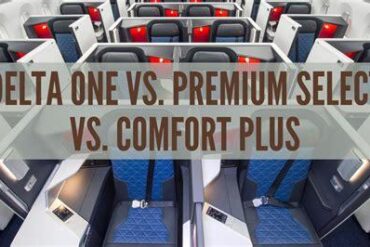
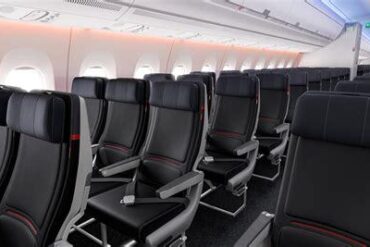
Delta Comfort+, United Economy Plus, and American Main Cabin Extra all follow the same strategy. The seats remain largely identical to standard economy seating while offering slightly more legroom and modest perks such as early boarding or complimentary beverages.
For airlines, this model is financially efficient because passengers frequently pay substantial surcharges for relatively small improvements.
That profitability helps explain why Delta chose to maximize First Class capacity instead of creating a separate premium economy section onboard the new A321neos.
Delta’s Massive Narrowbody Fleet Reveals the Scale of Its Long-Term Strategy
Delta’s unusual Airbus A321neo configuration also reflects the broader transformation of the airline’s narrowbody fleet.
As of 2026, Delta operates one of the largest and most diverse narrowbody fleets in the world. The airline maintains more than 800 narrowbody aircraft spanning Airbus A220s, A319s, A320s, A321s, Boeing 717s, Boeing 737s, and Boeing 757s.
The Airbus A321neo plays a particularly important role in Delta’s future strategy.
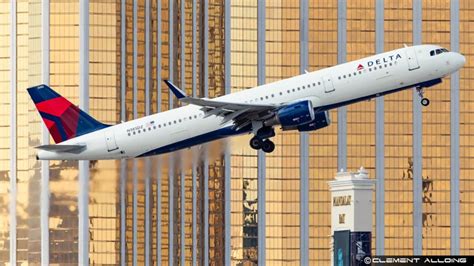
The airline already operates nearly 100 A321neos with more than 100 additional aircraft on order. These jets are expected to gradually replace older Boeing 757s while improving fuel efficiency, reducing maintenance costs, and modernizing the passenger experience.
Interestingly, Delta has not ordered the Airbus A321XLR, despite strong interest in the aircraft from competitors like American Airlines and United Airlines.
That decision may indicate Delta remains more cautious about ultra-long-range narrowbody operations than some rivals. Instead, the airline appears focused on maximizing efficiency and premium density within existing domestic and short-haul international networks.
Meanwhile, Delta continues operating large fleets of older aircraft that most airlines have already retired.
Its Boeing 717 fleet remains one of the largest in the world. The airline is also among the final major operators of the Boeing 757, a legendary aircraft that still performs exceptionally well on transcontinental routes despite its age.
Can Delta’s 44-Seat First Class Experiment Actually Work?
The answer depends entirely on execution.
From a revenue perspective, the strategy could prove surprisingly effective. Premium travel demand remains robust, especially on business-heavy transcontinental routes where corporate travelers continue prioritizing flexibility, loyalty benefits, and comfort.
If Delta successfully fills a significant percentage of those 44 First Class seats at elevated fares, the aircraft could generate impressive premium revenue despite reduced overall capacity.
But operational success is less certain.
Premium passengers are often the airline’s most demanding customers. Long lavatory lines, inconsistent meal delivery, overcrowded aisles, or delayed service could quickly damage the onboard experience. Maintaining exclusivity becomes much harder when nearly half the aircraft sits in First Class.
There is also the psychological factor.
Part of the appeal of premium cabins comes from separation and exclusivity. Expanding First Class to eleven rows risks making the cabin feel less intimate and more like a densely packed premium economy section, even if the actual seats remain high quality.
Still, Delta deserves credit for attempting an unconventional solution instead of simply grounding expensive aircraft.
The airline effectively turned a supply chain problem into an opportunity to test the upper limits of premium narrowbody operations in the United States. Even if the configuration remains temporary, the experiment could provide valuable data about passenger behavior, service logistics, and premium demand patterns.
More importantly, it demonstrates how fiercely competitive the US premium transcontinental market has become.
Airlines are no longer merely transporting passengers between coasts. They are competing to deliver luxury experiences inside aircraft originally designed for domestic short-haul flying.
Delta’s 44-seat Airbus A321neo may have emerged from necessity rather than long-term strategy, but it has already succeeded in doing one thing exceptionally well: forcing the entire airline industry to pay attention.