Delta Air Lines has spent years refining its premium travel experience, carefully separating its cabins into distinct tiers rather than creating small incremental upgrades. That strategy becomes especially obvious when comparing Delta One and Premium Select. On paper, both products promise more comfort than economy class. In practice, however, the gap between them is enormous.
Premium Select was designed to make long-haul travel more comfortable without fundamentally changing the traditional airline seating experience. Delta One, meanwhile, was built to redefine how passengers use personal space in the air altogether. The distinction is not simply about extra inches of legroom or slightly wider seats. It is about transforming the cabin from a dense shared environment into something that resembles a private hotel suite at 35,000 feet.
For travelers deciding whether the price difference is justified, the answer largely comes down to space. The amount of physical room Delta allocates to each passenger dramatically changes how flights feel, especially on overnight international routes where comfort becomes critical rather than optional.
The contrast is particularly noticeable on aircraft like the Airbus A350-900, where Delta showcases some of its most advanced cabin designs. While Premium Select offers a polished premium economy experience, Delta One creates an entirely different category of travel focused on privacy, freedom of movement, and lie-flat luxury.
Delta One Completely Changes The Meaning Of Personal Space
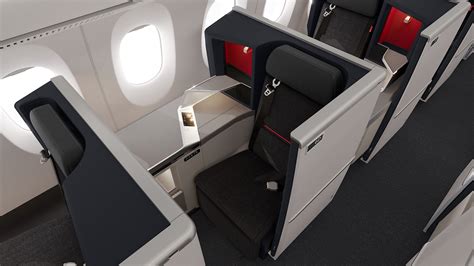
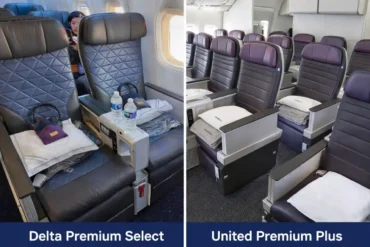
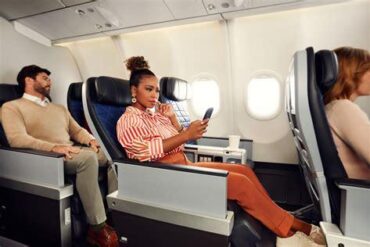
The clearest difference between Delta One and Premium Select begins with the concept of personal footprint. In Premium Select, passengers still exist within a traditional airline seat framework. The seat reclines farther than economy, offers additional legroom, and includes upgraded cushioning, but the traveler remains confined to a seated environment.
Delta One abandons that structure entirely.
Premium Select generally provides around 38 inches of seat pitch, which already represents a meaningful improvement over standard economy seating that often falls closer to 31 or 32 inches. For many passengers, that added space significantly improves long-haul comfort by reducing knee compression and allowing easier movement during flights.
Delta One operates under a completely different philosophy. Because the seats convert into fully flat beds, the concept of seat pitch becomes almost irrelevant. Instead of measuring how far your knees are from the seat ahead, the focus shifts toward how much usable living space surrounds the passenger.
Once reclined, the Delta One suite transforms into a bed stretching roughly the length of an adult human body. That changes the way travelers interact with the cabin. Rather than remaining upright for 10 or 14 hours, passengers can fully extend their legs, roll onto their side, or sleep horizontally without interruption from neighboring seats.
This difference fundamentally alters long-haul fatigue levels. Premium Select improves sitting comfort. Delta One eliminates sitting altogether for large portions of the journey.
That distinction becomes increasingly valuable on ultra-long-haul routes such as New York to Johannesburg or Atlanta to Cape Town, where passengers spend more than half a day onboard. On those flights, the ability to sleep flat rather than reclined can dramatically impact arrival energy levels and jet lag recovery.
Premium Select Still Feels Like A Traditional Airline Cabin
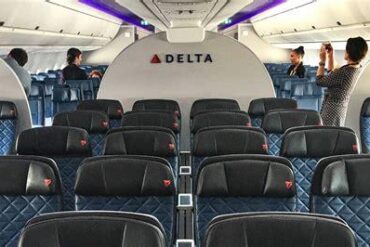
Despite offering meaningful upgrades, Premium Select retains many characteristics of a conventional passenger cabin. The seats remain arranged in dense row-based configurations, and travelers continue sharing armrests, aisles, and visual space with surrounding passengers.
Typically configured in a 2-4-2 layout on widebody aircraft, Premium Select cabins can seat up to eight travelers per row. Compared to economy, the arrangement feels more open and refined, but the environment still prioritizes airline efficiency and passenger capacity.
That density affects how spacious the cabin truly feels.
Passengers reclining their seats inevitably impact the personal space of travelers behind them. Movement remains somewhat restricted during meal service. Accessing overhead bins still involves navigating crowded aisles. Even with upgraded finishes and better padding, the overall environment remains communal rather than private.
Delta One dramatically reduces those compromises.
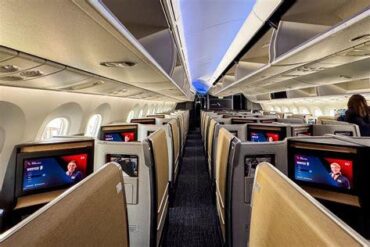
With its standard 1-2-1 configuration, every passenger receives direct aisle access without climbing over neighboring travelers. More importantly, fewer seats per row create visibly larger gaps between passengers, making the cabin feel calmer and far less crowded.
The psychological impact of reduced density is substantial. Even before passengers recline their seats into beds, the cabin already feels larger because fewer people occupy the same physical footprint inside the aircraft.
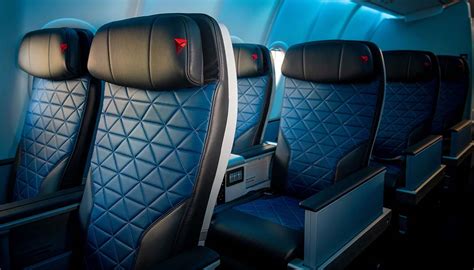
Seat Width Creates A Bigger Difference Than Most Travelers Expect
Many passengers focus heavily on legroom while overlooking the importance of seat width. On long-haul flights, however, shoulder space often becomes equally important, especially during overnight journeys where passengers attempt to rest for extended periods.
Premium Select seats generally measure between 18.5 and 19 inches wide, providing noticeably more room than standard economy seats. That additional width reduces shoulder contact with neighboring passengers and creates a less cramped seating posture.
Delta One expands those dimensions considerably.
Depending on aircraft type, Delta One seats frequently exceed 20 inches in width, with some configurations approaching 22 inches. Numerically, the difference may appear small. Physically, however, the added inches create a dramatically more spacious environment.
The reason goes beyond seat measurements alone.
Delta One suites incorporate side consoles, storage ledges, arm compartments, and fixed surfaces that effectively expand each passenger’s usable territory. Travelers are not merely sitting in a wider chair. They occupy a self-contained personal zone designed around independent movement and organization.
That becomes especially valuable during long flights involving work, dining, entertainment, and sleep within the same confined area.
In Premium Select, passengers still compete for shared armrest space and must carefully manage personal belongings within tighter boundaries. In Delta One, items like headphones, laptops, water bottles, passports, and tablets can remain accessible without cluttering the seating area itself.
The cabin consequently feels less stressful because passengers spend less time negotiating physical space with strangers.
Privacy Is One Of Delta One’s Biggest Luxury Advantages
Perhaps the most dramatic distinction between Delta One and Premium Select is privacy.
Premium Select offers little meaningful separation between travelers. While seat shells and modest dividers create slight visual barriers, passengers remain exposed to surrounding movement, conversations, and cabin activity throughout the flight.
Delta One takes the opposite approach.
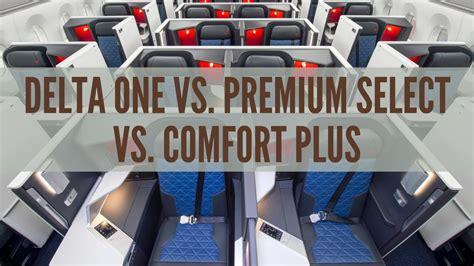
Modern Delta One suites feature tall walls, enclosed seating pods, and on many aircraft, sliding privacy doors. These elements transform the seating experience from open-plan travel into something closer to a personal room.
Privacy changes how passengers perceive space.
Even if the cabin dimensions remained identical, the ability to isolate oneself from surrounding activity would still make Delta One feel substantially larger. Humans naturally associate openness and control with spaciousness. When travelers can close a suite door, adjust lighting independently, and separate themselves visually from the cabin, the environment immediately feels calmer and more expansive.
This is especially noticeable during overnight flights when much of the cabin is darkened. In Premium Select, sleeping passengers remain surrounded by visible movement from flight attendants and neighboring travelers. In Delta One, the enclosed suite creates a cocoon-like atmosphere that feels remarkably detached from the rest of the aircraft.
That sense of exclusivity has become a defining feature of modern international business class competition, particularly against premium offerings from airlines such as Qatar Airways, Singapore Airlines, and Emirates.
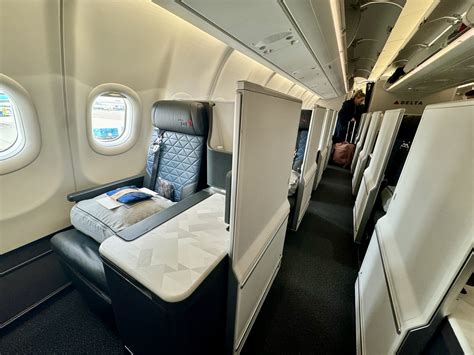
Lie-Flat Beds Transform Long-Haul Flying
The difference between reclining and lying flat cannot be overstated.
Premium Select seats recline farther than economy and include features such as adjustable leg rests and footrests. These upgrades certainly improve comfort during lengthy flights, particularly compared to cramped economy cabins.
Yet passengers remain in a seated posture.
The body continues carrying pressure on the lower back and hips, circulation remains partially restricted, and sleep quality suffers because the spine never fully relaxes into a natural horizontal position.
Delta One’s lie-flat beds solve these problems entirely.
When converted into bed mode, the seat becomes a completely horizontal sleeping surface capable of supporting genuine rest. Travelers can sleep stretched out rather than folded into an angled seated position.
The physiological benefits are substantial. Pressure points diminish, muscle tension decreases, and passengers experience deeper sleep cycles compared to upright recliners. On overnight international flights, this can dramatically improve how travelers feel upon arrival.
Business travelers especially value this advantage because it allows them to land prepared for meetings instead of losing an entire recovery day to exhaustion.
The difference becomes even more pronounced on routes exceeding 10 hours, where maintaining a seated posture for prolonged periods becomes physically draining regardless of seat quality.
Delta One Offers More Functional Living Space
Space is not solely about seat size. It is also about functionality.
Premium Select offers practical but limited storage options. Passengers typically receive a tray table, literature pocket, bottle holder, and small compartments for personal devices. While adequate for most travelers, the arrangement still requires careful organization.
Delta One dramatically expands usable workspace and storage.
Large side consoles allow passengers to spread out personal belongings without sacrificing seating comfort. Dedicated storage bins accommodate headphones, chargers, passports, and electronics. Oversized tray tables support dining and laptop use simultaneously.
This creates a cabin experience that feels less restrictive during long flights.
Passengers can comfortably watch entertainment while working on a laptop, enjoy multi-course meals without balancing items awkwardly, and keep essential belongings within easy reach throughout the journey.
That versatility matters because long-haul premium travel increasingly functions as a hybrid environment combining sleep, productivity, dining, and entertainment inside a single space.
Premium Select improves passenger comfort. Delta One creates a fully functional personal environment.
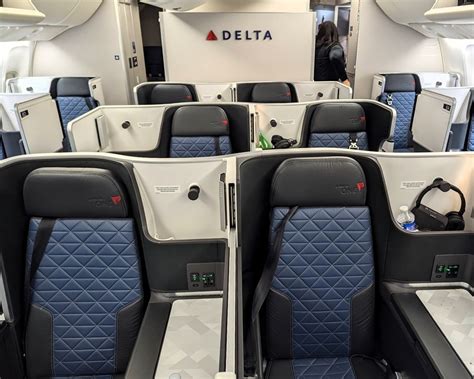
Aircraft Types Shape The Delta One Experience
Delta currently operates Delta One across several aircraft families, each featuring slightly different cabin layouts and suite designs. The airline’s flagship configurations are primarily found aboard the Airbus A350-900 and Airbus A330-900neo fleets, where the newest suite products showcase sliding privacy doors and highly refined cabin finishes.
Older aircraft such as the Boeing 767-300ER still offer lie-flat seating but generally lack the same level of enclosure and modern styling seen on newer jets.
Premium Select is also concentrated on Delta’s international widebody fleet, including the A330 family, A350-900, and Boeing 767 variants. However, regardless of aircraft type, the underlying distinction between the two cabins remains consistent: Premium Select enhances conventional seating while Delta One fundamentally redesigns the passenger experience.
That philosophy will continue evolving as Delta prepares to introduce the Airbus A350-1000 later this decade. Both Delta One and Premium Select are expected onboard, but the carrier’s newest flagship aircraft will likely push the spatial separation between cabins even further.
Delta One Is More Than Extra Inches Of Legroom
The biggest misconception surrounding premium airline cabins is that travelers are simply paying for a slightly larger seat.
That is not what Delta One delivers.
Passengers upgrading from Premium Select to Delta One are moving into an entirely different category of air travel centered around autonomy, privacy, and physical freedom. The experience extends far beyond dimensions printed on a seating chart.
Premium Select makes long-haul flying more tolerable. Delta One attempts to make it genuinely enjoyable.
The additional space affects every part of the journey, from sleeping quality and stress levels to productivity and personal comfort. Reduced cabin density lowers noise and visual clutter. Lie-flat beds allow true overnight rest. Expanded storage and surfaces create a practical living environment rather than a temporary seat assignment.
For travelers spending significant hours crossing oceans, those differences compound quickly.
On routes like New York to London or Los Angeles to Tokyo, the contrast between Premium Select and Delta One becomes obvious within minutes of boarding. One cabin provides an upgraded airline seat. The other creates an experience designed to minimize the traditional discomforts of air travel almost entirely.
That is why Delta One feels dramatically more spacious than Premium Select — not because of a single measurement, but because every aspect of the cabin is engineered around giving passengers greater control over how they occupy space in the air.