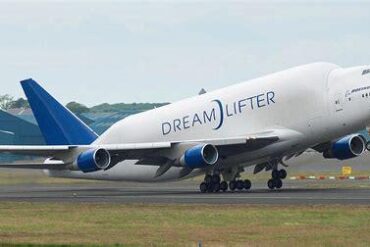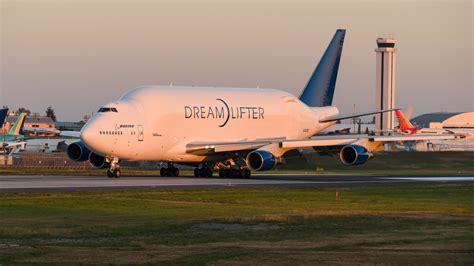
The Boeing 747 Dreamlifter is one of those aircraft that seems to exist slightly outside reality. It looks like a 747 that wandered too close to a funhouse mirror and never quite recovered. Its swollen fuselage and hinged tail give it the silhouette of an airborne warehouse, and that visual oddity has fueled a persistent misunderstanding that refuses to die. The most common belief is simple and intuitive: Boeing owns the Dreamlifters, Boeing built them, and therefore Boeing flies them. The truth is more interesting, more industrial, and more revealing about how modern aerospace actually works.
The Dreamlifter is officially known as the Boeing 747-400 Large Cargo Freighter (LCF), a title that sounds bureaucratic until you realize what it does. It exists for a single, highly specific purpose: to move gigantic Boeing 787 Dreamliner components across oceans in hours instead of weeks. Only four were ever created, and they spend their entire operational lives quietly stitching together a global supply chain that spans Japan, Italy, and the United States.
Because these aircraft never appear on cargo schedules, never sell capacity on the open market, and never carry anything except 787 parts, they are often misunderstood as a kind of private Boeing air force. That assumption feels reasonable. It is also wrong in a way that reveals how deeply specialized aviation logistics has become.
The Dreamlifter Is Not a Normal Cargo Aircraft
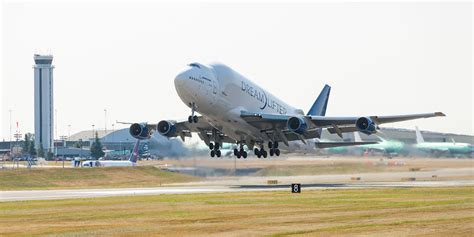
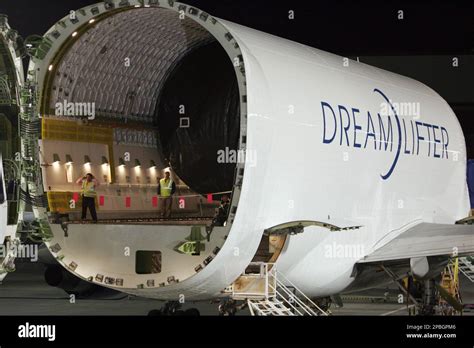
To understand the misconception, it helps to appreciate just how extreme the Dreamlifter really is. This is not a slightly modified freighter with a corporate paint job. The Dreamlifter has three times the internal cargo volume of a standard 747-400F, roughly 65,000 cubic feet, making it the largest-volume aircraft in the world. Volume, not weight, is the limiting factor here. A 787 fuselage barrel is light by aviation standards, but absurdly large by any reasonable definition of space.
In the early 2000s, no aircraft could carry a complete 787 wing or multiple fuselage barrels in a single load. Sea transport was far too slow for Boeing’s ambitious production model, which aimed to reduce inventory and accelerate final assembly. Airbus’s Beluga, even in its later BelugaXL form, was never designed for components of this size. The Dreamlifter was not a luxury. It was an engineering necessity.
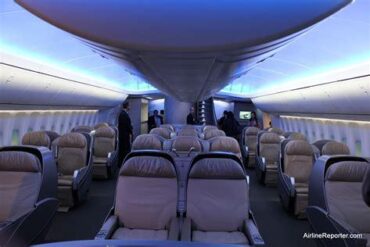
All four Dreamlifters began life as ordinary Boeing 747-400 passenger aircraft, previously operated by airlines including Malaysia Airlines, Air China, and China Airlines. They were already mature airframes when Boeing acquired them, a deliberate cost-saving move. The oldest first flew in 2006, years before the 787 entered airline service. What transformed them was an extraordinary conversion, not new production.
Why Boeing Does Not Fly the Dreamlifter
Here is where the misconception hardens into myth. The Dreamlifters are owned by Boeing Aircraft Holding Company, a Boeing entity. They are scheduled by Boeing. Their routes, payload priorities, and mission profiles are dictated entirely by the needs of the 787 program. Yet Boeing does not operate them.
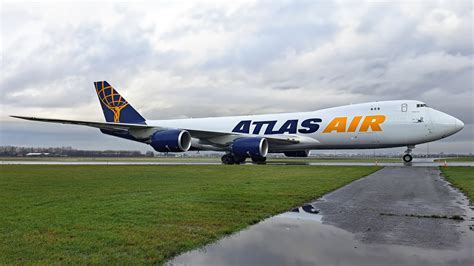
The actual operator is Atlas Air, one of the world’s most experienced cargo airlines and the single largest operator of the Boeing 747. Under a long-term contract, Atlas Air provides the flight crews, maintenance, training, regulatory compliance, and day-to-day operational execution of the Dreamlifter fleet. Boeing tells the aircraft where to go and what to carry. Atlas Air makes it happen safely, legally, and reliably.
This arrangement is not unusual in aviation, but it feels counterintuitive when applied to such a bespoke aircraft. The key insight is that aircraft ownership and aircraft operation are separate disciplines. Boeing is unmatched at designing airplanes and orchestrating global manufacturing programs. Atlas Air specializes in operating complex widebody fleets across international regulatory environments. The Dreamlifter sits precisely at that intersection.
Boeing even outsourced the physical conversion work. The transformation from standard 747-400 to LCF was carried out by Evergreen Aviation Technologies (EGAT) in Taiwan, with Boeing providing engineering oversight. Boeing defined the mission. Specialists executed it.
A Fleet Built Around the Jumbo Jet
Atlas Air’s role becomes clearer when viewed in the context of its broader fleet. This is not an airline that happens to operate a few old 747s out of nostalgia. Atlas Air is the world’s preeminent Boeing 747 specialist, with deep institutional knowledge of the type’s quirks, maintenance demands, and long-haul operating economics.
As of the mid-2020s, Atlas Air operates dozens of 747 variants, including standard 747-400 freighters, the four Dreamlifters, and the newer Boeing 747-8F. It was the final commercial customer to take delivery of a brand-new 747 when the type quietly exited production. That fact alone places Atlas Air in a unique position within global aviation.
The airline even maintains a small number of 747-400s configured for VIP and passenger charter missions, a reminder of just how adaptable the Jumbo can be when paired with the right operator. For Atlas Air, the Dreamlifter is not an alien machine. It is an extreme example of a familiar species.
The Dreamlifter Exists Because the 787 Is Global by Design
The Dreamlifter makes sense only when seen as a physical manifestation of the 787’s global production strategy. Unlike earlier Boeing programs, the Dreamliner was designed from the outset as an internationally distributed manufacturing effort. Large, fully assembled structures would be built by Tier-1 partners and flown to the final assembly line.
Japanese industry plays an especially large role. Mitsubishi Heavy Industries designs and manufactures the 787’s wings and center wing box, producing enormous composite structures that cannot be broken down without losing the efficiency gains of modular assembly. Italian firm Leonardo builds major fuselage sections and the horizontal stabilizer. Spirit AeroSystems, now reintegrated into Boeing, produces the forward fuselage and cockpit sections in Wichita.
The Dreamlifter connects these sites to North Charleston, South Carolina, where the 787 is assembled. Without it, the program would collapse back into slower, inventory-heavy logistics. With it, Boeing can move parts from Japan to the US in roughly a day.
This is why the Dreamlifter’s route network looks sparse and repetitive. These aircraft spend their lives cycling between a small set of airports: Nagoya, Taranto, Wichita, North Charleston, Everett, Anchorage, and Miami. Anchorage and Miami are not manufacturing sites but logistical pivots, chosen for their geography and infrastructure.
Why the Dreamlifter Is Not a Beluga
Comparisons with Airbus’s Beluga aircraft are inevitable and often misleading. The BelugaXL is a marvel in its own right, but it was designed around a very different industrial geography. Airbus can move most of its large components by barge, road, or short regional flights within Europe. Boeing cannot.
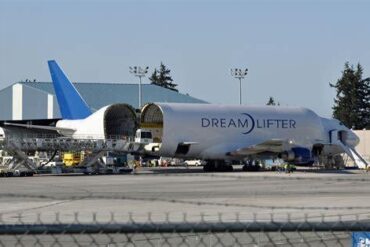
The Dreamlifter is larger than the BelugaXL in usable volume and is optimized for straight-in loading via a hinged tail and nose opening. Its floor is reinforced to handle extreme point loads from massive composite structures. It is not a general-purpose outsized freighter. It is a flying production line.
Even today, no other aircraft can fully replace it for the 787 program. Large turbofan engines like the GE9X for the 777X can be carried by conventional 747 freighters or even by sea when time allows. Full 787 wings cannot.
The Misconception, Finally Resolved
The enduring misconception about the Boeing Dreamlifter is not really about who flies it. It is about how people imagine industrial power works. The assumption is that a giant like Boeing must do everything itself, from design to piloting. In reality, modern aerospace is an ecosystem of hyper-specialists.
Boeing owns the Dreamlifters because they are integral to its production system. Atlas Air operates them because running long-haul widebody aircraft safely and efficiently is a profession in its own right. The Dreamlifter is the quiet proof that the most important aircraft in the world are sometimes the ones that never carry passengers, never make headlines, and never deviate from their mission.
It is not a Boeing airplane in the way people assume. It is something more revealing: a flying contract between design ambition and operational reality, held together by composite barrels, global trust, and four of the strangest-looking 747s ever to leave the ground.