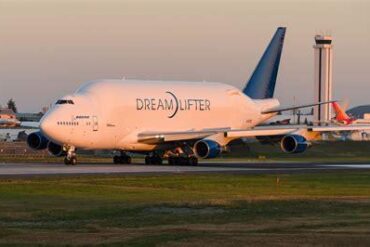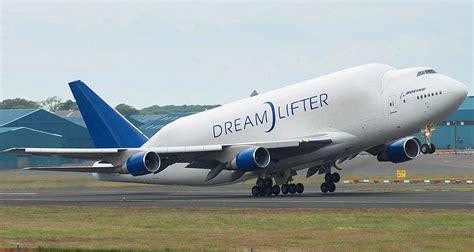
The Boeing Dreamlifter, officially designated the 747-400LCF (Large Cargo Freighter), is one of the most visually striking aircraft ever to take flight. With its swollen fuselage and outsized cargo bay, it looks almost surreal against a standard airport backdrop. Yet beneath that distinctive profile lies a precisely engineered logistical machine built for a single mission: transporting massive Boeing 787 Dreamliner components across continents with speed and efficiency.
Understanding how many hours the Boeing Dreamlifter can fly without refueling requires more than a simple time estimate. It demands a close look at its range, fuel burn characteristics, payload limitations, and the unique operational routes it serves. The answer, grounded in its certified performance data, reveals both its capabilities and its deliberate constraints.
Boeing Dreamlifter Maximum Range and Flight Hours
The Boeing Dreamlifter has a published maximum range of approximately 4,200 nautical miles (7,800 kilometers) when fully loaded. Translating that into flight hours depends on cruise speed. The aircraft cruises at roughly Mach 0.85, or around 560 miles per hour (900 km/h) at typical cruise altitude.
At that cruise speed, a fully loaded Dreamlifter can remain airborne for approximately:
8 to 9 hours without refueling.
This figure assumes optimal cruise conditions, standard atmospheric performance, and a full payload of 787 components. Under lighter loads or favorable winds, endurance can stretch slightly longer, but operational planning rarely pushes the aircraft to theoretical limits. Reliability matters more than squeezing out extra minutes.
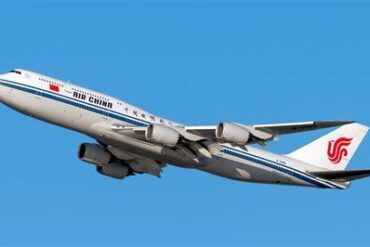
What makes this endurance particularly interesting is that it is shorter than a standard Boeing 747-400 passenger aircraft, which can exceed 7,000 nautical miles. The Dreamlifter’s endurance tradeoff stems directly from its structural and aerodynamic redesign.
Why the Dreamlifter’s Range Is Limited Compared to a Standard 747
At first glance, it might seem puzzling that an aircraft derived from the long-haul Boeing 747-400 has significantly less range. The explanation lies in three fundamental engineering realities:
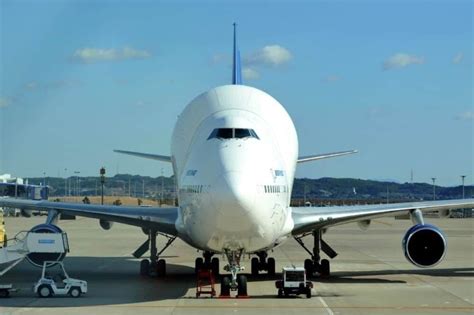
First, the Dreamlifter’s massively enlarged fuselage dramatically increases aerodynamic drag. That bulbous upper fuselage creates greater frontal area and disturbs airflow patterns optimized in the original 747 design. More drag equals higher fuel consumption.
Second, the aircraft’s maximum takeoff weight (MTOW) is lower than a standard 747-400. The Dreamlifter is capped at approximately 364 metric tons, compared to over 394 metric tons for the standard model. This reduction reflects its specialized mission profile. It was never intended to carry dense cargo or large passenger loads across ultra-long-haul routes.
Third, the aircraft carries voluminous but relatively lightweight composite components. Boeing designed the Dreamlifter around high volume rather than high mass. The 787 is roughly 50% composite by weight and nearly 80% composite by volume, meaning large fuselage barrels and wings occupy space without pushing weight limits. As a result, the aircraft does not need the structural reinforcement required for heavier freight.
In short, the Dreamlifter sacrifices range and aerodynamic elegance for cargo volume. It is a purpose-built logistics instrument rather than a global-range freighter.
Real-World Routes: How the Dreamlifter Operates in Practice
On paper, 4,200 nautical miles may appear restrictive. In operational reality, it is precisely calibrated to the aircraft’s mission.
The Dreamlifter routinely connects key global production centers:
- Nagoya, Japan (wings and wing boxes)
- Taranto, Italy (center fuselage sections)
- Wichita, Kansas (forward fuselage sections)
- North Charleston, South Carolina (final assembly)
One of the longest routine missions is from Taranto to North Charleston, a route measuring roughly 4,472 nautical miles (8,283 km). While slightly longer than the nominal fully loaded range, operational planning may involve weight adjustments, fuel management strategies, or favorable wind considerations to safely complete the route.
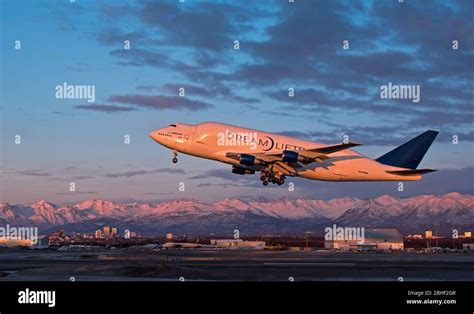
Flights from Japan typically include a stop in Anchorage, Alaska, breaking the journey into manageable segments. This staging approach aligns with safe operational margins while optimizing scheduling efficiency.
The aircraft does not attempt trans-Pacific or ultra-long-haul non-stop missions. It performs structured, repeatable logistics cycles designed to maintain production flow.
How Fuel Burn Influences Endurance
The Dreamlifter retains its four Pratt & Whitney PW4056 engines, largely unmodified from their original 747-400 configuration. These engines were optimized for a sleeker fuselage. When paired with the enlarged cargo body, fuel burn naturally increases.
Higher drag means the aircraft consumes more fuel per nautical mile than a standard 747. Combined with its reduced MTOW, this constrains maximum endurance.
However, Boeing made a strategic choice. The aircraft does not require extreme range because its production network is geographically structured. Instead of designing for global cargo competition, Boeing designed for precision industrial logistics.
Operational economics also play a role. Lower MTOW reduces landing fees, which are often calculated based on aircraft weight. Since the cargo itself is light, there is no incentive to carry excess structural capacity.
In effect, the Dreamlifter is engineered to do one job extremely well, not to win range records.
Design Features That Affect Flight Duration
Several unique structural elements directly influence flight performance:
Bulging Cargo Fuselage
The redesigned fuselage provides approximately 65,000 cubic feet (1,840 cubic meters) of cargo volume, roughly three times that of a standard 747-400F. This makes it capable of transporting entire 787 fuselage barrels in one piece.
Unpressurized Cargo Hold
Because it carries aircraft components rather than people or sensitive freight, the cargo hold is unpressurized and unheated. This reduces system complexity but does not significantly affect endurance.
Swing Tail Loading System
The Dreamlifter loads cargo through a unique swing tail mechanism, allowing the entire aft fuselage section to open. This requires structural reinforcement that adds weight and alters aerodynamics.
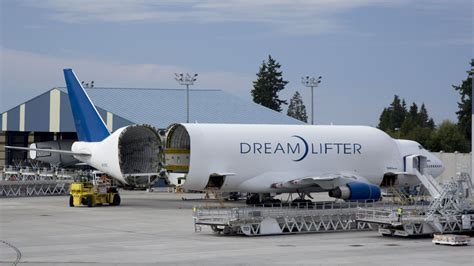
Modified Vertical Stabilizer
The aircraft features a taller vertical stabilizer to compensate for the enlarged fuselage’s impact on directional stability. Without this modification, yaw control at cruise altitude could be compromised.
Each of these changes contributes incrementally to increased drag and fuel burn, which ultimately shapes the aircraft’s maximum flight time.
Comparing Flight Hours: Dreamlifter vs. Airbus Beluga and BelugaXL
The Dreamlifter’s endurance becomes even more impressive when compared with its European counterparts.
The original Airbus A300-600ST Beluga has a fully loaded range of approximately 900 nautical miles, translating to roughly 2 hours of flight time. The newer BelugaXL, based on the A330, extends that range to around 2,300 nautical miles, or approximately 4 to 5 hours.
In contrast, the Dreamlifter’s 8–9 hour endurance allows true intercontinental logistics capability. This extended range reflects the 747’s inherent long-haul DNA, even after heavy modification.
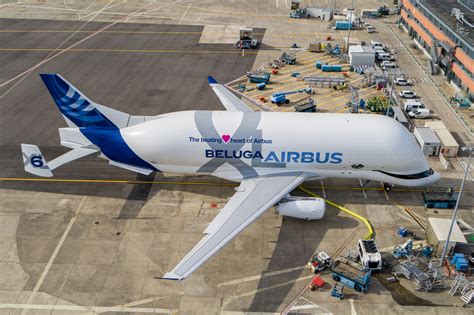
The difference highlights Boeing’s geographically dispersed supply chain. Airbus production sites are concentrated within Europe, requiring shorter-range shuttle operations. Boeing’s 787 network spans Japan, Italy, and the United States, necessitating longer legs.
How Weather and Payload Affect Maximum Flight Time
The theoretical 8–9 hour figure assumes standard payload and atmospheric conditions. In real operations, endurance varies depending on:
- Payload weight and volume
- Headwinds or tailwinds
- Route selection
- Air traffic routing constraints
- Temperature and density altitude
Strong headwinds can significantly reduce effective range, requiring fuel stops even within nominal limits. Conversely, tailwinds can extend operational flexibility.
Because the Dreamlifter’s cargo is relatively lightweight, Boeing retains some payload flexibility for fuel optimization. This operational buffer ensures that production schedules are not disrupted by weather variability.
The Strategic Importance of the Dreamlifter’s Endurance
The question of how many hours the Boeing Dreamlifter can fly without refueling is not just about numbers. It is about industrial tempo.
The 787 program depends on synchronized global manufacturing. Entire fuselage barrels, wings, and stabilizers must arrive in North Charleston in a precise sequence. Delays ripple through production lines, affecting airline deliveries and financial performance.
An aircraft capable of nearly 9 hours of continuous flight provides enough endurance to connect continents directly. That capability shortens supply chains, reduces maritime shipping time from weeks to hours, and enables rapid response to production bottlenecks.
While the aircraft’s range may appear limited compared to long-haul passenger jets, it is optimized for industrial efficiency rather than passenger convenience.
Operational Ownership and Fleet Structure
Only four Dreamlifters exist. They are owned by Boeing and operated by Atlas Air under lease agreements. Three entered service in 2008, with the fourth joining in 2010.
This small fleet underscores the aircraft’s niche role. It is not a commercial cargo platform competing in the broader freight market. It is a dedicated logistics backbone for a single aircraft program.
Each aircraft cycles continuously between production sites, maximizing utilization within its 8–9 hour flight envelope.
Conclusion: The True Endurance of the Boeing Dreamlifter
So, how many hours can the Boeing Dreamlifter fly without refueling?
Under full payload conditions, the aircraft can sustain approximately 8 to 9 hours of continuous flight, corresponding to its 4,200 nautical mile maximum range. This endurance reflects a careful balance between aerodynamic compromise and logistical necessity.
The Dreamlifter does not chase global range records. It does something arguably more impressive: it compresses a global aerospace supply chain into a sequence of intercontinental air bridges. Its flight duration is long enough to span oceans, yet precisely calibrated to its specialized mission.
In the world of aviation logistics, endurance is not about how far you can go. It is about going exactly as far as you need to, with absolute reliability.