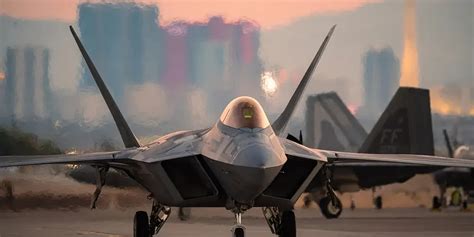
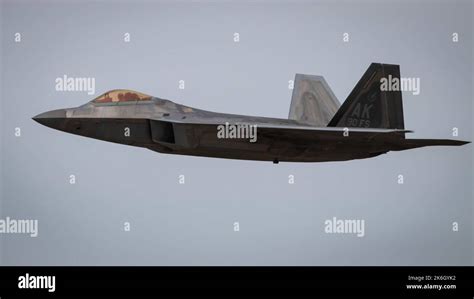
The F-22 Raptor stands as a symbol of American air superiority, embodying the apex of fifth-generation stealth fighter design. From its introduction in the early 2000s to its operational use today, it remains unmatched in its blend of stealth, speed, agility, and situational awareness. Among its numerous capabilities, a crucial operational metric is how long this formidable jet can stay airborne without needing to refuel — a question of both strategic and tactical relevance.
The answer is more complex than a fixed number. The flight endurance of the F-22 Raptor depends on a wide array of factors: altitude, fuel configuration, speed, atmospheric density, and mission profile. But examining the jet’s performance parameters and pilot testimonies helps us construct a nuanced understanding.
Understanding the F-22’s Fuel Capacity and Range
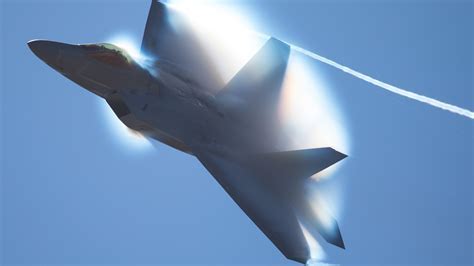
At its core, the F-22 Raptor is powered by two Pratt & Whitney F119-PW-100 turbofan engines, which are capable of producing a combined 70,000 pounds of thrust. These engines are optimized for supercruise, meaning the aircraft can maintain supersonic speeds — typically around Mach 1.5 — without engaging afterburners. This is a rare capability, and one that sets the F-22 apart from earlier generation fighters.
In standard configuration, the F-22 carries internal fuel tanks that provide a combat radius of approximately 600 miles, or roughly 1,200 miles round trip. When fitted with two external drop tanks, the aircraft’s maximum range increases to about 1,850 miles. However, that figure is highly conditional.
If flown subsonically, without afterburners and at an optimal cruising altitude (typically above 40,000 feet), the jet can extend its flight time to over two and a half hours, according to Holloman Air Force Base reports. Under those flight profiles, the aerodynamic and fuel efficiency of the aircraft is optimized, taking full advantage of reduced drag and thinner air.
Supercruise: Fuel Efficiency at Supersonic Speeds
Supercruise was a central innovation in the F-22’s design philosophy. By enabling the jet to travel faster than the speed of sound without using fuel-intensive afterburners, the Raptor achieves a balance between speed and range that older jets could not.
However, it’s important to recognize that even supercruise consumes more fuel than subsonic flight, and still significantly impacts the aircraft’s range. When operating in a supercruise regime, the F-22 is burning more fuel than in standard cruise, but far less than if it were in full afterburner.
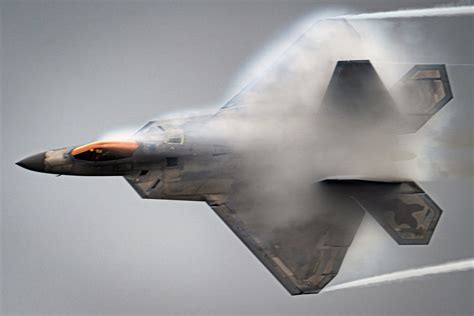
For example, if an F-22 cruises at around Mach 1.5 (approx. 1,150 mph) at high altitude, it may exhaust its fuel in just under two hours, assuming full internal and external fuel tanks. Tactical scenarios rarely call for such continuous supersonic flight, however. Pilots will often alternate between subsonic and supersonic speeds based on mission objectives, fuel conservation requirements, and radar evasion tactics.
Afterburners and Speed-Range Tradeoffs
Engaging the F-22’s afterburners unleashes its full thrust potential — up to Mach 2.0 at high altitudes, equivalent to approximately 1,500 mph. But the cost is steep: fuel consumption increases exponentially. At these speeds, the jet’s fuel supply would only sustain about 75 minutes of flight — or even less — depending on atmospheric conditions and payload.
At lower altitudes, the drag increases significantly. For instance, at sea level, the F-22 maxes out around Mach 1.21 (approximately 921 mph), and in this configuration, the aircraft may last about two hours if carrying full fuel with external tanks. Once again, the air density, mission altitude, and pilot inputs make precise endurance calculations challenging.
Pilot Perspective: Tactical Realities and Refueling Strategy
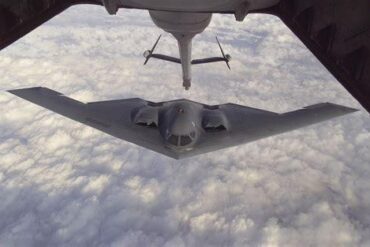
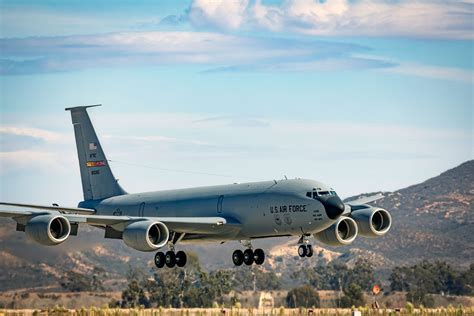
Pilots of the F-22 are trained to incorporate these limitations into every mission plan. Maj. Chris “Bandit” Bergtholdt, an experienced Raptor pilot, emphasized that supersonic flight is integral to their tactics — and each pilot is trained to execute multiple supersonic runs per flight. While this capability is a game-changer in air dominance missions, it also necessitates tight integration with aerial refueling platforms like the KC-135 Stratotanker or KC-46 Pegasus.
In real-world scenarios, the F-22 rarely flies anywhere near its range limits without a refueling option nearby. The United States Air Force maintains a global network of aerial tankers, allowing Raptor squadrons to deploy rapidly and stay in the air for extended periods if needed. Theoretically, this means the F-22’s range becomes nearly unlimited — constrained only by pilot fatigue and mechanical wear.
Flight Endurance Scenarios: Breaking Down the Numbers
To better understand how mission configuration affects F-22 endurance, consider the following common scenarios:
Scenario 1: Subsonic Cruise at High Altitude (Optimal Conditions)
- Speed: ~Mach 0.9 (690 mph)
- Altitude: 45,000 feet
- Fuel Use: Most efficient
- Flight Duration: Up to 2.5 hours with full tanks
- Range: ~1,800 miles
Scenario 2: Supercruise at High Altitude
- Speed: Mach 1.5
- Altitude: 50,000 feet
- Fuel Use: Moderate to high
- Flight Duration: ~1.5 to 2 hours
- Range: ~1,500 miles
Scenario 3: Full Afterburner at Max Speed
- Speed: Mach 2.0
- Altitude: 50,000 feet
- Fuel Use: Extremely high
- Flight Duration: ~1.2 hours or less
- Range: ~1,200 miles or less
These estimates are illustrative. In practice, flight duration is subject to continuous updates from mission control, weather conditions, enemy radar activity, and airframe status.
Refueling and Strategic Reach
The U.S. Air Force’s commitment to global air dominance means that no F-22 is expected to operate long distances from a refueling asset. Missions in the Indo-Pacific, for example, regularly require Raptor squadrons to fly from bases in Alaska, Guam, or Hawaii, and connect with aerial tankers for transit over extended ranges.
This strategic dependency on refueling infrastructure is what makes tanker aircraft such high-value assets. Without them, the deployment range of the F-22 is limited. With them, it becomes functionally limitless. Moreover, refueling allows the Raptor to carry more weapons and less fuel on shorter-range missions, thus maximizing its lethality and combat loadout.
Operational Implications and the Future of Air Dominance
Understanding the F-22’s fuel limitations isn’t merely a technical detail — it’s a strategic variable. For planners and pilots, it’s about timing the perfect moment to enter or exit contested airspace, managing fuel to support extended combat air patrols, and ensuring survivability during missions requiring stealth and high speed.
As the U.S. transitions toward sixth-generation air dominance platforms — like the Next Generation Air Dominance (NGAD) program — lessons from the F-22’s performance inform future requirements. Fuel efficiency, stealth, and interoperability with unmanned wingmen will all hinge on the same careful balance the Raptor has mastered: performance versus persistence.
Conclusion: The F-22’s Flight Time Without Refueling
In ideal conditions, the F-22 Raptor can fly for up to 2.5 hours without refueling, reaching up to 1,850 miles with external tanks. But such optimal scenarios are rarely reflective of combat operations. High-speed maneuvers, low-altitude flights, and afterburner engagement can drastically reduce that endurance — sometimes to as little as an hour. For this reason, aerial refueling is not a luxury but a necessity in real-world deployments. With the right support, however, the Raptor’s range becomes virtually unlimited, reaffirming its status as one of the most advanced and strategically versatile fighter jets in the world.