Boeing did not build the Dreamlifter to impress airshow crowds. It built it because the modern aerospace supply chain broke the old rules of logistics. When the Boeing 787 Dreamliner program was launched, it introduced a radical manufacturing philosophy: major structural components would be built by international partners and delivered almost fully assembled to final assembly lines. That meant wings from Japan, fuselage barrels from Italy, structural sections from the United States and Canada, all converging with clockwork precision.
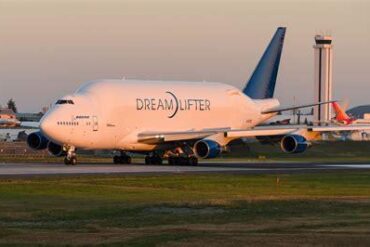
Traditional cargo aircraft were never designed to carry airplane parts that are, quite literally, airplane-sized. Sea freight was too slow. Disassembly would have destroyed the efficiency gains of the 787’s modular production system. Boeing needed a flying cavern with intercontinental range. The result was one of the most unusual widebody aircraft ever created: the Boeing Dreamlifter, a heavily modified 747-400 with an enormous bulbous fuselage and an unmistakable swinging tail door.
Understanding why Boeing chose that tail-door configuration requires looking beyond aesthetics and into aerodynamics, structural engineering, and the ruthless math of production timelines.
The Global Manufacturing Gamble Behind The 787
The 787 was not merely a new airplane. It was a new industrial experiment. Boeing shifted from centralized manufacturing toward a globally distributed supply chain. Instead of shipping small parts for final assembly in Everett, Washington, suppliers would build large, integrated structures. Entire fuselage sections would arrive pre-wired and largely complete. Wings would arrive assembled, not as ribs and skins.
That strategy reduced final assembly time dramatically. But it created a logistics nightmare. These components were too large for any conventional cargo aircraft. Even the Boeing 747-400 Freighter, the workhorse of global freight, lacked the internal clearance to handle full 787 wing sections or large fuselage barrels intact.
Shipping by sea would have added weeks to the production cycle. In aerospace manufacturing, weeks are not minor inconveniences. They are schedule risks, cash flow disruptions, and cascading delays that can cost billions. Boeing needed speed, reliability, and repeatability. The only viable solution was to create an aircraft purpose-built for oversized air transport.
What Exactly Is The Boeing Dreamlifter?
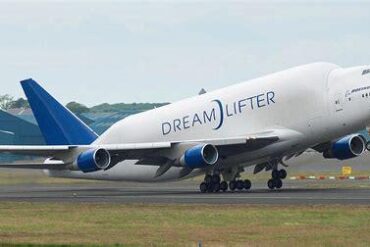
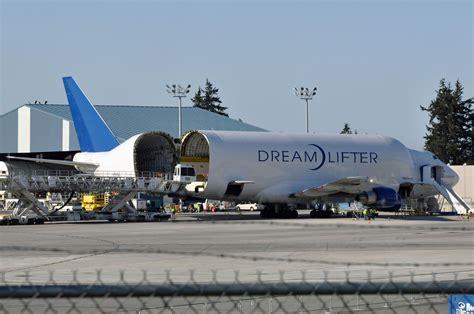
The Boeing Dreamlifter, officially known as the 747 Large Cargo Freighter (LCF), is a modified Boeing 747-400 engineered exclusively to transport 787 components. Only four exist in the world. Each began life as a passenger 747-400 before undergoing extensive structural transformation.
The aircraft’s most visible feature is its dramatically enlarged upper fuselage. A massive cylindrical extension was added above the original 747 structure, creating a cavernous cargo hold with over 65,000 cubic feet (1,840 cubic meters) of volume—roughly three times that of a standard 747-400 freighter.
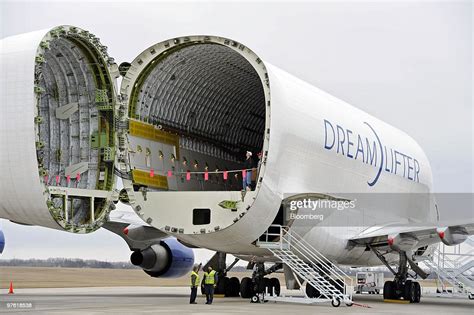
This bulging fuselage altered the aircraft’s aerodynamics significantly. The airflow around the expanded upper body introduced new structural challenges. The original 747 winglets were removed due to flutter concerns—flutter being an aeroelastic instability where aerodynamic forces and structural flexibility interact in potentially destructive ways. To maintain directional stability, engineers enlarged the vertical stabilizer. Every change reflected a delicate balance between cargo capacity and safe flight characteristics.
The Dreamlifter has a range of approximately 4,200 nautical miles, more than sufficient for its mission routes linking facilities such as Nagoya, Charleston, Wichita, Toronto, and Everett. It is not a commercial freighter available for general cargo. It is a dedicated logistical artery in Boeing’s production ecosystem.
Why Existing Cargo Doors Were Not Enough
The standard 747 freighter uses a nose door that swings upward, allowing cargo to be loaded from the front. For most freight, this works beautifully. Pallets, containers, vehicles—no problem.
But 787 wings and fuselage barrels are not “cargo” in the usual sense. They are massive, rigid structures with awkward geometry. The nose door of a 747-400 freighter simply did not provide enough clearance in width and height. The problem was not just volume. It was the shape of the opening.
Engineers evaluated alternative concepts. Large side cargo doors were considered. Roof openings were studied. Each idea introduced structural penalties. Cutting enormous openings into the fuselage compromises its strength, increases weight due to reinforcement, and complicates pressurization and certification. Aircraft fuselages are essentially pressurized tubes. Cutting giant holes into that tube is not something done casually.
The Dreamlifter’s already modified upper fuselage added further constraints. The loading system had to preserve structural integrity while maximizing usable opening dimensions.
The Engineering Logic Of The Swinging Tail Door
The solution Boeing adopted was bold and surprisingly elegant: a hinged, swinging tail door that opens sideways. Instead of lifting upward like some military transports, the Dreamlifter’s aft fuselage pivots open, creating an enormous rear cargo entrance.
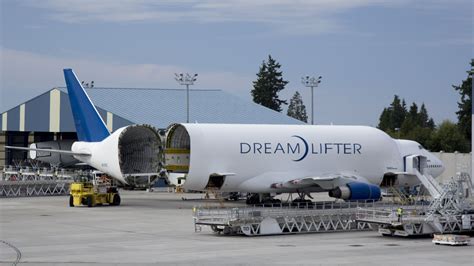
This configuration provided several decisive advantages.
First, it maximized usable opening size. By opening the entire rear section, Boeing achieved a cargo aperture wide and tall enough to accommodate complete 787 fuselage sections without disassembly.
Second, it simplified loading procedures. Oversized components are mounted on specialized transport fixtures and rolled directly into the aircraft. No cranes hoisting wings vertically. No delicate rotations mid-air. Just controlled, horizontal movement into a cavernous hold. Reduced handling means reduced risk.
Third, reinforcing the tail structure proved more structurally manageable than carving out massive side openings. The hinge and locking mechanisms required robust engineering, but the overall fuselage strength could be preserved more effectively than alternative designs would have allowed.
There was a trade-off. The tail section now houses the door mechanism and reinforcement structures. The aircraft does not carry a conventional auxiliary power unit (APU) in the tail. Instead, it relies on ground-based remote start equipment for engine starts. The Dreamlifter sacrifices a degree of operational independence for its singular mission. This is not an airplane designed for flexibility. It is designed for precision logistics.
Structural Modifications Beyond The Door
The swinging tail door is the most dramatic feature, but it is only one piece of a larger engineering transformation.
The fuselage extension altered the aircraft’s center of gravity and aerodynamic profile. Engineers had to recalibrate weight distribution carefully. The vertical stabilizer was enlarged to ensure sufficient directional stability, especially given the increased side area of the upper fuselage.
The removal of winglets may seem minor, but it reveals how sensitive large aircraft are to airflow changes. The altered wake patterns around the expanded fuselage increased flutter risk. Removing the winglets mitigated that risk and preserved structural margins.
These modifications highlight a key reality: the Dreamlifter is not a cosmetic redesign. It is a deeply re-engineered airframe that leverages the proven 747 platform while bending it—almost literally—to serve an entirely different purpose.
Why Not Build A Brand-New Aircraft?
Developing an all-new outsized cargo aircraft would have been astronomically expensive and time-consuming. Certification of a new widebody platform can take years and billions of dollars. Boeing needed a solution aligned with the 787 production schedule.
The 747-400 was a known quantity. Its flight characteristics, systems architecture, and maintenance infrastructure were well understood. By modifying existing airframes, Boeing accelerated development while containing costs.
Only four Dreamlifters were required. The mission profile is narrow and predictable. A clean-sheet design would have been industrial overkill. Instead, Boeing executed a targeted adaptation of an existing giant, creating a logistical specialist rather than a generalist.
Who Operates The Dreamlifter?
Although Boeing owns the aircraft, they are operated by Atlas Air, one of the world’s leading widebody cargo operators. Atlas provides crews, maintenance, and operational management under contract.
In the program’s early years, Evergreen International Airlines played a pivotal role, performing the complex structural conversions and initially operating the aircraft. The transition to Atlas Air brought large-scale 747 operational expertise to the Dreamlifter’s tightly scheduled routes.
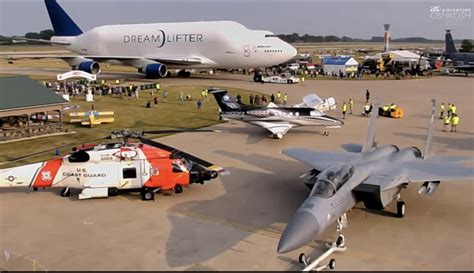
This partnership allows Boeing to focus on manufacturing while relying on a specialized cargo carrier to maintain reliability across global routes. The Dreamlifter does not chase freight contracts. It flies where the 787 supply chain demands, when it demands.
Airbus Beluga: A Different Answer To The Same Problem
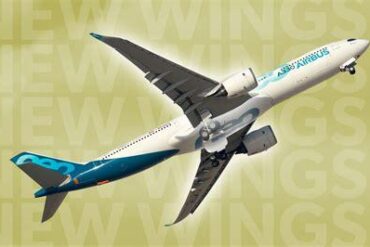
Airbus faced a similar challenge: transporting oversized aircraft components between European production sites. Its answer was the Airbus Beluga and later the BelugaXL.
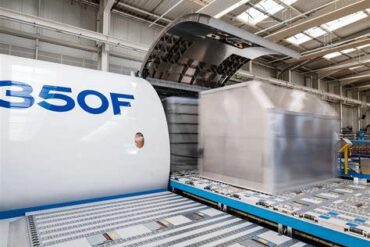
Unlike the Dreamlifter’s rear-loading approach, the Beluga is front-loaded. Airbus lowered the cockpit position so the nose can swing open without disturbing flight deck systems. The BelugaXL can carry two A350 wings simultaneously, improving logistical efficiency within Airbus’s network.
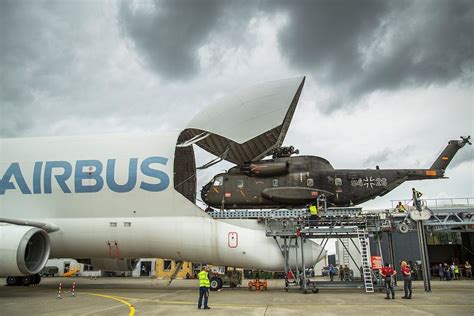
Both aircraft share a bulbous fuselage designed for internal volume. But the loading philosophies differ. Boeing’s swinging tail door reflects the geometry of 787 components and the constraints of modifying the 747. Airbus designed its solution around its own production architecture and a different base airframe.
The existence of both aircraft underscores a broader truth: modern aircraft manufacturing depends on air transport of outsized structures. Without these airborne giants, globalized aerospace production would slow dramatically.
The Swinging Tail Door As A Symbol Of Industrial Evolution
The Dreamlifter’s swinging tail door is not a gimmick. It is the physical embodiment of a manufacturing revolution. It represents the moment aerospace production became truly planetary.
In earlier decades, aircraft were built largely in one place. Today, a widebody jet is an international collaboration measured in thousands of miles. The Dreamlifter compresses geography. It turns oceans into manageable gaps in a production schedule.
Every time the tail swings open, it reveals not just a cargo bay but a philosophy: build big, build globally, move fast.
The design choice was driven by geometry, structural physics, and economic necessity. The tail door maximized opening dimensions, preserved fuselage strength, reduced handling risk, and aligned with the 787’s modular construction strategy. It solved a very specific problem with surgical precision.
And that is the quiet genius of the Dreamlifter. It does not carry mail. It does not carry consumer goods. It carries the future of widebody aviation in pieces large enough to look like aircraft themselves.
In an industry where minutes matter and millimeters matter even more, the swinging tail door was not merely an option. It was the logical endpoint of engineering constrained by physics and liberated by imagination.