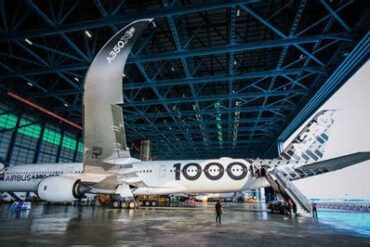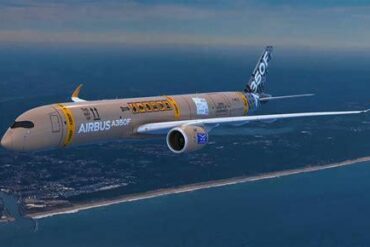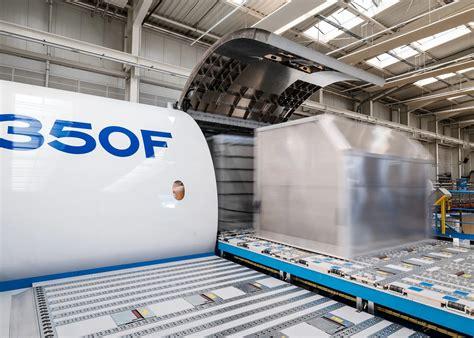
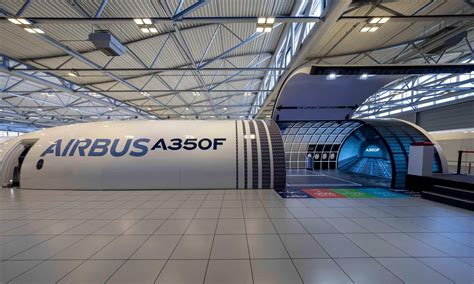
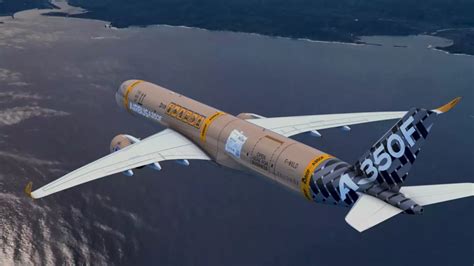
The Airbus A350F represents far more than another next-generation freighter entering the global cargo market. While its carbon-fiber structure, fuel efficiency, and modern flight deck have attracted considerable attention, one feature has emerged as the aircraft’s defining competitive advantage: its enormous main deck cargo door. Measuring 14 feet 9 inches (4.5 meters) wide and 14 feet 1 inch (4.3 meters) tall, the opening is larger than the fuselage diameter of many regional jets and even exceeds the effective loading width of the legendary Boeing 747 Freighter’s nose door.
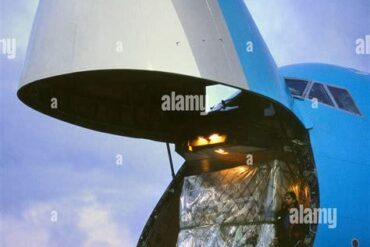
For decades, the Boeing 747’s hinged nose established the benchmark for transporting oversized cargo. Entire logistics networks, aircraft engine manufacturers, freight operators, and airport cargo facilities were built around its unique capability. The A350F challenges that long-standing monopoly not by copying the nose-loading concept, but by replacing it with an exceptionally wide side-loading solution capable of handling many of the same oversized shipments with greater efficiency.
Instead of requiring the entire aircraft nose to swing open through a complex hydraulic mechanism, the A350F simply opens an enormous side cargo door within seconds. That seemingly simple engineering decision dramatically reduces loading complexity while preserving the capability operators have depended on for over half a century.
A Cargo Door That Changes the Rules
Throughout modern commercial aviation, cargo doors have generally followed similar dimensional limitations dictated by fuselage structure. Even highly capable freighters such as the Boeing 777F feature side cargo doors considerably narrower than the cargo itself often demands.
The Airbus A350F breaks that convention.
Its main deck cargo opening spans nearly 208 square feet (19.35 square meters), making it one of the largest side cargo doors ever installed on a commercial aircraft. More remarkably, its opening exceeds the external fuselage width of several regional aircraft.
To appreciate the scale, consider that the Embraer E175 has an exterior fuselage width of roughly 3.3 meters (10 feet 9.6 inches). The Bombardier CRJ900 measures approximately 2.7 meters (about 10 feet) across. The A350F’s cargo door alone is wider than either aircraft’s fuselage.
That comparison is not simply a fascinating statistic—it illustrates how dramatically Airbus has expanded the physical envelope available to cargo operators.
Instead of treating oversized cargo as an exception requiring specialized aircraft, Airbus designed the A350F so those shipments become routine.
Why the Boeing 747 Nose Door Became Legendary
For more than fifty years, no aircraft could challenge the Boeing 747 Freighter’s nose-loading capability.
When Boeing introduced the 747-200F in the early 1970s, engineers developed the upward-hinged nose primarily because exceptionally large cargo could not negotiate conventional side doors. The solution created a straight loading path extending directly into the aircraft’s main deck.
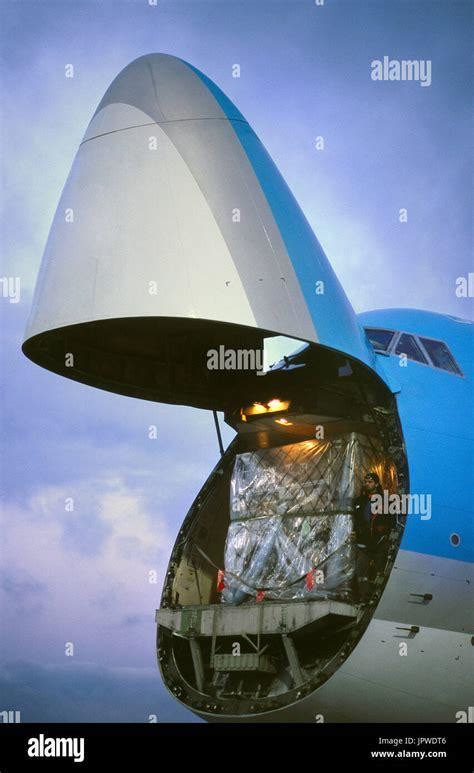
The design transformed global logistics.
Entire industries relied on the 747 to transport aircraft engines, industrial generators, oil and gas equipment, satellites, helicopters, military hardware, and countless oversized components that simply would not fit through standard cargo doors.
Cargo operators invested billions in infrastructure tailored specifically to nose-loading aircraft. Ground crews became experts in positioning unusual freight, while manufacturers engineered transport cradles around the 747’s unique loading geometry.
For decades, no competing aircraft offered a practical alternative.
Airbus Focused on the World’s Most Valuable Cargo
Rather than designing a giant cargo door simply to achieve a marketing headline, Airbus started with one of aviation’s most demanding logistical challenges: transporting complete commercial turbofan engines.
Modern engines such as the GE9X, Rolls-Royce Trent XWB, and similar powerplants represent some of the most valuable freight routinely transported by air.
Each engine can weigh between 6.8 and 9 metric tonnes, while the fan diameter approaches 4.3 meters.
These engines require rapid transportation for deliveries, scheduled overhauls, lease returns, and unexpected aircraft-on-ground situations.
Every hour spent moving an engine affects airline operations, maintenance schedules, and revenue generation.
Traditional side-door freighters often require lengthy maneuvering to rotate these massive engines into alignment before loading can begin.
With the A350F, Airbus largely eliminates this bottleneck.
Saving Nearly an Hour on Every Engine Shipment
The operational advantage becomes immediately obvious during engine loading.
Existing widebody freighters frequently require careful repositioning of the engine transport frame. Specialized loading equipment slowly rotates the engine through multiple angles before it finally clears the cargo opening.
This painstaking process typically consumes close to one hour.
The A350F’s enormous opening allows the engine to enter almost exactly as it arrives on the transport vehicle.
Minimal repositioning is required.
Minimal rotation is necessary.
Ground crews complete the operation in minutes rather than nearly an hour.
While a time saving of approximately fifty-five minutes may appear modest, multiplied across dozens of weekly engine movements over years of operation, the reduction translates into substantial labor savings, lower airport handling costs, faster aircraft turnaround, and improved fleet utilization.
Rear Door Placement Was a Carefully Calculated Decision
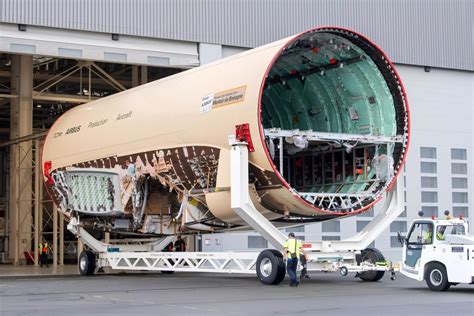
One of the A350F’s most distinctive design choices is the location of its oversized cargo door.
Instead of positioning it near the aircraft’s nose, Airbus installed the opening in the rear fuselage.
This location helps maintain proper aircraft balance during loading.
Loading several tonnes of freight near the nose could temporarily shift the center of gravity forward, complicating ground handling and potentially requiring additional balancing procedures.
An aft-mounted loading position distributes weight more naturally as cargo progresses through the aircraft.
It also simplifies cargo floor design, allowing containers and oversized freight to move efficiently along the aircraft’s loading system.
The door’s location demonstrates that Airbus optimized not only cargo size but also the entire loading sequence.
Building One of Aviation’s Largest Composite Aircraft Doors
Constructing a cargo door of this magnitude presents enormous engineering challenges.
Unlike a warehouse door, an aircraft cargo door must endure repeated pressurization cycles, substantial structural loads, aerodynamic forces, and thousands of flights while maintaining a flawless pressure seal.
Any structural weakness could compromise aircraft integrity.
To overcome these challenges, Airbus manufactures the A350F door using advanced carbon-fiber reinforced composite materials, matching the broader A350 family’s highly composite airframe.
The door itself contains more than 500 individual components, including structural frames, reinforcing members, attachment fittings, seals, hinges, locking mechanisms, and electrical actuation hardware.
Despite its immense size, engineers sought to minimize weight while maximizing rigidity.
Composite construction enables precisely that balance.
Electrification Reduces Complexity
Another important innovation lies within the opening mechanism itself.
Older cargo aircraft frequently depend upon hydraulic systems to actuate massive cargo doors.
Hydraulic equipment performs well but introduces additional plumbing, fluid reservoirs, maintenance requirements, and potential leak points.
The A350F instead adopts an electrically powered cargo door actuation system.
Electric actuators reduce maintenance complexity while fitting Airbus’ broader ‘more-electric aircraft’ philosophy already employed throughout the A350 family.
Before installation on the first flight-test aircraft, Airbus validated the complete system using dedicated integration benches specifically designed to simulate cargo door operation under real-world conditions.
This extensive ground testing minimizes certification risk while identifying potential issues before flight testing begins.
Extensive Ground Testing Before First Flight
Certification programs increasingly emphasize exhaustive ground validation before aircraft ever leave the runway.
The A350F reflects this modern philosophy.
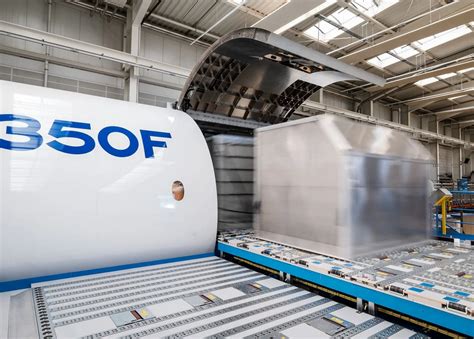
Airbus developed dedicated test facilities capable of replicating the cargo hold, cargo floor system, loading equipment, and cargo door operation.
Known internally as Cargo Zero, these facilities allow engineers to repeatedly test oversized freight loading, verify system reliability, refine operational procedures, and identify potential improvements long before certification flights commence.
Such investments significantly reduce program risk while accelerating the overall certification campaign.
Replacing an Aging Boeing 747 Fleet
Perhaps the A350F’s greatest commercial opportunity stems from demographics rather than technology.
Hundreds of Boeing 747 freighters remain in service worldwide, yet many approach retirement during the coming decade.
Production of the Boeing 747 has already concluded, meaning airlines can no longer purchase newly manufactured aircraft.
Operators therefore face a critical fleet renewal decision.
Historically, replacing a 747 often required sacrificing nose-loading capability.
The A350F changes that equation.
Its enormous side cargo door enables operators to continue transporting many oversized shipments previously associated almost exclusively with the 747.
For logistics providers whose business depends upon moving aircraft engines, industrial machinery, and unusually large freight, this capability substantially reduces the operational compromises typically associated with fleet replacement.
Fuel Efficiency Strengthens the Business Case
The A350F combines its cargo capability with significantly improved operating economics.
Designed to carry approximately 111 tonnes of payload over 8,700 kilometers, the aircraft offers long-range performance while reducing fuel consumption and carbon emissions by as much as 20 percent compared with older-generation freighters.
Those improvements become increasingly valuable as fuel prices fluctuate and environmental regulations tighten worldwide.
The aircraft already complies with upcoming international emissions standards, allowing operators to future-proof fleet investments for decades.
Meanwhile, airlines already operating passenger A350 fleets benefit from substantial commonality in pilot training, maintenance procedures, spare parts inventories, and engine support infrastructure.
Strong Customer Confidence
The commercial market has responded positively.
Major cargo operators, leasing companies, and international airlines have collectively placed more than one hundred firm orders, representing customers across Asia, Europe, the Middle East, and North America.
These commitments demonstrate confidence not only in the aircraft’s performance but also in its long-term role as the successor to today’s large freighter fleets.
Large orders from operators experienced in oversized cargo transportation suggest that Airbus successfully identified one of the market’s most valuable unmet needs.
Rather than simply building another efficient cargo aircraft, Airbus developed a platform capable of preserving capabilities previously thought inseparable from the Boeing 747.
Competition With the Boeing 777-8F
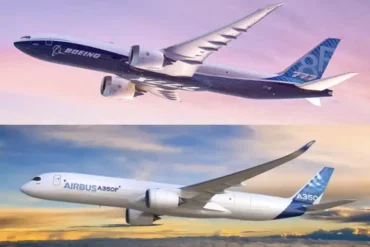
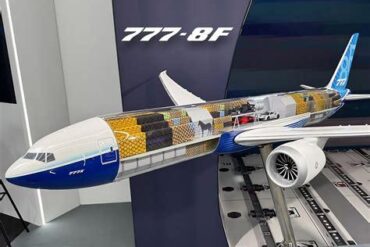
The Boeing 777-8F remains the A350F’s primary rival in the next-generation large freighter market.
Both aircraft promise similar payload capacity, long range, and advanced fuel efficiency.
However, their cargo access philosophies differ considerably.
While Boeing emphasizes payload performance and fleet continuity, Airbus places exceptional emphasis on oversized cargo accessibility.
The A350F’s substantially larger cargo door enables freight missions that smaller side openings cannot easily accommodate.
That distinction may prove decisive for operators specializing in engine logistics and heavy industrial cargo.
Rather than competing solely on payload figures, Airbus has differentiated its aircraft through operational flexibility.
A New Standard for Oversized Air Cargo
The Airbus A350F’s giant cargo door symbolizes a broader transformation taking place within global air freight.
As aging Boeing 747 freighters gradually leave service, the industry requires an aircraft capable of handling the same complex cargo while delivering dramatically improved fuel efficiency, lower emissions, and reduced operating costs.
Instead of recreating the iconic hinged nose, Airbus engineered an entirely different solution. By making the world’s largest commercial side cargo door larger than many regional aircraft fuselages, the company has preserved one of aviation’s most valuable logistical capabilities while simplifying ground operations.
Ultimately, the significance of the A350F is not measured solely in meters or square feet. It lies in how intelligently those dimensions translate into faster loading, lower operating costs, greater flexibility, and a practical replacement for one of the most iconic cargo aircraft ever built. If the Boeing 747 defined the first half-century of oversized commercial freight, the Airbus A350F appears well positioned to define the next.