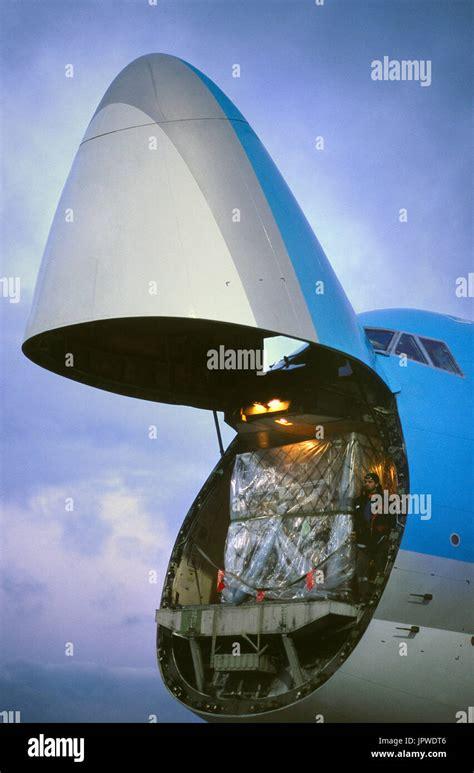
The Boeing 747 freighter looks like no other cargo aircraft ever built, and that is not an accident of styling or nostalgia. The hinged nose door is not a gimmick, not a visual quirk, and certainly not an indulgence. It is the physical expression of a brutally practical idea: if you want to move things the rest of aviation cannot, you must design an airplane that breaks the rules everyone else quietly accepts.
When Boeing conceived the original 747, the company already suspected that supersonic passenger travel might one day make large subsonic airliners obsolete. That fear shaped the aircraft from day one. The 747 was designed not just as a people-mover, but as a future freighter. The raised cockpit and partial upper deck were not aesthetic choices. They were structural chess moves, clearing the entire front of the fuselage so cargo could one day be driven straight inside.
This foresight would turn the 747 into the most adaptable heavy-lift aircraft in civil aviation history. The nose door became the key that unlocked cargo missions no side-loading airplane could perform efficiently, or sometimes at all. In an industry where minutes on the ground cost thousands of dollars and millimeters decide feasibility, loading through the nose changed everything.
Long before cargo airlines embraced the 747 as their flagship, engineers were already solving a problem that did not yet exist at scale. They were designing for awkward, uncooperative freight: objects too long, too tall, or too rigid to be bent to the airplane’s will. The nose door is the visible answer to that invisible question.
The Structural Logic Behind the Raised Cockpit
The 747’s distinctive upper deck exists because Boeing needed to keep the flight deck out of the way of a future cargo opening. By lifting the cockpit above the main deck, engineers preserved a full circular fuselage cross-section from nose to tail. That uninterrupted tube is what makes straight-in loading possible, and it is something no conventional widebody with a front cockpit can replicate.
This decision had cascading effects. The fuselage nose could hinge upward without compromising the pressure vessel of the main deck. The load-bearing structure could be reinforced around the hinge line instead of cut through the middle of the aircraft. The result was a nose door strong enough to survive repeated pressurization cycles while still opening wide enough to swallow industrial-scale cargo.
The genius of the design is that it does not feel clever when you look at it. It feels obvious, almost inevitable. That is usually the sign of good engineering. The complexity is buried inside the structure, where sixteen locking latches, heavy-duty pins, and mechanical actuators work together to make the opening reliable, repeatable, and safe at altitude.
Why Side Cargo Doors Were Not Enough
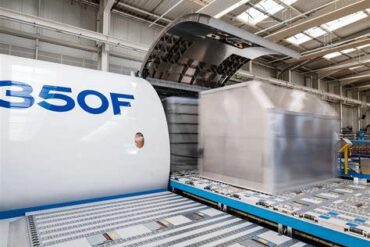
Most cargo aircraft rely on large side doors, and for many loads that works perfectly well. Pallets, containers, mail, and parcels are standardized to fit through rectangular openings. The problem appears when cargo refuses to be standardized. Helicopters, oil drilling equipment, aircraft engines, power plant components, and military vehicles do not politely conform to pallet dimensions.
Side doors impose hard limits on length and geometry. Even if an item technically fits, maneuvering it through a side opening can require awkward angles, multiple lifts, and wasted time. The 747 nose door eliminates that dance. Cargo can be rolled straight in, aligned perfectly, and secured without bending physics or patience.
This capability transforms the aircraft from a simple transporter into a logistical problem-solver. Airlines can accept cargo others must reject, and that translates directly into high-yield freight contracts. When the cargo is irreplaceable or urgently needed, customers pay for certainty, not elegance.
How Nose Loading Actually Works on the Ground
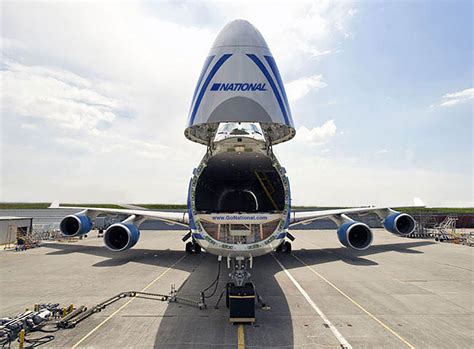
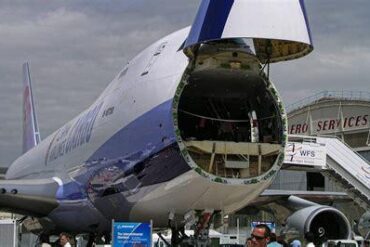
Opening the 747’s nose is not a dramatic flourish but a carefully choreographed mechanical process. A dedicated control panel monitors the status of all sixteen latches, each locked by steel pins designed to withstand enormous pressure differentials. Only when every system reports safe conditions does the nose lift upward on its hinges.
Once open, the aircraft effectively becomes a straight tunnel. Ground crews can roll cargo directly onto the main deck using specialized loaders. For extremely long items, pallets can be repositioned mid-load, something impossible with side doors. This flexibility is crucial when cargo extends across multiple pallet positions and must be aligned with structural load limits.
From an operational perspective, the nose door is used selectively. Ground handling teams always evaluate whether cargo can fit through the side door first. Nose loading is reserved for items that truly require it, preserving mechanical life and minimizing turnaround complexity. When it is needed, however, nothing else comes close.
The Economic Power of Oversized Cargo
Cargo airlines love the 747 not out of nostalgia, but because it prints money in niches others cannot touch. The ability to carry 120 tonnes in the 747-400F and up to 140 tonnes in the 747-8F is impressive on paper. The ability to carry cargo nobody else can move is what makes those numbers meaningful.
Oversized freight often travels under tight deadlines. Oil rigs cannot wait. Disaster relief equipment cannot be delayed. Aerospace components are scheduled to the minute. The 747’s nose door allows airlines to bid on contracts that smaller freighters must decline, creating a competitive moat that has lasted for decades.
This is one reason the 747 remains dominant in heavy cargo even as passenger versions vanish from the skies. The airplane does not compete on fuel burn alone. It competes on capability density, the ratio of what it can do versus what it costs to operate.
Why the 747-400F and 747-8F Still Matter
The 747-400F and 747-8F represent the peak of this philosophy. The -400F refined the platform with improved avionics, range, and payload efficiency. The -8F pushed it further with new engines, increased length, and a payload bump of nearly sixteen percent.
Despite being larger and heavier, the -8F burns roughly 17% less fuel than the -400F, a staggering achievement for an aircraft of its size. Both cruise comfortably at Mach 0.845, proving that speed and strength are not mutually exclusive.
Range differences between the two variants are marginal and heavily dependent on payload. In real-world operations, runway length and cargo density matter far more than published range figures. What matters most is that both aircraft retain the same nose-loading advantage that made the original concept unstoppable.
Converted Freighters and the Second Life of the 747
With production ended, cargo airlines now rely on passenger-to-freighter conversions to sustain their fleets. This works because the 747 was designed for this fate from birth. Structural provisions, floor strength, and fuselage geometry all lend themselves to conversion in a way few aircraft can match.
Converted freighters retain the nose door capability, allowing airlines to acquire powerful cargo aircraft at a fraction of the cost of factory-new builds. For operators with lower utilization rates, older airframes make economic sense. Acquisition costs drop, maintenance becomes predictable, and the revenue potential remains enormous.
Atlas Air, UPS Airlines, Cargolux, Kalitta Air, and Cathay Pacific continue to invest in the type because it solves problems their customers still have. Age matters less when the mission profile remains unmatched.
The Nose Door as a Symbol of Aviation Boldness
The 747 nose door is more than a mechanical feature. It is a symbol of an era when aircraft were designed with audacity. Boeing did not ask what was safe. It asked what was necessary. The result is an airplane that still dominates a sector half a century after its first flight.
Other manufacturers explored nose-loading concepts, but none combined scale, reliability, and global support the way the 747 did. The infrastructure, training, and operational knowledge built around the type created a self-reinforcing ecosystem that competitors never fully penetrated.
In a world increasingly obsessed with incremental efficiency, the 747 freighter stands as a reminder that sometimes the right answer is not smaller, lighter, or simpler. Sometimes the right answer is to open the front of the airplane and let reality roll straight in.
Why No Aircraft Has Truly Replaced It
Modern twin-engine freighters are marvels of efficiency, but they operate within narrower constraints. Their side doors and fuselage geometry limit the kind of cargo they can accept. They excel at volume and fuel economy, not at brute-force flexibility.
The 747 occupies a strange and powerful niche. It is not the cheapest aircraft to fly, but it is often the only aircraft that can do the job. As long as the world needs to move impossibly large objects across oceans quickly, that niche will exist.
When the last 747 eventually retires, it will not be because it failed. It will be because the world changed enough to no longer need what it uniquely offered. Until then, the nose door remains aviation’s most unapologetic answer to the problem of moving the unmoving.