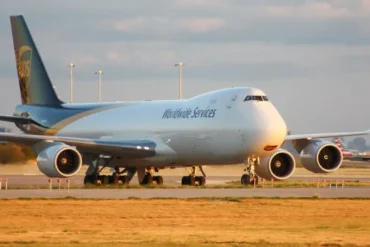
The Boeing 747-400F’s cargo hold feels less like a compartment and more like a moving warehouse, a cavernous interior designed to swallow the awkward, the oversized, and the economically essential. Long before global supply chains became a household topic, this aircraft was quietly shaping them, knitting continents together with steel, aluminum, and a carefully choreographed ballet of loaders, pallets, and precision engineering. The 747’s silhouette is iconic, but the story that matters to logistics professionals unfolds inside its fuselage, where volume, geometry, and access converge to create a machine built for the improbable.
This freighter variant sits at the intersection of ambition and pragmatism. The original 747 program was born in a moment of wild optimism about supersonic travel eclipsing conventional passenger jets, which pushed Boeing to design a jet that would remain economically relevant even if passengers moved on. That hedged bet produced an airplane whose bones favored freight from day one, and the 747-400F refined that idea into a peak expression of cargo-first design. The result is not just capacity in the abstract, but capacity that respects the real-world shapes of engines, turbines, satellites, industrial machinery, and relief supplies that refuse to fit neatly into boxes.
In practice, the cargo hold is a geometry lesson in service of commerce. The main deck stretches roughly the length of a city block, and the engineering choices that lower the ceiling in some sections and reshape sidewalls near the nose are not aesthetic flourishes but deliberate acts of volumetric chess. Each centimeter reclaimed is another crate loaded, another contract fulfilled, another route made profitable. The 747-400F doesn’t merely carry cargo; it negotiates with it, making room for the stubbornly tall and the inconveniently long.
The Geometry of Abundance Inside the Main Deck
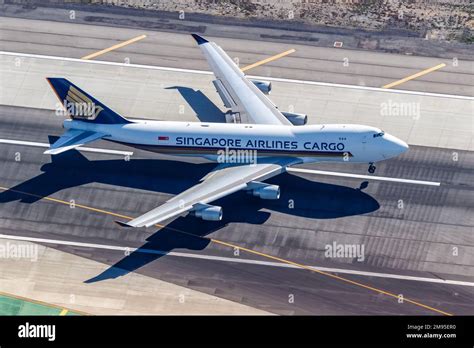
The main deck of the 747-400F is the star of the show, a long, rectilinear corridor engineered to accept standardized pallets while remaining forgiving to the misfits of global industry. With more than twenty-one thousand cubic feet devoted to the main deck alone, the space behaves like an architectural compromise between a hangar and a shipping terminal. Overhead rails and floor locks choreograph the movement of cargo into exact positions, turning a cavern into a precise grid where weight distribution is as important as raw volume.
What elevates this hold beyond sheer size is its willingness to host tall containers behind the upper deck. The redesign that allows ten-foot-high units in select positions is a small change with large consequences, opening the door to cargo that would otherwise demand special aircraft or fragmented shipments. Heavy machinery components, medical equipment enclosures, and preassembled industrial modules can travel intact, reducing handling steps and the hidden costs of disassembly and reassembly. This is where the 747-400F quietly wins battles against inefficiency, shaving hours and risk from complex logistics chains.
The length of the main deck also reshapes planning. Long items such as fuselage sections for smaller aircraft, wind turbine components, or even elongated vehicles can be aligned in ways that avoid contortions. The interior is not a blank tube; it is a negotiated space where loaders exploit every usable inch while respecting structural limits. The hold’s design tolerates this dance, absorbing the improvisations of cargo planners who must solve three-dimensional puzzles under the pressure of departure windows.
The Lower Deck and Bulk Hold: Precision in the Shadows
Beneath the main deck, the lower holds add another layer of logistical finesse. These spaces are less dramatic to the eye, yet they carry a disproportionate share of operational value. The lower deck compartments accommodate standardized containers that move seamlessly from trucks to aircraft, minimizing touchpoints that can damage sensitive goods. Pharmaceuticals, electronics, and high-value components often live here, sheltered from the bustle of the main deck while still benefiting from the aircraft’s immense payload capacity.
The bulk cargo area adds a final pocket of flexibility. This is where odd parcels, late additions, or irregular shipments find refuge when standardized containers run out of options. The presence of this space reflects a deep understanding of how freight actually behaves in the wild. Cargo is rarely polite. It arrives late, changes shape, or demands accommodation at the last moment. The 747-400F answers with a shrug and another cubic meter of tolerance.
Operationally, the lower holds complement the main deck by balancing weight and enabling mixed cargo profiles. Dense items can ride below while lighter, voluminous shipments occupy the upper levels, keeping the aircraft within structural and performance envelopes. This quiet interplay between decks is the difference between theoretical capacity and capacity that airlines can monetize across diverse routes and cargo mixes.
The Nose Door: Engineering a Straight Path for the Impossible
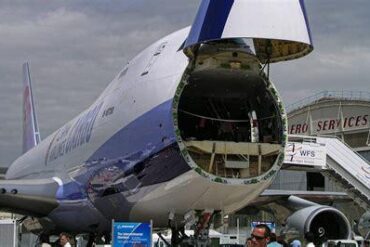
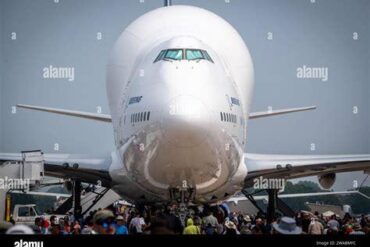
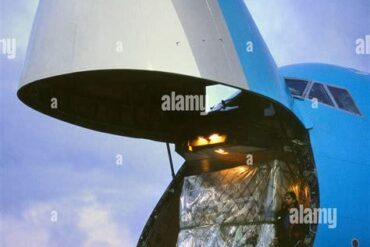
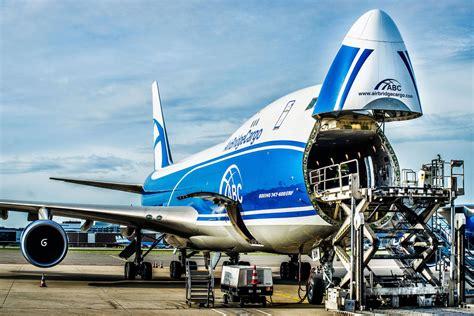
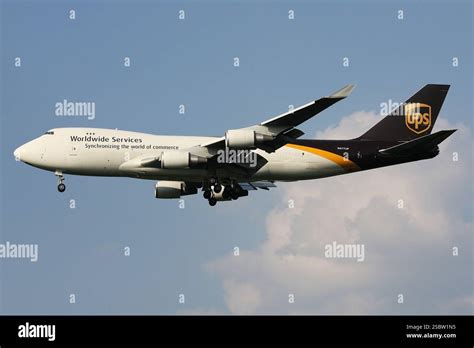
The hinged nose door is the 747-400F’s most theatrical feature, and for good reason. When the nose lifts, the aircraft transforms into a straight-through loading corridor, erasing the spatial bottleneck that plagues side-door-only freighters. This capability is not a novelty; it is a strategic advantage that turns the 747 into the default solution for outsize cargo when military transports are unavailable or inappropriate for commercial missions.
This straight-line access matters because many high-value industrial components are built as single units to preserve alignment and integrity. Power plant turbines, satellite buses, and specialized manufacturing tools resist disassembly. Sliding them into the aircraft nose-first reduces handling stress and risk, preserving tolerances that might be ruined by complex maneuvers through side doors. The 747-400F’s nose door democratizes outsize transport for commercial operators, bridging a gap that would otherwise require rarer, costlier aircraft.
The nose door also accelerates ground operations. Time on the tarmac is expensive, and the ability to roll cargo straight into position without elaborate rotations shortens turnaround windows. In a network where minutes cascade into missed connections, the geometry of the nose door becomes a quiet profit engine. This is logistics as ergonomics, where the aircraft’s anatomy respects the human choreography of loaders and ground crews.
Payload, Range, and the Economics of Reach
Capacity is seductive, but reach turns capacity into strategy. The 747-400F’s ability to haul heavy payloads across intercontinental distances reshapes route planning. Airlines can consolidate shipments that would otherwise require multiple legs or aircraft, simplifying networks and reducing cumulative handling risk. This matters most for time-sensitive freight, where every transfer introduces uncertainty.
The economics follow the physics. High payload combined with long range lowers the cost per ton-mile, making routes viable that would otherwise be marginal. This is why the 747-400F carved out a long reign as the workhorse of global express networks and heavy freight operators. It moves enough in one go to justify dedicated routes, and it moves far enough to keep those routes direct. The cargo hold, in this sense, is not just space but leverage, enabling network designs that compress geography.
The extended-range freighter variant nudges this logic further, trading even more performance for strategic flexibility. In practice, this allows operators to tailor fleets to specific corridors, choosing between raw payload and distance with a granularity that smaller freighters struggle to match. The cargo hold’s volume is the visible face of this capability; the invisible half is the performance envelope that makes that volume economically meaningful.
The Upper Deck: A Human Outpost Above the Freight
Above the cavern of cargo sits a small, purposeful habitat for the crew, a reminder that this flying warehouse is also a workplace. The relocated cockpit, originally conceived to clear the nose for loading, accidentally created a unique upper deck that evolved into a practical refuge on long-haul freight missions. Behind the flight deck, seats, a galley, and bunks turn endurance into routine. This matters because freight flights do not follow the circadian rhythms of passenger comfort; they chase demand across time zones, and crews need a functional space to reset.
The ladder that drops into the cargo hold is a subtle piece of engineering empathy. It acknowledges that crews must move between worlds, from the pressurized quiet of the upper deck to the industrial bustle below. By shifting the ladder toward the sidewall, designers reclaimed usable cargo space while improving the flow of human movement. This is the aircraft quietly negotiating between machines and people, optimizing both without fanfare.

Why the 747-400F Still Matters in a New-Freighter World
Newer freighters promise efficiency gains, quieter engines, and digital cockpits tuned for modern operations. Yet the 747-400F’s cargo hold continues to anchor real-world logistics because its geometry solves problems that efficiency alone cannot. The nose door remains a rare gift in commercial aviation, and the main deck’s tolerance for tall, awkward loads keeps the aircraft relevant for industries that ship things, not just boxes. Replacement programs chase similar payload and range numbers, but replicating the 747’s loading flexibility is harder than matching its performance charts.
There is also an ecosystem effect. Decades of infrastructure, from loading equipment to warehouse clearances, evolved around the 747’s dimensions. The cargo hold is embedded in a global choreography of pallets, dollies, and handling protocols. Replacing the aircraft means retraining people and retooling systems, costs that do not appear on spec sheets but loom large in operational reality. The 747-400F endures because it fits into this ecosystem like a well-worn key in a lock.
As fleets age, converted passenger aircraft join purpose-built freighters, swelling the population of 747-400Fs in cargo service. Even without the nose door, these conversions inherit much of the cargo hold’s volumetric generosity. They become the second life of an airframe, proof that the original design’s bias toward freight was not a historical curiosity but a durable truth about how this aircraft was meant to earn its keep.
The Cargo Hold as a Cultural Artifact of Globalization
The 747-400F’s cargo hold is more than a technical achievement; it is a cultural artifact of late twentieth-century globalization. Its dimensions mirror the scale of modern industry, where components are manufactured across continents and assembled in sprawling supply chains that depend on predictable, high-capacity transport. Inside this hold, one can read the story of how production fragmented geographically while remaining unified logistically.
Humanitarian missions add another layer to this story. The same space that carries turbines and engines also carries field hospitals, water purification systems, and relief vehicles. The ability to move bulky aid equipment intact accelerates response in crises where time is measured in lives. The cargo hold becomes a moral technology here, not because the aircraft intends goodness, but because its design choices enable rapid, practical help at scale.
There is a strange poetry in this duality. The hold is indifferent to what it carries, yet its shape quietly shapes outcomes. It smooths the rough edges of distance, making the improbable routine. In a world obsessed with speed and digital abstraction, the 747-400F reminds us that physical volume still rules the movement of matter, and that thoughtful engineering can bend the constraints of space without breaking them.
The Enduring Logic of a Flying Warehouse
The 747-400F’s cargo hold persists as a lesson in designing for messy reality. Engineers anticipated a future that never quite arrived, and in doing so they built a machine perfectly suited for the future that did. The aircraft’s interior is generous without being wasteful, precise without being brittle, and adaptable without losing structural integrity. That balance is rare in large systems, where optimization often creates fragility.
As newer freighters enter service, the 747-400F stands as a benchmark not just for capacity but for usability. The straight-line loading of the nose door, the tall-container positions on the main deck, and the quiet utility of the lower holds form a toolkit for solving logistical puzzles that refuse to be simplified. The cargo hold is where the aircraft’s legend becomes tangible, a space where the abstractions of global trade are converted into steel-on-roller reality.
This is why the 747-400F’s interior continues to feel improbable even to seasoned professionals. It is a place where scale and subtlety coexist, where the choreography of ground crews meets the patience of structural engineering, and where the world’s most awkward cargo finds a temporary home in the belly of a flying giant.