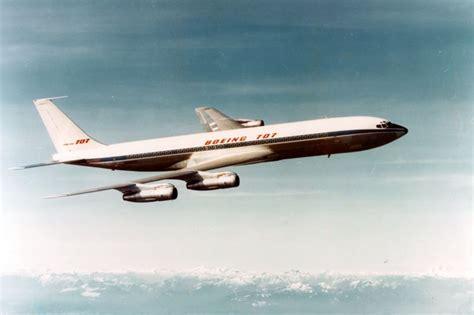
The Boeing 707 stands as a defining achievement in the history of aviation—a machine that not only revolutionized air travel but fundamentally altered the commercial and cultural landscape of the modern world. More than a jetliner, it was the gateway into the Jet Age, where intercontinental travel became faster, smoother, and significantly more accessible. With a sleek silhouette, thunderous engines, and pioneering performance, the Boeing 707 became the symbol of mid-20th century innovation in the skies.
The Birth of the Jet Age
When the Boeing 707 entered commercial service in 1958, it introduced something the world had never seen: a reliable, high-speed jet that could span oceans with ease. In contrast to the propeller-driven aircraft that dominated commercial fleets until the late 1950s, the 707 was a leap forward in speed, altitude, and passenger comfort.
Passengers who once endured turbulent, noisy flights aboard piston-powered airliners were now gliding at 35,000 feet, above most weather disturbances, in quieter cabins with significantly reduced travel times. Journeys that took 12 to 15 hours could now be completed in under 8. This shift wasn’t merely technological—it was experiential. The modern traveler had arrived.
Airlines that adopted the 707 swiftly redesigned their networks. Long-haul flights now became more economically viable and operationally practical, opening new city pairs and stimulating global tourism, business exchanges, and international cooperation.
From Propellers to Jets: Evolution of the Airliner
The Boeing 707 didn’t just replace a single aircraft; it marked the end of an era. Before its debut, transcontinental and transoceanic routes were serviced by piston-engine legends like the Douglas DC-6 and DC-7, or Boeing’s own 377 Stratocruiser. These aircraft were engineering marvels for their time, but they operated with limitations—low cruising altitudes, reduced range, slower speeds, and high maintenance needs.
While the Lockheed Constellation series improved the standards of long-distance comfort and elegance, even they could not match the range and economy of scale offered by jets. The 707 wasn’t merely a replacement—it was an evolution. It absorbed the lessons of these predecessors and delivered a product that outclassed them in every measurable way.
Pan Am and the Dawn of Jetliner Prestige
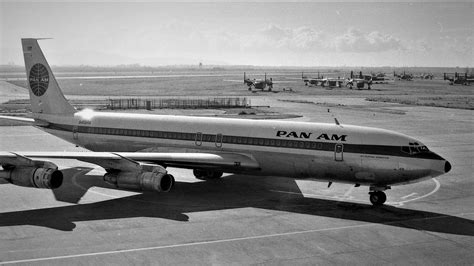
The first airline to seize this breakthrough was Pan American World Airways, which ordered the Boeing 707 in October 1955. It wasn’t a small bet—it was a declaration. On October 26, 1958, Pan Am made history with the inaugural transatlantic 707 flight from New York to Paris.
Carrying 111 passengers and 11 crew, that flight marked the beginning of the Jet Age in commercial service. The aircraft was a sensation, offering a level of speed and sophistication that captured public imagination. Pan Am, along with TWA and American Airlines, would go on to build massive fleets of 707s, reshaping their global strategies.
Other carriers—including Continental, Braniff, Northwest, and BOAC in the UK—followed suit. Soon, the jet had gone global, with orders pouring in from Air France, El Al, Air India, and Pakistan International Airlines. From Europe to Asia and across the Americas, the 707 quickly became the standard-bearer of modern aviation.
Engineering Innovation: The 707 Variants
Boeing engineered multiple variants of the 707 to meet the evolving needs of commercial airlines. Each version represented a refinement in performance, capacity, or operational flexibility.
The 707-120 was the original model that introduced jet travel to the world. It typically seated up to 189 passengers in a high-density layout and served as the platform for future development.
Next came the 707-320, the intercontinental version with a longer fuselage and extended wings, which significantly increased fuel capacity and range. This model enabled airlines to operate nonstop services on transoceanic routes with high reliability.
The most commercially successful variant was the 707-320C—a convertible version capable of transporting either passengers or cargo. Its versatility made it a staple for both airlines and governments.
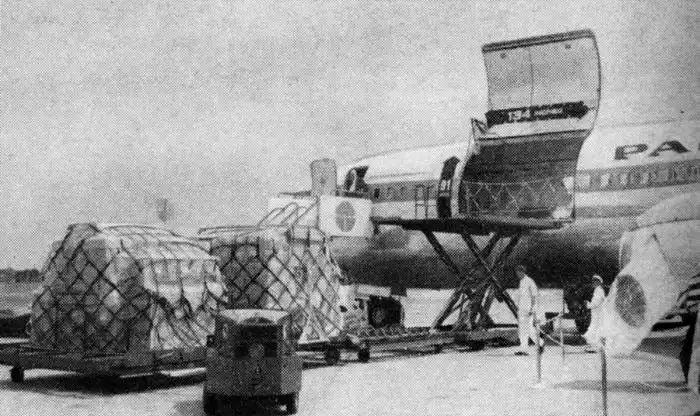
European operators, in particular, were drawn to the 707-420, powered by Rolls-Royce Conway engines. The model retained the strengths of the -320 while adapting to engine preferences and noise regulations outside the U.S.
The Boeing 707’s Safety Record: A Dual Legacy
As with many pioneering aircraft, the Boeing 707’s service record includes both triumph and tragedy. Over its operational lifetime, the type experienced 174 hull-loss accidents and 89 other incidents, culminating in over 3,000 fatalities.
While these numbers reflect the growing pains of early jet operations, they also tell a story of learning, adaptation, and progress. For instance, the first 707 accident occurred during an American Airlines training flight in August 1959, highlighting the steep learning curve in handling jet-powered aircraft.
The worst disaster involving the 707 happened on August 3, 1975, when a Royal Air Maroc charter flight tragically crashed near Agadir, Morocco. All 188 on board were killed, underlining the challenges of terrain navigation and communication in that era.
Each incident, though tragic, contributed to improved safety protocols, pilot training, and aircraft systems that continue to shape commercial aviation.
The Military Workhorse: 707’s Second Life
While the Boeing 707 has all but disappeared from commercial passenger service, its military derivatives remain essential to this day. Perhaps the most prominent is the KC-135 Stratotanker, which still serves as the backbone of the United States Air Force’s aerial refueling fleet.
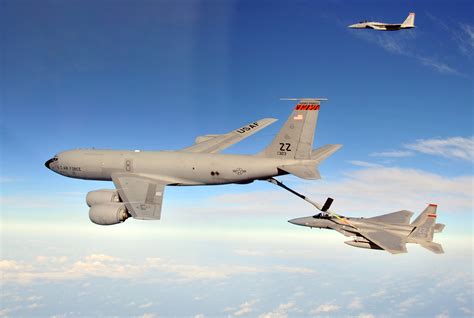
Introduced in 1957, the KC-135 shares the 707’s airframe and has undergone continuous upgrades. Today, over 376 KC-135s remain in active duty, highlighting the durability and flexibility of the original design.
Other critical military adaptations include:
- RC-135 Rivet Joint: A signal intelligence aircraft used by the U.S. and NATO allies.
- E-3 Sentry (AWACS): A mobile air traffic control and battlefield management system with its iconic rotating radar dome.
- VC-137C (Air Force One): The presidential aircraft used during the Kennedy through Reagan administrations.
These aircraft continue to carry out critical global missions, long after their commercial counterparts have been retired.
A Catalyst for Global Connectivity
The Boeing 707 ushered in an era where cities previously separated by days of travel were now just hours apart. The combination of range, speed, and passenger capacity meant that airlines could connect far-flung regions without multiple stops or complex routing.
This new network of global routes catalyzed economic globalization, tourism expansion, and cultural exchange. Major urban centers—London, New York, Tokyo, and others—saw increases in international visitors, while smaller airports began receiving flights from across continents.
Equally important was the cultural transformation. The glamour of jet travel in the 1960s, symbolized by the Boeing 707, helped embed flying into the public imagination as both a necessity and a luxury. Air travel was no longer just for the wealthy; the 707 democratized the sky.
Boeing’s Path to Industry Dominance
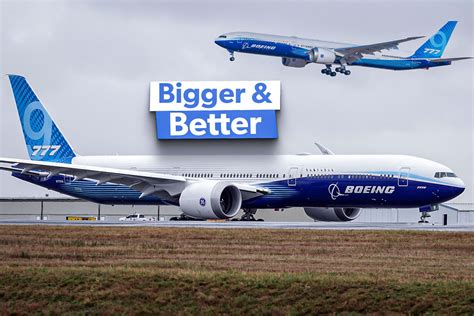
The 707’s success gave Boeing a strategic and psychological edge over its competitors. It proved the company’s ability to design, manufacture, and support large-scale jetliner programs. This confidence led directly to the development of legendary aircraft like the 727, 737, 747, and 777.
Each of these aircraft built on the foundation laid by the 707—its aerodynamics, systems architecture, and production methodology. Even today, echoes of the 707 can be found in Boeing’s product line and corporate DNA.
A Legacy Carved in the Skies
Though the Boeing 707 is no longer a common sight in commercial aviation, its legacy is everywhere. It’s in the comfort of modern cabins, in the flight networks that define our world, and in the very notion of global interconnectedness.
More than just a machine, the 707 was a moment in time—a flash of boldness and brilliance that showed humanity just how small the world could be.