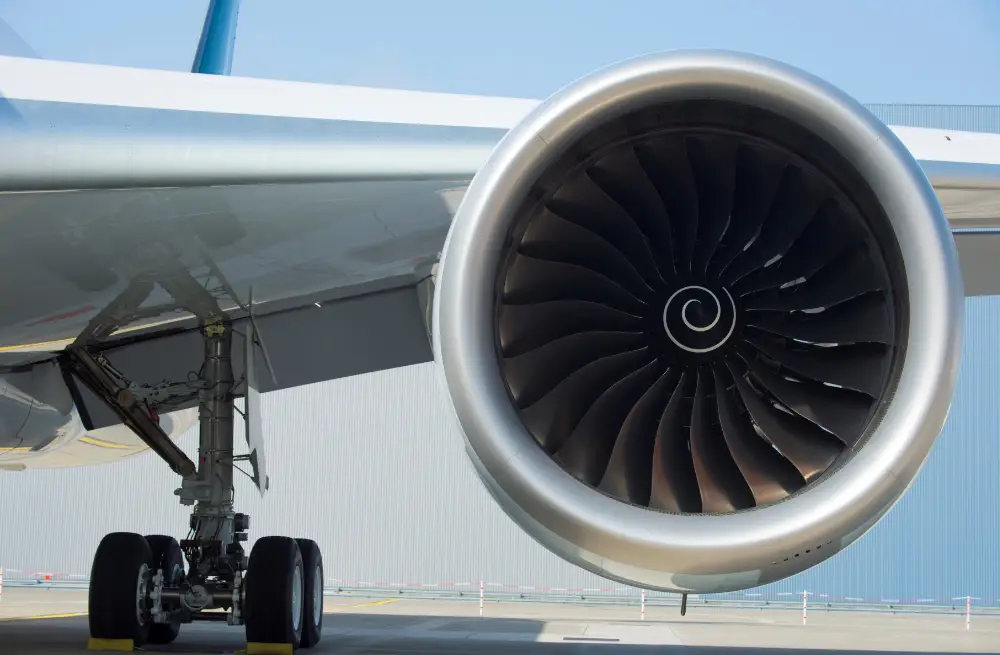
In the world of commercial aviation, few innovations have reshaped the skies as fundamentally as the aircraft engine. From the noisy, oil-spewing radial engines of the 1920s to the high-bypass turbofans of today—and now on to the promising horizon of open-fan and hybrid-electric propulsion—each leap in engine design has brought with it transformative shifts in range, safety, economics, and sustainability. The following are the seven most revolutionary commercial aircraft engines that altered the very DNA of air travel.
Wright J-4/J-5 “Whirlwind” – Birth of Reliable Flight
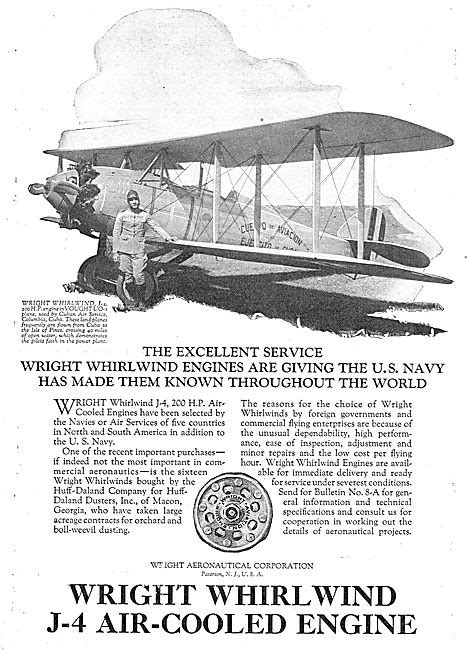
When aviation was still in its infancy, engine reliability was the single greatest hurdle for commercial air travel. The Wright Whirlwind family, particularly the J-5 variant, brought a fundamental shift. Introduced in the 1920s by Wright Aeronautical, these air-cooled radial engines were the first to achieve true operational reliability, opening the door to passenger aviation.
Unlike their water-cooled predecessors, which were prone to overheating and failure, the Whirlwind’s air-cooled design drastically improved endurance and safety. Charles Lindbergh famously selected the J-5 for his Spirit of St. Louis, relying on its dependability during the first solo nonstop transatlantic flight in 1927. Commercially, it powered pivotal aircraft such as the Ford Trimotor and Fokker F.VII, laying the groundwork for scheduled air service.
This engine wasn’t just a technological upgrade; it redefined what was possible, establishing trust in commercial flight at a time when public confidence was scarce.
Pratt & Whitney Wasp – Powering the Golden Age
If the Whirlwind opened the skies, the Pratt & Whitney Wasp series cemented aviation’s role in global connectivity. Emerging in the 1920s, these radial piston engines embodied engineering refinement and massive scalability. The R-1340 Wasp and especially the R-1830 Twin Wasp would go on to become among the most produced aircraft engines in history.
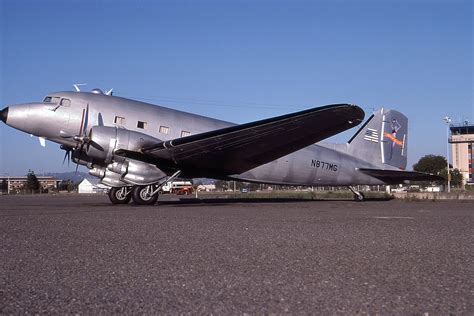
They reached their pinnacle with the legendary Douglas DC-3, which not only revolutionized air travel with transcontinental range and economical operation but also became a vital lifeline in WWII logistics. The Wasp engines offered exceptional performance in extreme conditions, from icy Arctic routes to humid tropical jungles. This mechanical resilience enabled airlines and militaries alike to operate across every corner of the globe.
The Wasp wasn’t just powerful—it was the foundation of mid-century air transport.
Rolls-Royce Dart – The Turboprop Pioneer
While jet propulsion was beginning to dominate headlines, the Rolls-Royce Dart quietly launched the next commercial revolution: the turboprop. First running in 1946 and entering service in 1948 aboard the Vickers Viscount, it enabled the world’s first turbine-powered commercial airline flight.
The Dart wasn’t just a new engine—it introduced a new category of commercial aviation. Turboprops, more efficient than piston engines at mid-range speeds and altitudes, offered quieter cabins, smoother flight, and reduced maintenance. These advantages made them ideal for regional routes and emerging markets. The Dart itself powered a series of essential aircraft including the Fokker F27, Hawker Siddeley HS 748, and Handley Page Herald, and remained in production for nearly four decades.
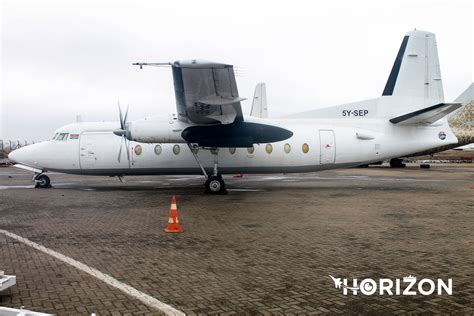
Its importance lies in unlocking regional air travel’s economic viability—a legacy still thriving today in modern turboprops like the ATR 72.
Pratt & Whitney Canada PT6 – The Swiss Army Knife of Engines
No engine represents versatility and ruggedness quite like the Pratt & Whitney Canada PT6. Debuting in 1964, its reverse-flow architecture—with air entering at the rear and reversing through the turbine—revolutionized maintainability and compactness.
It powers everything from the Pilatus PC-12 and Beechcraft King Air to helicopters, hovercrafts, and agricultural planes. The PT6’s ability to operate in remote areas with minimal support turned it into the lifeline for thousands of communities across Canada, Africa, Australia, and beyond.
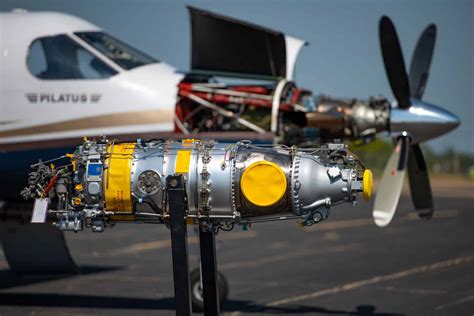
Its reputation for near-bulletproof reliability and easy field servicing has made it a favorite of bush pilots, medevac operators, and military trainers alike. The PT6 remains in production today, with more than 64,000 units built and over 500 million flight hours logged—a staggering legacy of operational trust.
Pratt & Whitney JT9D – Birth of the Jumbo Era
When Boeing envisioned the 747—a plane that would double airline capacity and shrink the world—it needed a new kind of power. Enter the Pratt & Whitney JT9D, the first high-bypass turbofan certified for civil aviation, introduced in 1970.
Delivering the high thrust levels required for widebody aircraft while dramatically reducing fuel consumption and noise, the JT9D enabled the Jet Age to scale globally. It wasn’t merely an engine for a new aircraft—it was the force multiplier behind the entire intercontinental travel boom of the 1970s and 1980s. Airlines could carry more passengers farther and cheaper than ever before.
The JT9D also powered aircraft like the DC-10 and Airbus A300, anchoring the early widebody market. Its architecture—bypass ratios around 5:1 and modular construction—paved the way for future giants. Without it, the modern airport hub system simply wouldn’t exist.
General Electric GE90 – Powering the World’s Longest Flights
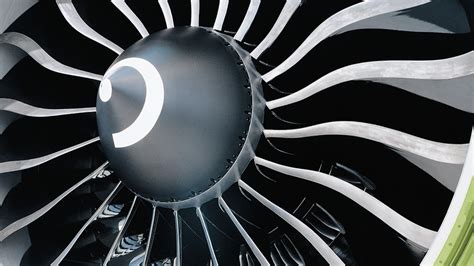
The General Electric GE90, introduced in 1995, wasn’t just a record-setter—it was a technological marvel. With a fan diameter of 123–128 inches, composite fan blades, and a bypass ratio nearing 9:1, it redefined what a jet engine could do. Its variant, the GE90-115B, holds the world record for thrust at 127,900 lbf, making it the most powerful jet engine ever flown.
Built for the Boeing 777, the GE90 was instrumental in enabling ultra-long-haul routes, such as New York to Hong Kong or Dubai to Los Angeles, with twin-engine reliability and efficiency. The engine’s swept wide-chord blades, forged from carbon fiber composites, were both lighter and stronger than traditional metal blades, reducing weight and improving fuel efficiency.
It also served as the springboard for newer engines, like the GEnx on the Boeing 787 and GE9X for the 777X. The GE90 didn’t just break records—it created a new expectation for what large turbofans could achieve in both performance and environmental efficiency.
CFM International RISE – The Next Frontier
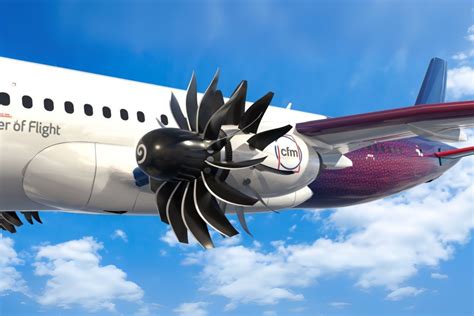
The future of aviation lies in decarbonization, and the CFM International RISE (Revolutionary Innovation for Sustainable Engines) is poised to lead that charge. Jointly developed by GE Aerospace and Safran, this open-fan concept engine, unveiled in 2021, promises a 20% fuel efficiency improvement and corresponding emissions reduction.
Unlike traditional turbofans, the RISE features unducted fan blades, improving bypass ratios beyond what current architecture allows. It represents a paradigm shift in engine design, not unlike the transition from piston to turbine engines nearly a century ago. RISE is expected to be integrated into the next-generation Airbus narrowbody, with entry into service projected for the late 2030s.
Its open-fan structure, hybrid-electric compatibility, and ability to run on sustainable aviation fuels (SAF) place it at the crossroads of environmental necessity and technological ambition. With the aviation industry targeting net-zero by 2050, engines like RISE will become the linchpin of future airline fleets.
Conclusion: The Evolution Engineered the Sky
The story of aviation is in many ways the story of engine evolution. Each of these seven engines marked a critical inflection point—whether by unlocking new geographies, reshaping business models, or enabling safer, quieter, and more efficient flight.
- The Whirlwind and Wasp laid the groundwork.
- The Dart brought turbine technology to the masses.
- The PT6 democratized flight with rugged flexibility.
- The JT9D enabled widebody global travel.
- The GE90 shattered performance limits.
- And the RISE seeks to save the planet while flying faster and farther.
Their legacy is not only in the miles flown or the aircraft they powered, but in the collective leap in what humanity believed it could achieve in the skies. As the next era dawns with hydrogen, electric propulsion, and sustainable fuels, these engines remind us that revolutionary innovation is always just over the horizon.