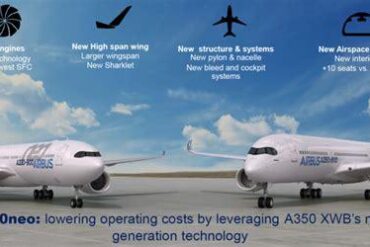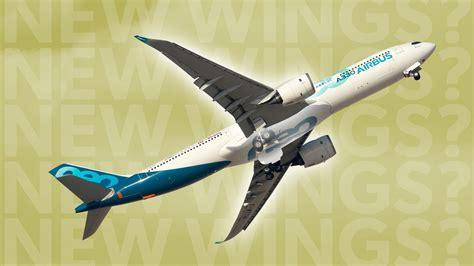
The Airbus A330neo did not receive new winglets as a cosmetic flourish or marketing garnish. It received them because physics demanded it. When Airbus decided to evolve the A330 rather than pursue the abandoned A350-800, it stepped into a delicate engineering dance: how do you extract meaningful efficiency gains from an aluminum widebody first conceived in the late 1980s without redesigning the entire airplane? The answer came down to engines, wings, and the invisible spirals of air twisting off the wingtips at cruise altitude.
The A330neo’s blended Sharklets are not just different from the original A330’s wingtip fences—they represent a generational shift in aerodynamic philosophy. They are part of a broader wing redesign that reshaped how the aircraft interacts with air across all flight phases. To understand why Airbus chose a new winglet configuration, you have to understand the aerodynamic battlefield modern airliners inhabit: one where every percentage point of drag reduction translates into millions of dollars over an aircraft’s lifetime.
The story begins with induced drag—the drag penalty created simply because wings generate lift. And once you see that invisible cost, the logic behind the A330neo’s different winglets becomes almost inevitable.
From Wingtip Fences To Sharklets: The Evolution Of Airbus Wing Design
The original A330ceo used wingtip fences—vertical surfaces extending both upward and downward from the wingtip. They were effective for their time, reducing wingtip vortices and improving efficiency. But aerodynamics is a relentless science. What was good in the 1990s became merely adequate by the 2010s.
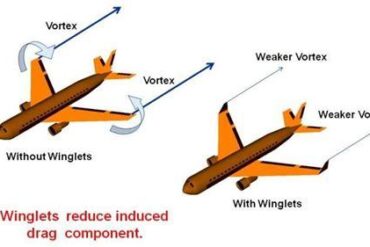
Wingtip vortices form because high-pressure air beneath the wing curls around the tip toward the lower-pressure region above. This creates swirling air structures that trail behind the aircraft like invisible tornadoes. These vortices generate induced drag, a byproduct of lift. Induced drag is especially costly during climb and at lower speeds, but it also influences cruise performance.
The solution? Reduce the strength of those vortices.
Blended winglets—like Airbus’ Sharklets—reshape airflow in a more continuous way. Instead of abrupt vertical fences, they smoothly extend and curve upward, increasing the effective wingspan without dramatically increasing structural weight or airport gate footprint.
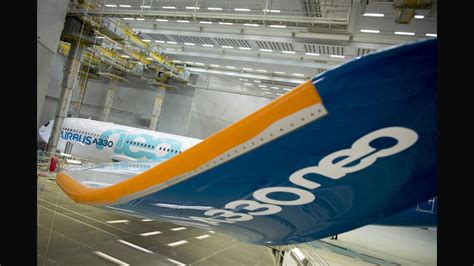
The A330neo’s Sharklets are the product of aerodynamic lessons learned from two other programs: the A320neo family and the A350 XWB. Airbus did not simply copy one design. It synthesized experience. The result was a wingtip device specifically optimized for the A330neo’s new wing geometry and performance envelope.
The A330neo Wing: More Than Just A Winglet Upgrade
Focusing only on the winglets misses the deeper story. The A330neo received an extensively reworked wing. The span increased to 64 meters (210 feet), pushing the aircraft to the limit of Code E airport compatibility. That matters because airport infrastructure determines whether airlines can operate an aircraft widely without expensive modifications.
The redesigned wing boasts an aspect ratio of 11, one of the highest among production widebody aircraft at the time of its introduction. Aspect ratio is simply the ratio of wingspan to average wing chord. Higher aspect ratios reduce induced drag because longer, narrower wings distribute lift more efficiently.
Longer wings mean weaker vortices. Weaker vortices mean lower induced drag. Lower induced drag means better fuel efficiency.
The Sharklets complement this longer wing. Without them, the aerodynamic benefit would not be fully realized. Together, the wing and Sharklets deliver roughly 4% improved aerodynamic efficiency compared to the previous generation. Four percent might sound modest, but in commercial aviation, 4% is the difference between profitability and marginal economics on long-haul routes.
Why Not Use The A350’s Wingtip Design?
The Airbus A350 uses elegantly curved blended wingtips integrated into its composite wing structure. So why didn’t Airbus simply transplant that design onto the A330neo?
Because wings are ecosystems. You cannot swap components without considering structural loads, flutter margins, bending moments, and manufacturing constraints.
The A350’s wing is primarily composite and was designed from scratch around its wingtip geometry. The A330neo retains a largely aluminum alloy wing structure derived from the original A330 platform. The structural and aerodynamic constraints differ significantly.
The Sharklet chosen for the A330neo provided the optimal balance of:
- Induced drag reduction
- Structural reinforcement compatibility
- Weight management
- Airport gate compliance
Airbus determined that adapting a variant of its Sharklet technology—refined from the A320neo and influenced by A350 research—offered better overall efficiency within the A330’s legacy framework.
Aerodynamics is rarely about copying the most beautiful design. It is about selecting the design that performs best within constraints.
The Engine-Wing Partnership: Why The Trent 7000 Changed Everything
When Airbus committed to the A330neo, it paired the aircraft exclusively with the Rolls-Royce Trent 7000. This engine introduced a 10:1 bypass ratio, improved materials, and a roughly 10% reduction in specific fuel consumption compared to earlier A330 engines.
Engines and wings operate as a system. More efficient engines change airflow characteristics, alter optimal cruise speeds, and shift aerodynamic sweet spots. The original A330 wing could not fully exploit the performance of the Trent 7000. It was designed in an era of different engine technology and shared compromises with the four-engine A340.
Yes, the A330 and A340 shared a common wing design. That meant structural compromises. One wing had to support two engines in one configuration and four in another. This was efficient from a development standpoint but suboptimal aerodynamically.
The A330neo’s redesigned wing liberated the twin-engine configuration from those legacy compromises. The Sharklets are part of that liberation. They help the aircraft achieve a superior lift-to-drag ratio across its mission profile.
Without upgraded wing aerodynamics, the new engines would not have delivered their full potential benefit.
Competing With The Boeing 787: Efficiency Without A Clean-Sheet Gamble
The Boeing 787 Dreamliner was a clean-sheet design with extensive composite construction and advanced aerodynamics. Airbus initially intended to respond with the A350-800, but the market shifted. Airlines preferred larger variants, and development economics favored upgrading the A330 instead.
The A330neo became a strategic counterpunch. Rather than match the 787 in radical materials innovation, Airbus targeted efficiency gains where they mattered most:
- New engines
- Improved wing aerodynamics
- Sharklet wingtip devices
- Cabin and avionics enhancements
The result was a 14% reduction in fuel burn per seat compared to the A330ceo. While not matching the 25% generational leap associated with clean-sheet aircraft like the A350, it delivered meaningful savings at far lower development cost—approximately $2 billion versus the A350’s estimated $12–15 billion.
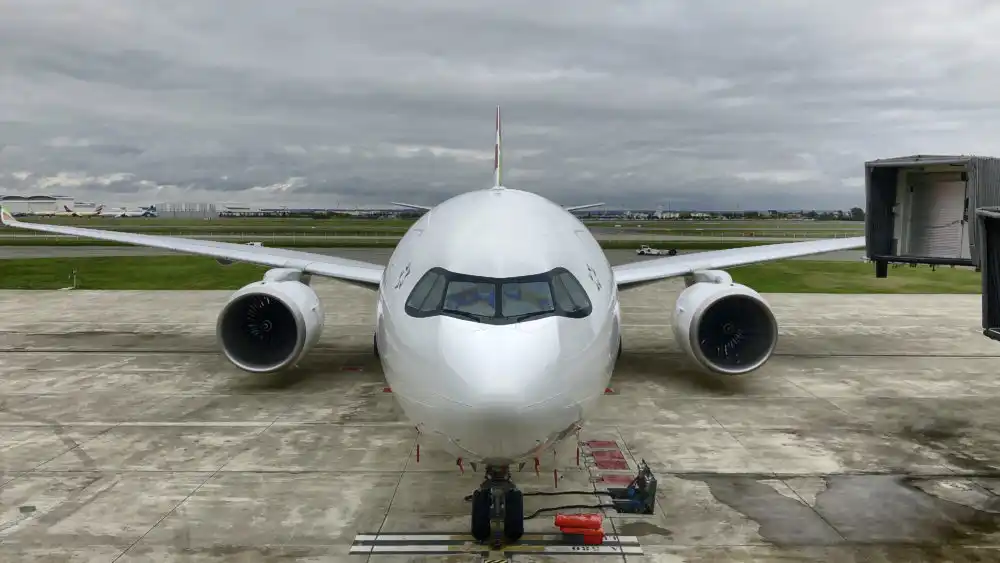
This cost discipline mattered. Airlines evaluating fleet upgrades consider not only fuel burn but acquisition price, training continuity, and maintenance commonality. The Sharklets, though aerodynamically sophisticated, fit within this incremental upgrade philosophy.
Code E Constraints And The Geometry Of Airports
Airport compatibility is an invisible force shaping aircraft design. The A330neo had to remain within Code E wingspan limits to ensure operational flexibility at major global airports.
Increasing wingspan improves aerodynamic efficiency. But exceeding Code E would restrict airport access and undermine the aircraft’s market appeal.
The Sharklets allowed Airbus to increase effective aerodynamic span without breaching these infrastructure constraints. Their curved, blended design extracts aerodynamic benefit while keeping the aircraft within allowable gate dimensions.
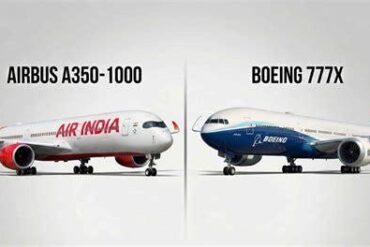
Contrast this with Boeing’s 777X, which uses folding wingtips to exceed Code E during flight and fold down on the ground. Airbus chose not to pursue that complexity for the A330neo. The Sharklet approach delivered meaningful gains without mechanical systems, weight penalties, or additional maintenance complexity.
Sometimes elegance is about restraint.
Market Positioning: Bridging The Gap In The Widebody Segment
The A330neo was designed to bridge the gap between the A321XLR narrowbody and the A350-900 widebody. Its range of approximately 7,350 nautical miles for the A330-900 variant allows it to operate transatlantic, transpacific, and dense regional long-haul routes efficiently.
The smaller A330-800 offered longer range—around 8,100 nautical miles—but struggled commercially. Airlines gravitated toward the higher-capacity A330-900 or already committed to the 787-8.
The Sharklet-equipped wing contributes directly to the A330-900’s mission versatility. By reducing induced drag and improving lift characteristics, it enhances payload-range performance. This makes the aircraft viable on thinner long-haul routes where margins are tight and efficiency matters intensely.
Aerodynamic refinement is not abstract engineering art. It is route economics translated into metal and composite.
Noise Reduction And Environmental Pressures
The curved Sharklet profile also contributes to noise reduction during takeoff. By smoothing airflow at the wingtips, it reduces turbulent interaction and vortex intensity. In an era of tightening environmental regulations and community noise restrictions, this is not trivial.
Lower induced drag also translates into lower fuel burn, which means reduced carbon emissions. Every incremental aerodynamic improvement compounds across thousands of flight hours annually.
Environmental performance is now a competitive differentiator. The Sharklet is part of Airbus’ strategy to future-proof the A330 platform against regulatory tightening and airline sustainability goals.
A Calculated Upgrade, Not A Revolution
The A330neo is not a revolutionary aircraft. It is something arguably more interesting: a masterclass in targeted evolution.
Airbus identified the most cost-effective levers for improvement:
- Re-engine with a high-bypass turbofan
- Redesign the wing for higher aspect ratio
- Integrate blended Sharklet wingtip devices
- Maintain structural continuity where feasible
This strategy minimized development risk while maximizing return. It also allowed airlines operating older A330s to transition with reduced pilot retraining and maintenance overhaul costs.
The Sharklets symbolize this philosophy. They are not flashy. They are purposeful. They are the visible tip of an aerodynamic iceberg shaped by computational fluid dynamics tools unavailable when the original A330 was designed.
Why The Different Winglets Matter
The question is not merely why Airbus built the A330neo with different winglets. The deeper question is why incremental aerodynamic gains matter so profoundly in commercial aviation.
Fuel accounts for a significant portion of airline operating costs. A few percentage points of efficiency improvement, multiplied across long-haul fleets operating daily, translates into enormous savings. Those savings influence fleet renewal decisions, route expansion, and long-term viability.
The blended Sharklets reduce induced drag, increase effective wingspan, improve lift-to-drag ratio, contribute to noise reduction, and enhance range capability—all while respecting airport infrastructure limits and structural constraints.
That is why they are different.
They are the product of aerodynamic maturity, engine synergy, airport geometry, cost discipline, and market positioning. They represent Airbus choosing precision over reinvention.
In the world of commercial aircraft design, revolutions make headlines. Evolution pays the bills.
And somewhere at 35,000 feet, as an A330neo traces contrails across the sky, the quiet curve of its Sharklet is busy reshaping the air—one invisible vortex at a time.