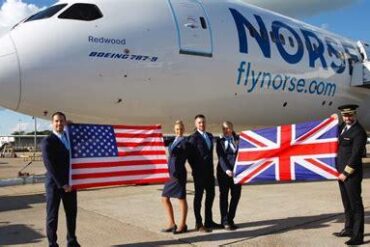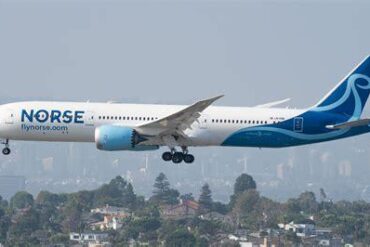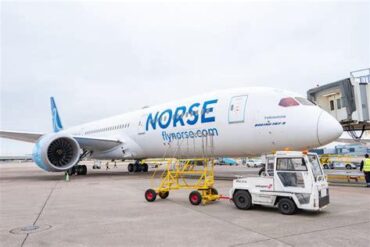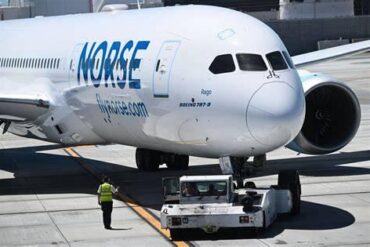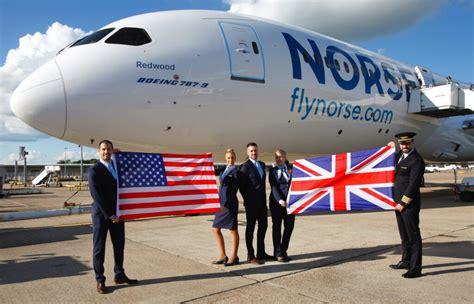
Norse Atlantic Airways was created around a simple but ambitious idea: take modern Boeing 787 Dreamliners, strip away many of the costs associated with traditional full-service airlines, and use them to offer cheap nonstop flights across the Atlantic. For travelers, the concept was attractive. A passenger could fly between major European and American cities without paying the traditionally high fares associated with long-haul travel. Yet in 2026, that original proposition is under serious pressure.
Norse Atlantic’s share price has fallen by almost 98% since April 28, 2023, reflecting the severe financial challenges facing the airline. The problem is particularly striking because Norse is not struggling to fill its aircraft. In the second quarter of 2026, the airline reported a 94% load factor across its own network, well above the roughly 84% worldwide average reported by the International Air Transport Association for the same period. On the surface, that looks like evidence of a successful airline.
The underlying numbers tell a very different story. Norse reported an operating margin of -21% in the quarter, while its cost per available seat kilometer increased dramatically. Revenue per passenger improved by 20% year over year to $447, but CASK climbed from 4.85 cents to 8.23 cents, an increase of about 70%. Norse therefore demonstrated that it could attract passengers and generate stronger unit revenue without solving the more fundamental problem: the cost of producing each seat kilometer was rising even faster.
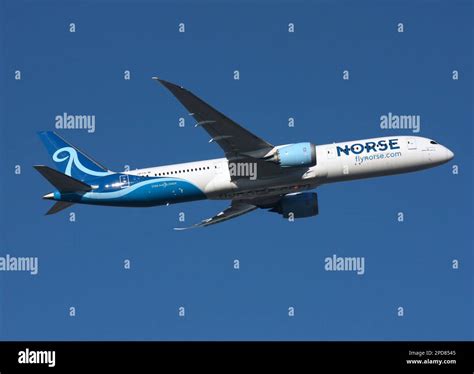
That combination raises an important question for travelers who have become accustomed to finding remarkably low fares on Norse: are the airline’s cheap transatlantic flights approaching the end of the road? The answer is not necessarily that every affordable Norse fare will suddenly disappear. Instead, the evidence suggests something more complicated. The airline is already changing its business model, shrinking its scheduled US network, moving aircraft into ACMI and charter work, and targeting long-haul leisure markets where it sees stronger returns.
Why Norse Atlantic Is Struggling Despite Full Aircraft
The central problem facing Norse is the difficult relationship between load factor, fares, and operating costs. Filling an aircraft is only one part of making an airline profitable. An airline can sell nearly every seat and still lose money if the average fare and additional passenger revenue are insufficient to cover the cost of operating those flights.
Norse’s second-quarter 2026 results illustrate this problem particularly clearly. Its 94% load factor was extremely high, while revenue per passenger increased from $372 in the second quarter of 2025 to $447 in 2026. Its TRASK, or total revenue per available seat kilometer, also increased from 5.01 cents to 6.15 cents. Those figures show that Norse was extracting more revenue from each unit of capacity.
The problem was the cost side. CASK increased from 4.85 cents to 8.23 cents, while CASK excluding fuel rose from 3.41 cents to 5.37 cents. In other words, the airline experienced a substantial increase in operating costs even before considering the full impact of fuel. A 94% load factor cannot compensate indefinitely when the cost base expands faster than revenue.
This is particularly damaging for an airline whose competitive identity depends on offering low fares. Norse needs to remain inexpensive enough to attract highly price-sensitive leisure travelers, but it also needs to generate enough revenue per seat to make long-haul flying financially sustainable. Those two objectives can become increasingly difficult to reconcile when operating expenses rise.
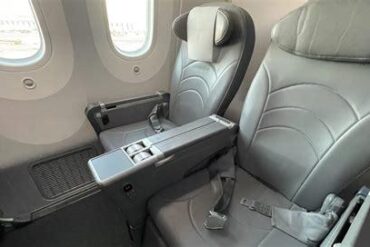
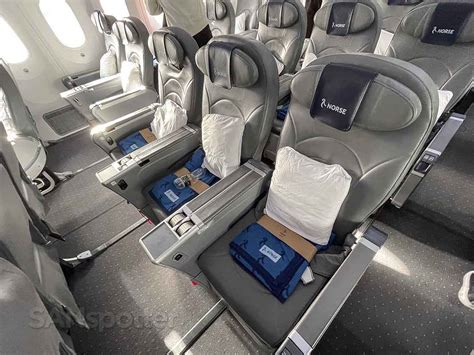
Traditional network airlines have another advantage. Carriers operating long-haul aircraft can generate significant revenue from business class, premium economy, and other higher-yield passengers. That premium revenue can help support competitive economy fares. Norse’s aircraft are heavily oriented toward economy travelers, with a comparatively small premium cabin, leaving less room to offset low economy fares with very high-value passengers.
Why Low-Cost Long-Haul Flying Is So Difficult
The difficulties facing Norse are not entirely unique to the airline. The history of low-cost long-haul aviation contains several examples of carriers discovering that the formula that works on short-haul routes becomes much harder to reproduce across oceans.
A short-haul low-cost carrier can achieve remarkable aircraft utilization. A narrowbody aircraft might operate several flights during a single day, allowing the airline to spread fixed costs across a large number of revenue-generating sectors. Secondary airports can also help reduce airport charges, while quick turnarounds allow aircraft to spend relatively little time sitting idle.
Long-haul operations are fundamentally different. A Boeing 787 flying from Europe to the United States may spend many hours completing one sector before it can begin another revenue flight. Time-zone differences, crew-rest requirements, airport curfews, slot restrictions, and longer turnaround procedures all make scheduling more complicated.
Widebody aircraft also represent a significant financial commitment. A Boeing 787 is highly efficient for its size, but it remains a large, sophisticated aircraft designed to carry hundreds of passengers over thousands of miles. Fuel remains a major cost, and many other expenses associated with actually operating the aircraft cannot simply be removed through the low-cost model.
Norse can reduce some costs by charging separately for services that traditional airlines bundle into the ticket price. Passengers may pay extra for baggage, meals, seat selection, or other products. However, these measures have limits. Removing complimentary services does not eliminate the cost of fuel, aircraft leases, maintenance, airport infrastructure, crews, navigation, insurance, or the substantial complexity involved in operating international widebody flights.
That helps explain why cheap long-haul flights are much harder to sustain than cheap short-haul flights. The airline must compete aggressively on price while carrying an aircraft that has relatively high absolute operating costs and fewer opportunities to maximize daily utilization.
Norse Is Already Moving Away From Its Original Network
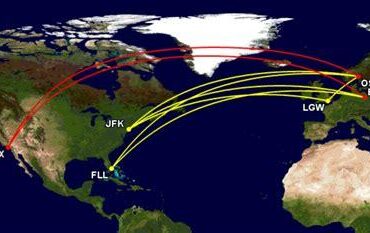
The most visible evidence of Norse’s strategic transformation is its shrinking transatlantic network. During the peak summer of 2025, the airline operated 12 transatlantic routes between Europe and the United States. One year later, only four remained: Athens to New York JFK, Rome Fiumicino to JFK, London Gatwick to JFK, and London Gatwick to Orlando.
That represents a dramatic reduction from the network Norse originally envisioned.
The airline’s route from Oslo to New York JFK, which was particularly symbolic because it was the route on which Norse began operations in June 2022, disappeared in September 2025. The carrier was subsequently left without scheduled transatlantic service from its home country.
Other routes also disappeared. Berlin to JFK, Paris Charles de Gaulle to JFK, and London Gatwick to Miami were removed. Planned summer 2026 services linking Los Angeles with London Gatwick, Paris, and Rome were also canceled, marking Norse’s withdrawal from the US West Coast.
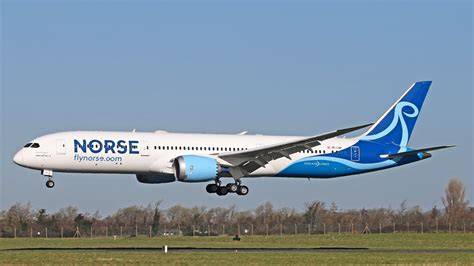
The changes reveal that Norse is no longer trying to build the broad transatlantic network that defined its launch strategy. Instead, the airline has become considerably more selective, concentrating capacity on markets where management believes demand and achievable ticket prices are stronger.
That strategy can make sense from a financial perspective because not all long-haul routes generate the same economic results. A flight that looks attractive because it has a large number of passengers may still produce weak returns if fares are too low. Conversely, a smaller market may become more attractive if travelers are willing to pay higher prices or if competition is less intense.
For consumers, however, this means that the availability of Norse’s cheapest transatlantic fares may become increasingly limited. The airline does not necessarily have to stop selling inexpensive tickets. It simply has fewer routes and fewer seats on which those fares can appear.
ACMI Operations Could Change Norse Atlantic Even Further
One of the most important changes in Norse’s strategy is its increasing focus on ACMI operations. Under an ACMI arrangement, an airline provides an aircraft, crew, maintenance, and insurance to another carrier, while the customer airline generally takes responsibility for selling the seats.
This model changes the commercial risk dramatically. When Norse sells its own tickets, it must estimate demand months in advance and accept the risk that fares may have to be reduced to fill the aircraft. Under an ACMI contract, much of that commercial uncertainty shifts to the customer.
The aircraft still costs money to operate, of course. But Norse can potentially earn more predictable revenue from its Boeing 787s without having to build an entire passenger market around every flight.
The scale of this transition is significant. In the second quarter of 2026, Norse’s own-network production was 64% lower than a year earlier, while ACMI and charter production increased more than eightfold. Revenue from ACMI and charter activities rose from only $6.1 million to $45 million.
Six of Norse’s 12 aircraft were deployed in ACMI operations during the quarter, demonstrating how quickly the business has shifted.
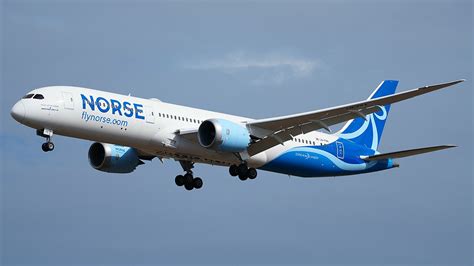
There is an important complication. Norse’s major ACMI agreement with IndiGo is scheduled to end in November 2026. The aircraft involved will then need to be redeployed into Norse’s own network, charter operations, or new ACMI contracts.
That creates both a challenge and an opportunity. Norse will have additional aircraft available, but management must decide where those aircraft can generate the strongest returns. If ACMI contracts remain more financially attractive than selling low-cost transatlantic tickets directly, the airline has a clear commercial reason to prioritize them.
Norse Is Expanding in Thailand and South Africa
The airline’s changing priorities are particularly visible in its long-haul leisure network. Rather than focusing almost exclusively on Europe-US flying, Norse is increasingly targeting Thailand and South Africa, particularly during the European winter.
For winter 2026/27, Norse plans to operate as many as five weekly flights from Oslo and Stockholm to Bangkok. It will also operate up to two weekly flights from both cities to Phuket, while London Gatwick-Phuket is scheduled to operate three times weekly. Manchester-Bangkok is increasing to four weekly flights, while London Gatwick-Bangkok and Cape Town services continue.
This is an important strategic development because it shows that Norse is not simply shrinking. It is redirecting capacity.
The airline has said that its Europe-Thailand operation received a strong response during the 2025/26 winter, while its first-quarter 2026 results highlighted increased demand for point-to-point travel between Europe, Asia, and South Africa. Norse has also acknowledged that future capacity could move away from the transatlantic market toward destinations offering stronger growth and less competition.
For travelers, this could mean fewer ultra-cheap Europe-US fares but more opportunities to find competitively priced nonstop flights to leisure destinations in Asia and Africa.
Could Norse Atlantic Be Sold or Merged?
There is another uncertainty hanging over the airline: Norse Atlantic may not remain independent.
In July, the company launched a formal strategic review that could result in a sale, merger, strategic partnership, or another type of transaction. Such a move could fundamentally alter the airline’s network and business strategy.
A new owner or strategic partner could decide that Norse’s Boeing 787 fleet is more valuable as an ACMI platform than as the foundation of a standalone low-cost transatlantic carrier. Alternatively, another company could see an opportunity to rebuild selected scheduled routes using Norse’s relatively attractive aircraft leases.
The aircraft themselves are potentially an important asset. Norse operates 12 Boeing 787-9s, and the airline has indicated that these aircraft are leased at rates significantly below current market levels. That could make Norse interesting to potential buyers even while its standalone operating model remains under pressure.
The airline has also raised fresh capital and launched a cost-cutting program intended to reduce annual expenses by as much as $50 million. These measures indicate that management is attempting to create a more sustainable financial structure rather than simply continuing the original strategy unchanged.
Will Norse’s Cheap Transatlantic Flights Disappear?
The evidence does not point to an immediate end to Norse Atlantic’s low-cost transatlantic flights. The airline still operates selected routes between Europe and the United States, and its strategy leaves room for scheduled flying when management believes the economics are attractive.
However, the broader trend is unmistakable. Norse Atlantic’s original low-cost transatlantic model has already become much smaller. The airline has reduced its US network, abandoned the West Coast, stopped serving its home country with scheduled transatlantic flights, and shifted a substantial portion of its fleet toward ACMI and charter operations.
That means the real question is not simply whether Norse will continue selling cheap tickets across the Atlantic. It is whether low-cost transatlantic flying will remain the central purpose of the airline.
At launch, the answer appeared straightforward. Today, it is not. Norse increasingly looks like a flexible long-haul operator that can move its 787s between scheduled passenger routes, seasonal leisure markets, charters, and ACMI contracts depending on where it can generate better returns.
For passengers, that distinction matters. A low-cost airline does not need to disappear entirely for its cheapest fares to become harder to find. It only needs to reduce capacity on the routes where those fares are available. As Norse becomes more selective, the bargain-basement transatlantic ticket could therefore become a less common feature of the market.
The irony is that Norse has demonstrated strong passenger demand. Its 94% load factor proves that travelers are willing to fill its aircraft. The financial challenge is making those passengers profitable. With costs rising much faster than revenue in the second quarter of 2026, the airline has little reason to preserve capacity simply because seats are full.
Norse Atlantic may therefore survive, but the version of Norse that once promised a broad network of cheap Boeing 787 flights across the Atlantic is already disappearing. Its future could be more diversified, more seasonal, and more dependent on ACMI contracts and long-haul leisure demand. For travelers hoping to keep finding exceptionally cheap Europe-US fares, that transformation is arguably more important than whether the Norse brand itself remains in the sky.
The cheap transatlantic flight is unlikely to vanish from aviation altogether. Competition, new-generation aircraft, changing fuel prices, and different airline business models will continue to create opportunities for lower fares. But Norse’s experience demonstrates just how difficult it is to build a durable business around those fares. A full aircraft is not enough. A popular route is not enough. Even record unit revenue is not enough when the cost of flying each seat rises faster.
Norse Atlantic’s story is therefore becoming less about proving that passengers want low-cost long-haul travel and more about discovering which business model can actually make that demand profitable. Its next chapter may determine not only the future of the airline, but also how much room remains for independent low-cost carriers in the long-haul market.