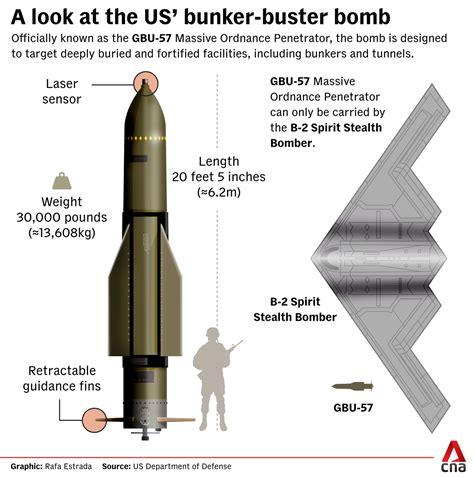
The US Air Force has taken a significant step toward reshaping the supply chain behind America’s most powerful conventional bunker-buster, awarding a contract worth up to $149 million to four smaller American steel manufacturers for production of hardened casings for the GBU-57 Massive Ordnance Penetrator. The September 8 award marks a notable change for a weapon that, for roughly 18 years, had been associated almost entirely with Boeing.
The four companies receiving the work are Superior Forge and Steel, Ellwood National Forge, Faxon Machining, and Grand Valley Manufacturing, all based in Ohio or Pennsylvania. Rather than handing the entire requirement to a traditional defense prime, the Air Force is creating a network of specialized suppliers capable of producing the enormous metal structures required by the weapon.
That may sound like a relatively modest procurement decision compared with the multibillion-dollar programs that dominate Pentagon headlines. In strategic terms, however, the move is considerably more important. The GBU-57 is not an ordinary bomb, and its enormous casing is not something that can simply be ordered from any conventional industrial supplier. The Air Force is effectively trying to ensure that a critical capability does not depend on a single industrial source at precisely the moment when demand for advanced munitions has exposed weaknesses throughout America’s defense-production system.
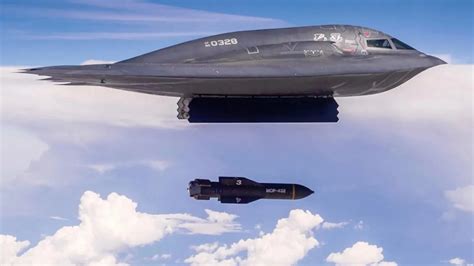
The GBU-57 Massive Ordnance Penetrator Is a Unique Weapon
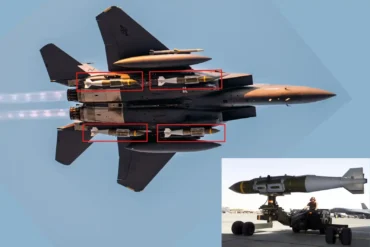
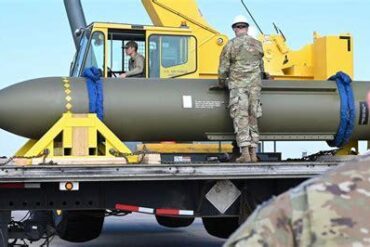
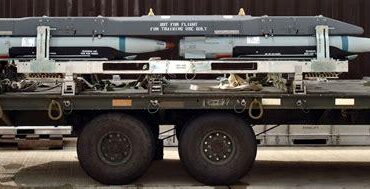
The GBU-57 Massive Ordnance Penetrator, commonly known as the MOP, is the largest bunker-busting bomb ever produced by the United States. It weighs approximately 30,000 pounds (13,608 kilograms), putting it in an entirely different category from conventional precision-guided bombs.
Its purpose is equally unusual. Instead of detonating immediately after striking a target, the weapon is designed to penetrate deeply into hardened structures before its explosive payload is triggered. That makes the MOP particularly relevant against facilities constructed underground or protected by substantial layers of reinforced concrete and earth.
The weapon’s effectiveness depends on the interaction of several systems. Its guidance equipment has to place the bomb accurately over the target, while its fuze has to determine when the weapon has penetrated sufficiently before initiating the detonation. But none of those sophisticated components would matter if the bomb’s outer structure failed during impact.
That makes the massive hardened steel casing one of the most important parts of the entire weapon. It must absorb the enormous forces generated when a six-ton-class bomb strikes the ground at high speed, while retaining enough structural integrity to continue penetrating before the explosive charge is triggered.
Four American Steel Companies Replace a Single-Source Model
The September contract is significant because the Air Force is not simply ordering more MOPs from Boeing. Instead, it is deliberately creating additional industrial capacity for one of the weapon’s most demanding components.
Superior Forge and Steel, Ellwood National Forge, Faxon Machining, and Grand Valley Manufacturing were selected through a competition managed by a specialized weapons organization at Eglin Air Force Base. The agreements are structured to support production over time, rather than requiring the government to purchase the entire potential value of the contract immediately.
The work is expected to continue through September 2033, assuming the Department of Defense continues the requirement.
The four companies are also notable because they are not among the traditional American defense primes such as Boeing, Lockheed Martin, Northrop Grumman, RTX, or General Dynamics. That distinction matters because the Air Force is deliberately pushing specialized manufacturing deeper into the industrial base.
For decades, America’s defense procurement system has often depended on large prime contractors coordinating enormous programs. That model can be effective when the prime has unique engineering knowledge and established production infrastructure. It can also create vulnerability when there is no practical alternative supplier.
The new MOP casing arrangement addresses that vulnerability by creating several potential sources for a component that requires unusual industrial capabilities.
Boeing’s 18-Year Role Was About More Than Manufacturing
Boeing’s long association with the GBU-57 went beyond simply assembling a large bomb. The company became the principal source for the weapon and retained important technical rights associated with its design and components.
That arrangement made sense when the MOP was an exceptionally specialized weapon with extremely limited production requirements. For years, the weapon remained largely a strategic capability held in reserve rather than something being consumed at a high operational rate.
The problem with such a structure becomes apparent when circumstances change rapidly. A weapon that spends years in storage can suddenly become an urgent procurement priority after a major military operation. If only one company possesses the necessary knowledge, tooling, designs, and production capacity, increasing output can become much more complicated than simply placing a larger order.
The same broader problem has appeared across America’s missile and munitions industry. Recent combat operations have placed pressure on stocks of systems including Patriot interceptors, THAAD-related equipment, Standard Missile variants, and other precision weapons. Replenishing those inventories can take years when production lines were never designed for sustained wartime consumption.
The lesson for the Pentagon is increasingly straightforward: a production line that works during peacetime may not provide enough resilience during a major conflict.
The MOP’s Combat Use Changed the Production Equation
For much of its early existence, the GBU-57 was a weapon whose capabilities were discussed largely in the context of potential missions. That changed dramatically in 2025, when the weapon was reportedly used against deeply buried Iranian nuclear facilities during Operation Midnight Hammer.
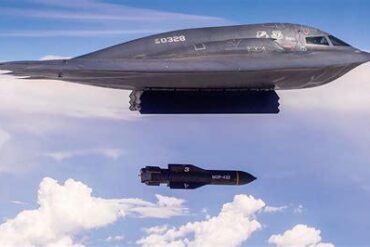
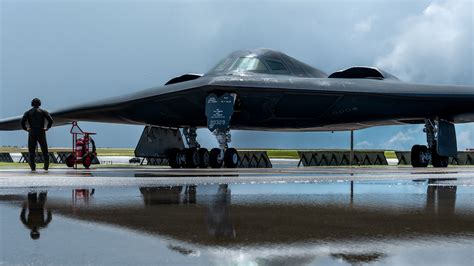
Seven B-2 Spirit stealth bombers reportedly flew an approximately 18-hour round trip from Missouri and delivered 14 MOPs against underground facilities at Fordow and Natanz. The operation demonstrated why the weapon exists in the first place: conventional aircraft-delivered weapons can have difficulty reaching targets protected deep beneath the surface, while a massive penetrator is specifically designed for that environment.
The reported expenditure of 14 weapons represented a substantial portion of the available inventory. Earlier estimates had suggested that the Air Force possessed only a relatively small number of operational MOPs, making every combat expenditure strategically significant.
The combat use therefore transformed the MOP from a specialized capability largely held for a hypothetical contingency into a weapon with a demonstrated wartime consumption requirement.
That distinction is crucial. Once a weapon has been used in combat, the military cannot simply assume that existing stocks will remain adequate indefinitely. Weapons have to be replaced, tested, maintained, and eventually modernized. A production system designed around occasional procurement suddenly has to support replenishment.
Why the Steel Casing Is the Real Industrial Challenge
The most interesting part of the new arrangement is that the Air Force is focusing specifically on the hardened outer casing.
Modern weapons often attract attention because of their electronics, software, sensors, and guidance systems. The MOP illustrates a different reality. Sometimes the most difficult component to produce is an enormous piece of metal.
The casing requires specialized, high-density steel capable of surviving extreme impact conditions. Manufacturing such a structure requires exceptionally large forging and machining capabilities, along with specialized equipment, experienced workers, quality-control systems, and facilities capable of handling components far larger and heavier than those used in ordinary industrial production.
That industrial capability has become less common in the United States since the end of the Cold War. The country retains sophisticated aerospace and defense manufacturing, but the number of companies capable of producing extremely large forged and machined components has contracted.
This creates a peculiar vulnerability. The United States can possess advanced aircraft, precision guidance, stealth technology, and sophisticated explosives while still encountering a bottleneck involving a giant piece of forged steel.
The September award is therefore about more than finding additional factories. It is also about preserving a manufacturing skill set that has become increasingly difficult to replace.
The Air Force Is Preparing for the Next-Generation Penetrator
The new supplier network could eventually become useful beyond the current GBU-57.
The Air Force is developing a successor known as the Next Generation Penetrator, or NGP. The planned weapon is expected to weigh up to approximately 22,000 pounds (9,979 kilograms), substantially less than the 30,000-pound MOP.
That reduction is not simply an attempt to make the bomb easier to manufacture. It is closely connected to the future of America’s stealth bomber fleet.
The B-2 Spirit is currently the aircraft most closely associated with the MOP’s operational employment. Its large bomb bay allows it to carry the enormous weapon internally. The newer B-21 Raider, however, is being designed around a different combination of size, payload, survivability, and flexibility.
A smaller next-generation penetrator could therefore provide capabilities that are better suited to the B-21’s internal weapons bay.
Boeing is still expected to have a role in the next-generation weapon, particularly in areas associated with the guided tail kit. The Air Force’s new industrial strategy should not therefore be interpreted as eliminating Boeing from the penetrator program.
Instead, it represents a move toward separating critical manufacturing functions among multiple suppliers.

One Supplier Network Could Support Two Generations of Bunker-Busters
One particularly important detail is that the Air Force’s approach is not necessarily limited to reproducing today’s MOP casing exactly.
By qualifying companies for large penetrator structures and heavy components, the service can potentially create a manufacturing base that remains useful as weapon designs evolve. A factory capable of producing enormous hardened casings for one penetrator could eventually adapt its processes to support another.
That is a more efficient approach than waiting until the MOP is retired and then attempting to build an entirely new supplier network for the next-generation weapon.
It also provides a degree of industrial redundancy. If one company experiences a production problem, equipment failure, labor shortage, or other disruption, the government has additional qualified sources to draw upon.
This concept has become increasingly important throughout the defense industry. A supply chain does not have to collapse completely to become a strategic problem. A single delayed component can hold up an entire weapon production line.
Breaking Boeing’s Monopoly Does Not Mean Boeing Is Out
The phrase “ending Boeing’s monopoly” needs some qualification. Boeing’s position in the MOP ecosystem is changing, but the company is not simply being removed from the program.
The new contract concerns the hardened outer casings. Other critical elements, including the weapon’s guidance and tail-kit architecture, remain connected to Boeing.
The more precise description is that the Air Force is ending a single-source manufacturing model for a critical MOP component.
That distinction matters because the Pentagon still needs companies with extensive engineering knowledge and experience with highly specialized military systems. The objective is not necessarily to eliminate prime contractors. It is to prevent individual contractors from becoming unavoidable bottlenecks for every major component.
The $149 Million Contract Signals a Larger Defense Strategy
The dollar value of the contract may look small compared with the cost of major aircraft programs, but its industrial significance is considerably larger.
The Air Force is effectively buying something that cannot be measured solely by the number of bomb casings delivered: additional manufacturing capacity.
If the four companies successfully establish reliable production, the United States will have more than one pathway for obtaining a critical penetrator component. That capacity could become particularly important during a future conflict in which demand for bunker-busting weapons rises sharply.
There are still uncertainties. The new suppliers must prove that they can manufacture components to the required specifications and at sufficient volume. Heavy forging and machining are demanding processes, and adding companies to a supplier network does not automatically guarantee that the resulting production rate will meet wartime requirements.
The arrangement also does not eliminate every supply-chain dependency surrounding the GBU-57. Boeing remains involved in other aspects of the weapon, and the broader US munitions industry continues to face production constraints.
Nevertheless, the September award represents a clear change in procurement philosophy.
A New Model for America’s Strategic Munitions
The GBU-57 has always represented an unusual intersection of technology and industrial power. Its guidance system makes it a precision weapon, but its enormous size and hardened casing remind us that some of the most strategically important military technologies still depend on very traditional manufacturing skills.
The $149 million Air Force contract recognizes that reality.
Four American companies are now being brought into a production network supporting a weapon once associated with a single major aerospace contractor. The immediate objective is to increase capacity for GBU-57 casings, but the longer-term goal is broader: create an industrial base capable of supporting both the existing Massive Ordnance Penetrator and the next generation of deep-penetration weapons.
For the Air Force, the significance goes beyond Boeing or even the MOP itself. The service is attempting to make its most specialized weapons less vulnerable to a single factory, a single supplier, or a single production bottleneck.
After 18 years of relying on one dominant source, America’s most powerful conventional bunker-buster now has four new industrial pathways behind it. The change may begin with forged steel, but its real target is much larger: building a defense-industrial base that can keep producing critical weapons when demand suddenly rises and the stakes are highest.