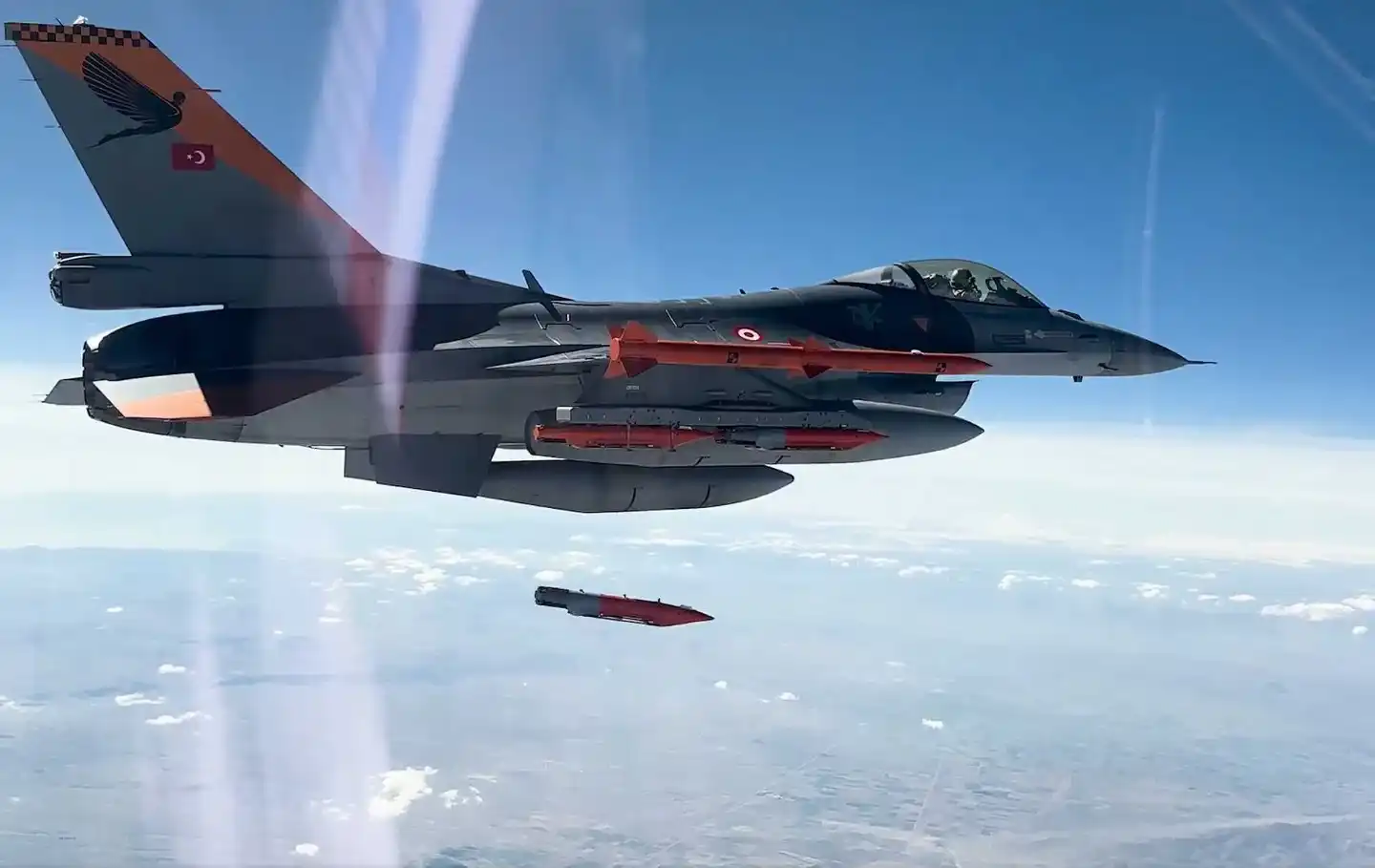
Türkiye has taken a bold step forward in defense self-reliance with the successful live-fire test of the Aselsan Tolun precision-guided bunker buster munition from a Turkish Air Force F-16 fighter jet. The test, conducted on December 27, 2025, marks a pivotal milestone in the country’s drive to field a robust, domestically-produced strike capability independent of foreign suppliers.
Aselsan Tolun Takes Flight from Turkish F-16
During the test at an undisclosed military range, the Tolun munition cleanly separated from an underwing pylon of the F-16, unfolded its control surfaces, and entered a guided glide phase, maneuvering mid-flight toward a hardened surface target. Video footage released by Aselsan showcased a seamless launch sequence, with trajectory corrections visibly confirming the weapon’s integrated inertial and satellite navigation systems in full operation.
The trial validates not only the munition’s physical integration with the F-16 but also its capacity to engage hardened targets with surgical accuracy. With a CEP (circular error probable) of under 10 meters, the Tolun is built to neutralize critical assets such as bunkers, command centers, and reinforced enemy infrastructure, even in densely built environments or near friendly forces.
Origins: A Strategic Response to Foreign Dependency
The Tolun program began in 2020, initiated by Aselsan to address a growing operational gap in Turkey’s arsenal: the lack of indigenous, precision-guided bunker buster munitions compatible with both UAVs and manned aircraft. For years, export restrictions, particularly from the U.S., have constrained Turkey’s access to advanced munitions. This drove a broader strategic shift toward defense industrial autonomy.
At the IDEF 2021 defense exhibition, Aselsan unveiled the first Tolun prototype, along with the SADAK-4T smart rack, allowing for multiple munition carriage. Throughout 2022, aerodynamic and structural tests validated its resilience and airframe compatibility. In 2023, trials expanded to include UAVs like the Bayraktar TB2 and AKINCI, proving the system’s modular adaptability across different aerial platforms.
Tolun-SI: Custom Fit for the Turkish F-16
By 2024, Aselsan introduced the Tolun-SI, a standalone variant engineered specifically for the Turkish Air Force’s F-16 Block 30 and Block 40 fighters. Unlike its rack-dependent predecessors, Tolun-SI allows single munition deployment without additional systems. After ground and captive carry tests, full integration with flight control systems was completed by mid-2025, culminating in the December 2025 live test.
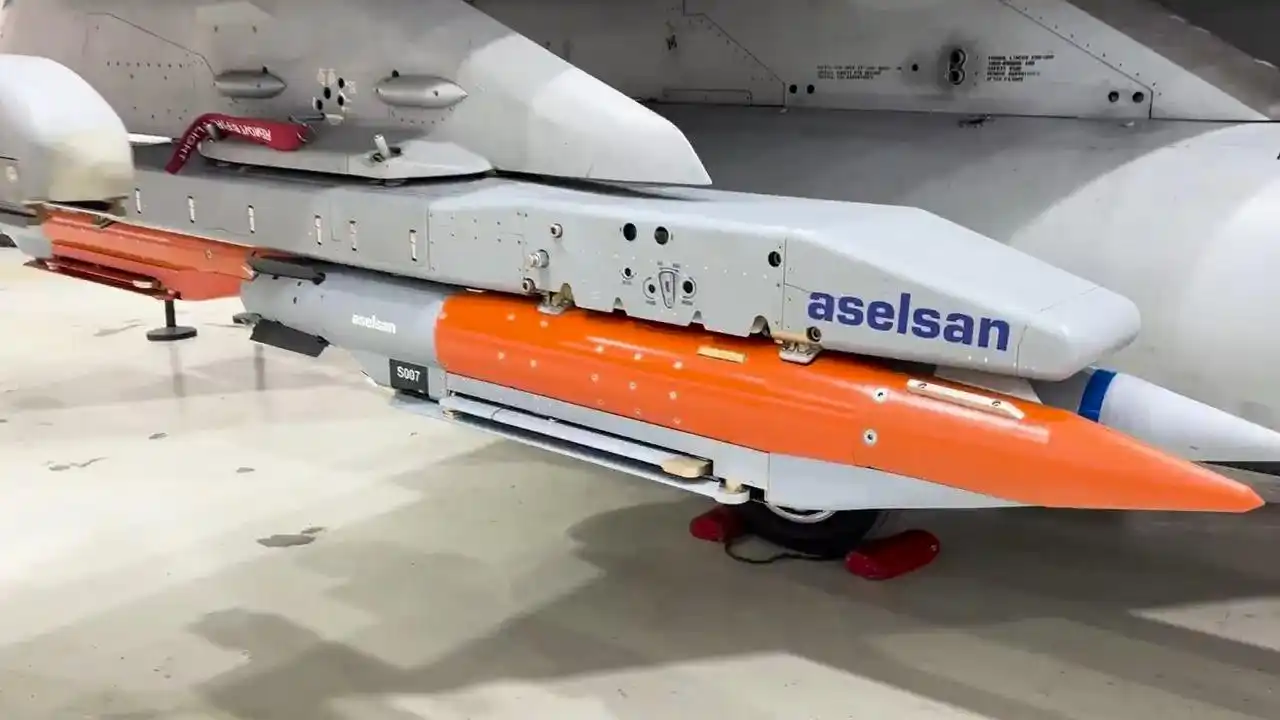
The weapon’s specifications reinforce its role as a versatile, high-impact strike solution:
- Warhead: 105 kg (231 lb) with shaped charge and hardened steel nose.
- Penetration: Capable of breaching up to 1 meter of reinforced concrete.
- Total weight: 136 kg (300 lb).
- Guidance: INS/GNSS hybrid system with anti-jamming CRPA antenna.
- Range: Up to 102 km from fighter jets, 57 km from UAVs.
- Deployment Altitude: 0–12,200 meters (0–40,000 feet) for jets.
This profile positions Tolun as an ideal solution for standoff attacks against fixed targets, especially in hostile airspace where minimal exposure is critical.
Combat Efficiency and Multi-Platform Integration
The Tolun system is compatible with both single mounts and multi-rack systems (SADAK-2T and SADAK-4T), allowing aircraft to carry multiple munitions per sortie. This enables simultaneous strikes on separate targets, enhancing sortie efficiency and reducing the number of aircraft required for complex missions.
As of now, the Tolun family is integrated with:
- F-16 multirole fighters
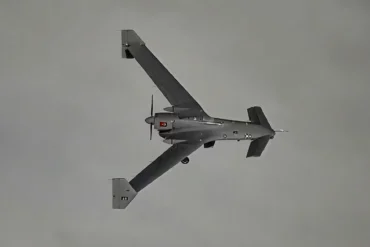
- Bayraktar TB2 UAV
- Bayraktar AKINCI HALE UAV
- ANKA-III stealth UCAV
Each of these platforms benefits from the munition’s modular carriage options, all-weather operation, and low maintenance profile, reflecting Aselsan’s intent to create a battle-hardened, operationally adaptable weapon.
Export Strategy and Strategic Significance
The test underscores a critical transformation in Turkey’s defense posture. By fielding indigenous alternatives like Tolun, Turkey is reducing dependency on ITAR-controlled or NATO-regulated munitions. The move aligns with Ankara’s policy of strategic autonomy in defense manufacturing, offering not only greater operational independence but also new export opportunities.
Aselsan is actively positioning Tolun for international markets, particularly among F-16 operators in the Gulf, North Africa, and Central Asia. These regions have shown rising demand for precision-guided strike solutions that are both combat-proven and free from Western export constraints.
Production Outlook and Future Deployment
While Aselsan has not formally announced full-scale production, insiders indicate that low-rate initial production may already be underway. Further environmental qualification and clearance trials are expected to precede mass production. The Turkish Ministry of National Defense is anticipated to release an official statement in the coming months.
Initial deployment of the air-launched Tolun-SI variant is planned for the second half of 2026, focusing on squadrons tasked with safeguarding Turkey’s southeastern and coastal borders—areas of strategic sensitivity requiring quick, autonomous precision strike capability.
Conclusion: A Strategic Milestone for Türkiye’s Defense Industry
The successful test of the Tolun munition is more than a technical triumph; it marks a strategic pivot in Türkiye’s defense trajectory. It demonstrates the nation’s capacity to produce high-precision, hardened target strike weapons fully compatible with its frontline fighter and UAV fleets. By shedding reliance on foreign suppliers and embracing homegrown solutions, Türkiye is rewriting the rules of regional airpower.
The Tolun now stands alongside the MAM and Kuzgun series in a growing arsenal of domestically engineered strike munitions, embodying a new era of self-sufficiency and technological innovation in Turkish defense. As full-scale fielding nears, the Tolun is set to become a cornerstone of Türkiye’s deep-strike doctrine, empowering both national defense and allied partnerships across volatile theaters of operation.