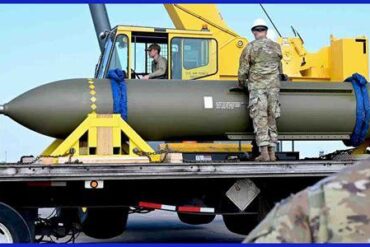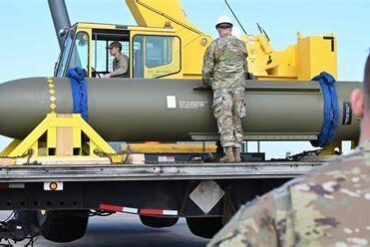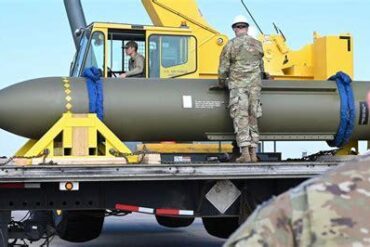
The U.S. Air Force has moved swiftly to restore one of its most specialized conventional strike capabilities, awarding Boeing a $61.55 million contract to replenish GBU-57 Massive Ordnance Penetrator (MOP) bunker-buster weapons following their operational use against Iranian nuclear sites. The contract underscores a simple but sobering reality: when a nation expends its most powerful conventional penetrators, rebuilding that inventory becomes a strategic priority, not a routine procurement action.
The award, described as a not-to-exceed and undefinitized contract, covers the essential hardware that transforms the 30,000-pound penetrator into a deployable, combat-ready weapon. This includes KMU-612 E/B tailkits, fuze-system components, separation hardware, and specialized shipping and storage containers. Work will be conducted in St. Louis, with completion projected between September 2028 and May 2030. That extended timeline reflects the niche, low-density nature of the capability and the industrial complexity behind it.
The replenishment follows the first confirmed operational employment of the MOP during Operation Midnight Hammer, when U.S. Air Force B-2 Spirit stealth bombers dropped 14 GBU-57s against Iran’s deeply buried nuclear facilities at Fordow and Natanz. Air Force documentation described the replenishment as “critically needed,” signaling that the weapon occupies a narrow but indispensable role in U.S. strategic planning.
The GBU-57 Massive Ordnance Penetrator: America’s Deepest Conventional Strike Tool
The GBU-57 Massive Ordnance Penetrator is engineered for one mission: the destruction of hard and deeply buried targets. Unlike general-purpose bombs designed for surface structures or lightly reinforced facilities, the MOP is purpose-built to penetrate reinforced concrete and earth before detonating at depth.
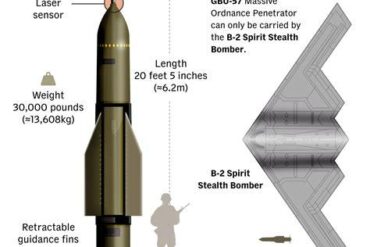
Weighing approximately 30,000 pounds, the weapon combines extreme mass with hardened casing and precision guidance. It is GPS-guided, enabling accurate aimpoint delivery against fixed, fortified targets. The Pentagon’s Director of Operational Test and Evaluation has highlighted the importance of the Large Penetrator Smart Fuze (LPSF) upgrade, which enhances the probability of kill when intelligence about internal target layout is incomplete or uncertain.
This distinction matters. The objective is not to create a dramatic surface crater but to drive the penetrator through layers of reinforced concrete or mountain overburden before triggering a delayed detonation. Timing, fuze logic, and penetration depth are central to the weapon’s effectiveness. In underground warfare, physics becomes strategy.
Open-source assessments indicate the weapon carries a high-explosive fill totaling more than 5,300 pounds, including approximately 4,590 pounds of AFX-757 and 752 pounds of PBXN-114. These explosive formulations are optimized for confined, high-pressure detonation within enclosed underground structures. Estimates suggest the MOP can penetrate up to roughly 18 meters of concrete or more than 60 meters of earth before exploding, placing facilities carved into mountains squarely within its engagement envelope.
Operation Midnight Hammer and the Fordow-Natanz Strikes
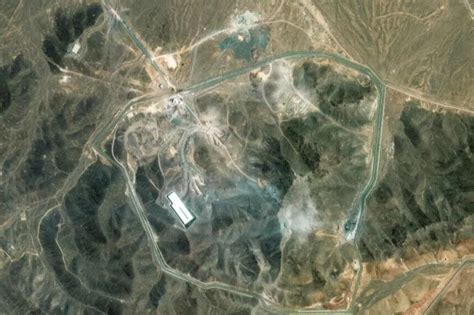
The operational debut of the MOP during Operation Midnight Hammer marked a turning point in conventional counterproliferation strategy. According to U.S. reporting, seven B-2 bombers participated in the strike package, delivering 14 MOPs against the fortified Iranian nuclear facilities at Fordow and Natanz.
Satellite imagery analysis following the strikes suggested a deliberate “double tap” approach at Fordow. Multiple penetrators appeared aligned along consistent aimpoints, implying repeated strikes into the same entry locations. The logic is straightforward: successive penetrations can exploit structural weaknesses created by prior impacts, effectively drilling deeper into hardened complexes.
This approach demands extraordinary precision. Strike planners must generate highly refined aimpoints based on intelligence, surveillance, and reconnaissance data. Bomb release timing must account for weapon spacing, trajectory alignment, and desired penetration paths. The margin for error narrows significantly when the target lies beneath rock and reinforced concrete rather than exposed infrastructure.
Why Only the B-2 Can Deliver the MOP
One of the defining characteristics of the GBU-57 is its limited delivery platform. The B-2 Spirit remains the only aircraft in the U.S. Air Force inventory programmed to employ the MOP. This constraint is not arbitrary; it reflects both the bomb’s immense size and the operational requirement for stealth.
The B-2’s internal carriage allows it to transport two MOPs per sortie while maintaining low observability. External carriage on non-stealth platforms would compromise survivability against integrated air defense systems. In contested airspace, survivability determines whether a penetrator ever reaches its target.
The weapon system itself is highly integrated. The GBU-57 consists of the BLU-127 warhead, the KMU-612 tail kit, dedicated bomb rack systems, loading adapters, and specialized separation hardware. This is not a generic munition that can be rapidly adapted to multiple aircraft. It is a tailored solution for a specific bomber operating in high-threat environments.
The limited B-2 fleet, combined with the low-density MOP inventory, creates a narrow but potent strike lane. When 14 weapons are expended in a single operation, the impact on available stockpiles is significant. Reconstitution becomes a strategic necessity rather than a procurement routine.
Industrial Base Realities and Long-Term Reconstitution
The $61.55 million award to Boeing highlights the industrial base realities surrounding unique munitions. The contract is sole-source, reflecting Boeing’s central role in production and sustainment of the MOP system. Developing an alternative production line with another vendor would introduce unacceptable delays and cost escalations for a capability tied directly to strategic contingency plans.
Low-density, high-consequence weapons do not roll off assembly lines in large batches. Tailkits, fuze components, separation nuts, and specialized shipping containers all require precise manufacturing and quality control. The long projected completion window—stretching to 2030—demonstrates the deliberate pacing of this reconstitution effort.
From a planning perspective, replenishing MOP stocks years in advance is essential. Strategic contingency planning operates on multi-year timelines. A temporary shortfall in penetrator availability could shape operational options during a crisis. Rebuilding inventory now restores flexibility to combatant commanders and reinforces conventional deterrence.
Conventional Deterrence and the Underground Challenge
The significance of the GBU-57 extends beyond its sheer size. It addresses a specific deterrence gap: the ability to defeat adversaries’ hard and deeply buried facilities without immediate recourse to nuclear weapons.
States pursuing weapons of mass destruction or hardened command-and-control nodes frequently place critical assets beneath mountains or reinforced underground complexes. These sanctuaries are designed to survive conventional bombing campaigns and ensure regime continuity during conflict. The existence of a conventional penetrator capable of reaching those depths complicates adversary calculations.
Deterrence rests on credible capability and demonstrated will. Operation Midnight Hammer provided the latter; the replenishment contract reinforces the former. The message is unambiguous: hardened facilities are not immune to conventional precision strike.
The Future: Next Generation Penetrators and the B-21 Raider
Rebuilding GBU-57 stocks also bridges the gap to future systems. The Air Force is developing a Next Generation Penetrator, with Boeing supporting tail-kit and all-up-round integration efforts. Future penetrators are expected to address evolving challenges, including degraded GPS environments and increasingly sophisticated air defenses.
Parallel to munition development is the arrival of the B-21 Raider, the Air Force’s next-generation stealth bomber. Designed for high-end contested environments, the B-21 is expected to employ a broad mix of stand-off and direct-attack munitions. Expanding penetrator capability beyond the small B-2 fleet would reduce reliance on a single platform and enhance operational flexibility.

The strategic equation is clear. As adversaries deepen and harden their most critical facilities, the United States is reinforcing and evolving its ability to hold those assets at risk. The GBU-57 replenishment is not merely a resupply action; it is a deliberate reaffirmation of conventional deep-strike doctrine.
In an era of proliferating underground complexes and modernized air defenses, the capacity to penetrate and destroy what lies beneath remains one of the most consequential elements of U.S. military power. By restoring its MOP inventory, the Air Force ensures that hardened sanctuaries remain vulnerable—and that conventional deterrence retains its sharpest edge.