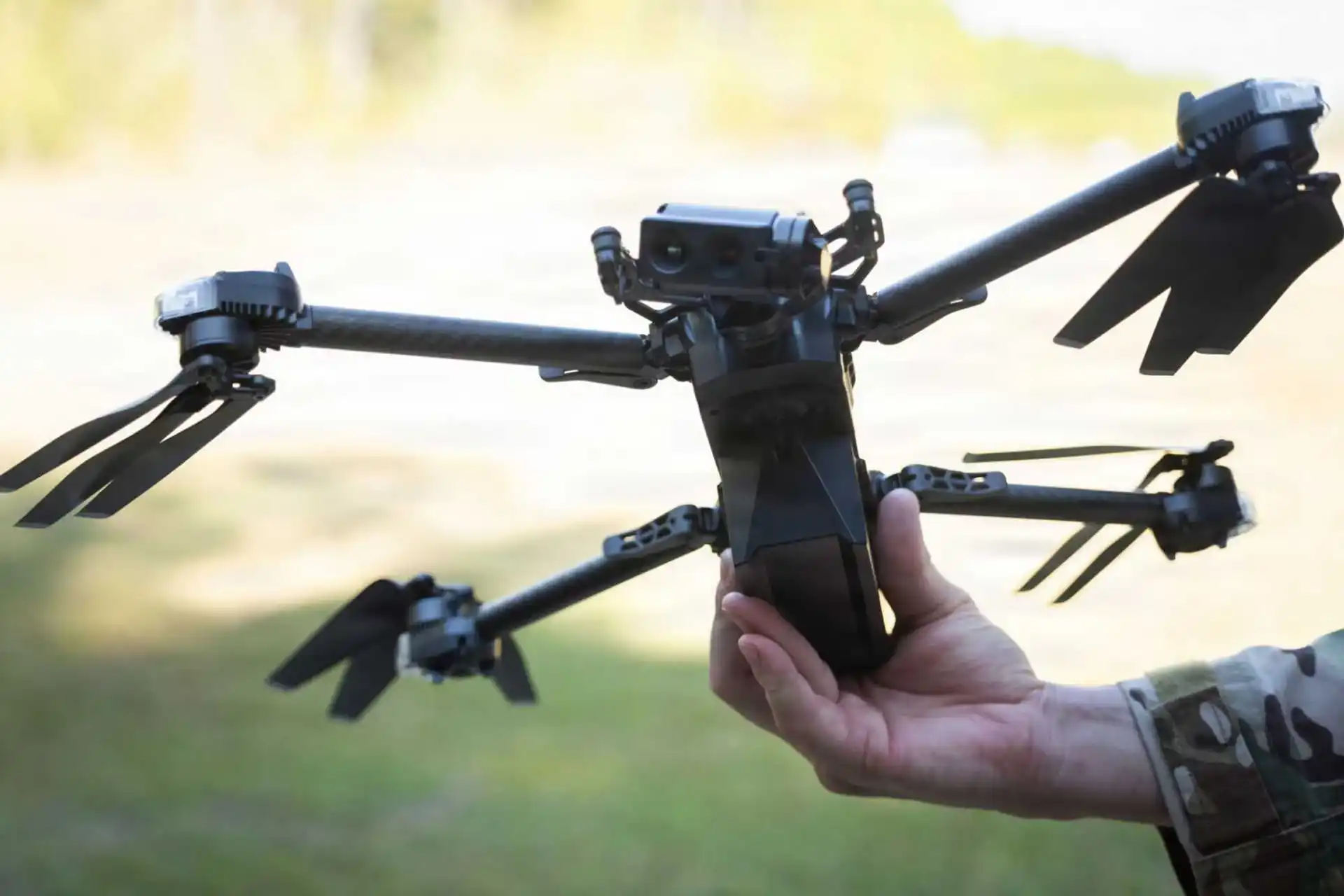
The U.S. Air Force is accelerating the evolution of explosive ordnance disposal (EOD) by field-testing backpack-portable drones designed to reach hazardous sites in seconds rather than minutes. At Hurlburt Field, Florida, Airmen from the 1st Special Operations Wing conducted a direct comparison between a small unmanned aerial system and a traditional tracked ground robot during a simulated casualty site assessment. The outcome was unambiguous: the drone reached the objective almost immediately and began transmitting live overhead video before the ground robot had covered even half the distance.
The demonstration highlighted a fundamental operational truth that has guided EOD doctrine for decades: distance equals safety. When facing improvised explosive devices, unexploded ordnance, or suspected booby traps, standoff capability directly correlates to survivability. Specialists cannot be rapidly replaced, and every additional meter between a technician and a threat increases mission resilience. By compressing deployment time and expanding reconnaissance reach, portable drones are redefining what “safe distance” means in modern operations.
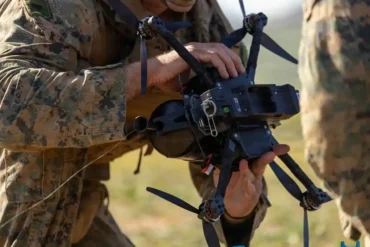
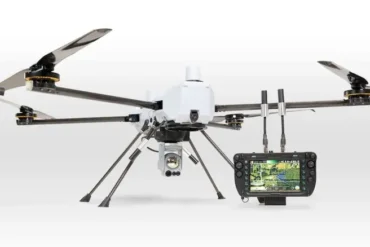
Unlike heavy robotic systems that require vehicle transport, setup, and terrain negotiation, these lightweight drones can be carried in a standard backpack and launched during dismounted patrols. Within moments of arrival, operators gain real-time optical and thermal imagery, day or night, across open terrain or complex environments. That speed advantage becomes critical in time-sensitive scenarios such as airfield recovery, runway inspections after attack, or rapid assessment of blast sites.
Speed as a Tactical Multiplier in EOD Missions
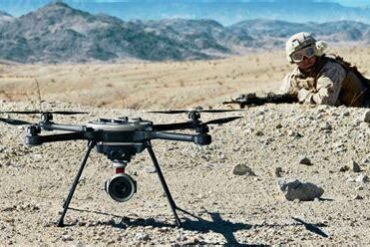
In the field exercise, two Airmen operated the systems across dirt and grass. The tracked robot advanced methodically, as expected, negotiating uneven terrain with mechanical precision. Meanwhile, the drone was airborne in seconds, hovering above the simulated casualty site and streaming a stabilized overhead feed. That aerial vantage point delivered immediate situational awareness, allowing commanders to assess terrain hazards, potential secondary devices, and casualty positions before committing additional assets.
Mobility is more than convenience; it is a force multiplier. Heavy ground robots remain indispensable for physical manipulation—cutting wires, lifting suspicious objects, or placing disruption charges. Yet their operational tempo is constrained by weight, transport requirements, and deployment complexity. Portable drones complement these systems by performing the first and often most dangerous phase of the mission: reconnaissance and initial threat characterization.
Integrated 3D scanning systems further expand capability. Within minutes, drones can generate digital models of blast craters, airfields, or contaminated areas. These models support repair planning, mine clearance mapping, and forensic documentation. The shift from purely visual reconnaissance to data-rich modeling reflects a broader trend in defense technology: EOD is becoming as much about information dominance as mechanical neutralization.
Bridging Aerial Reconnaissance and Ground Neutralization
The Air Force’s approach does not frame drones as replacements for ground robots but as complementary assets in a layered toolkit. Drones excel at reconnaissance, mapping, and hazard identification. Ground robots and trained technicians remain responsible for manipulation and neutralization. The synergy between aerial and ground platforms shortens decision cycles and reduces exposure time.
Artificial intelligence embedded in modern systems enhances this integration. Semi-autonomous flight functions—such as obstacle avoidance, target tracking, and position holding—reduce pilot workload and allow operators to focus on mission interpretation rather than manual control. These features are not fully autonomous combat decision-makers; they are assistive systems designed to increase reliability under stress.
Operational integration, however, extends beyond hardware. Shared airspace at installations like Hurlburt Field requires rigorous risk assessments, policy approvals, and certification standards. Unmanned systems must operate safely near conventional aviation traffic. Units conducting early testing have emphasized that environmental conditions, mission profiles, and airspace restrictions all influence deployment strategies. Rapid adoption is balanced with procedural discipline.
Directed Energy: From Detection to Remote Neutralization
Parallel research efforts are exploring whether drones can move beyond reconnaissance into active neutralization. Concepts under evaluation include mounting directed energy systems, such as lasers and electromagnetic pulse (EMP) devices, on unmanned aerial vehicles.
Laser systems offer precision application of heat energy. They can sever circuitry, melt structural components, or initiate controlled detonation of explosive material. In theory, a drone equipped with a stabilized laser could disable an electronic trigger at standoff range without requiring physical contact. EMP systems operate differently, inducing electrical overload within circuitry to render devices inoperative. A combined configuration could first disrupt electronics and then neutralize the explosive body itself.
Such capabilities would significantly reduce human proximity to hazards. However, physics imposes constraints. High-energy output demands robust onboard power generation and thermal management. Atmospheric interference—humidity, dust, and particulate matter—can degrade laser propagation. EMP deployment requires shielding to prevent self-interference with the drone’s own avionics. Adversaries may attempt countermeasures, including hardened electronics or shielding, prompting iterative adaptation.
The technical hurdles are substantial but not insurmountable. As battery density improves and lightweight power systems mature, directed energy integration may transition from experimental to operational reality.
Autonomous Detection and Swarm Innovation
Beyond individual drones, global research initiatives are demonstrating how autonomous systems and swarms can address large-scale contamination. In March 2025, Germany’s Fraunhofer Institute for Factory Operation and Automation (IFF) introduced the AutoDrone system, designed for unexploded ordnance detection in heavily contaminated regions.
The basic configuration flies preprogrammed routes at approximately 50 centimeters above ground, collecting high-resolution sensor data synchronized with RTK (Real-Time Kinematic) positioning for precise georeferencing. Speeds between 3 and 5 meters per second enable efficient coverage while maintaining sensor fidelity. A swarm configuration deploys multiple drones with tailored sensor packages optimized for different ordnance types, including nonmetallic mines that evade traditional metal detectors.
Coordinated communication protocols allow continued operation during partial signal loss. Adaptive flight path adjustments maintain data integrity over uneven terrain. The resulting datasets are transmitted to EOD services, enabling prioritized clearance operations based on precise hazard mapping rather than broad manual sweeps.
NATO’s Innovation Challenge on remote explosive-contaminated area recognition has further accelerated experimentation. One highlighted approach integrates grid-pattern drone flights with edge processing to create real-time mosaics of contaminated terrain. Software-defined radar enables low-cost synthetic aperture radar (SAR) capability, detecting mines at varying depths. Once identified, anti-tank mines can be addressed by unmanned ground vehicles, while anti-personnel mines are neutralized using specialized robotic rollers.
Hybrid vertical take-off and landing drones powered by gasoline engines extend endurance to four or five hours, enabling scalable coverage across expansive contaminated zones. The convergence of swarm coordination, AI-driven analysis, and multi-sensor fusion represents a systemic shift in how militaries and humanitarian organizations confront explosive remnants of war.
Humanitarian Impact and Global Demining Transformation
The military implications are clear, but the humanitarian dimension is equally significant. Organizations such as The HALO Trust, operating in more than 30 countries, have integrated drone imagery with machine learning to accelerate minefield analysis. Image processing time that once required three to five days can now be reduced to hours. Globally, an estimated 110 million landmines remain buried, causing roughly 20,000 casualties each year, most of them civilians.
HALO reports clearing over two million landmines and reclaiming more than 760 square kilometers of land. Innovations such as the Mine Kafon Drone, equipped with 3D mapping systems and retractable metal detectors, claim operational speeds up to 20 times faster and costs 200 times lower than traditional approaches. In Bosnia and Herzegovina, microdrones deployed after severe flooding generated high-resolution digital surface models at modest operational cost, demonstrating how aerial mapping supports recovery and safety planning even in post-disaster contexts.
These examples underscore a broader pattern: drones are not a single-purpose tool but an adaptable platform supporting reconnaissance, mapping, detection, and preparation for neutralization across military and civilian domains.
The Strategic Implications for the U.S. Air Force
For the U.S. Air Force, testing backpack-portable drones at Hurlburt Field reflects more than incremental modernization. It signals an institutional recognition that speed, data integration, and standoff capability define the future of EOD. Heavy robots remain essential for hands-on tasks, but the first moments of any mission—when uncertainty is highest—are increasingly owned by aerial systems.
The equation is simple but profound. Faster reconnaissance reduces exposure. Better data improves decisions. Integrated systems compress timelines from detection to action. In environments where a single misstep can prove fatal, shaving minutes off response time is not a marginal gain; it is operational transformation.
As unmanned technologies mature, EOD doctrine will continue evolving toward layered, data-driven engagement. Backpack drones launched in seconds today may, in the near future, coordinate with autonomous ground vehicles and directed energy platforms in tightly synchronized operations. The core principle remains unchanged: protect the specialist, extend the standoff, and let technology absorb the initial risk.
The test at Hurlburt Field may appear modest—a drone outrunning a robot across open terrain—but its implications ripple outward. In the calculus of bomb disposal, seconds matter. And in those seconds, the balance between vulnerability and control is being recalibrated by the quiet hum of a drone lifting off from a backpack.