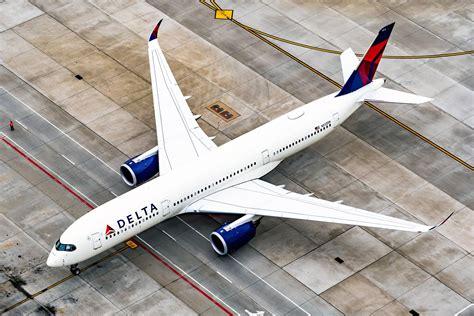
Founded nearly a century ago, Delta Air Lines has evolved from a humble crop-dusting operation into one of the world’s most respected and powerful carriers. Headquartered in Atlanta, Georgia, Delta is a founding member of the SkyTeam alliance and boasts the highest airline revenue globally, recording $61.6 billion in 2024. Operating a staggering 5,400 daily flights to 325 destinations across 52 countries, Delta’s influence spans continents and decades.
Origins and Early Development: From Dust to Destinations
Delta traces its lineage to 1925, when it began as Huff Daland Dusters, the first aerial crop-dusting company. By 1928, it had incorporated as Delta Air Service, and in 1929, the company launched its first passenger services. The 1930s saw a structural evolution, and in 1934, Delta was renamed Delta Air Lines, signaling its ambition to grow beyond regional confines. The move of its headquarters to Atlanta in 1941 placed the company in a key geographic and logistical position, cementing its influence in the American South.
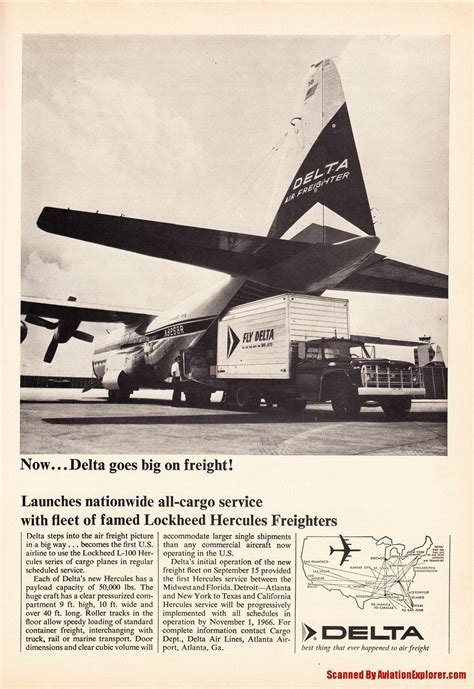
Delta’s postwar decades were marked by several pivotal milestones: it launched scheduled freight services in 1946, introduced the first discounted airfares in 1949, and began its first international routes in 1953. The 1960s witnessed Delta’s entrance into the jet age, with aircraft such as the Douglas DC-8, Convair 880, and DC-9, and its technological advancement through the launch of the Deltamatic reservation system in 1964.
Aggressive Expansion: Mergers, Acquisitions, and International Growth
Delta’s ambition materialized into strategic acquisitions throughout the late 20th century. Its 1972 acquisition of Northeast Airlines extended its network into the Northeast U.S. and Canada. The 1987 merger with Western Airlines opened up transpacific routes, especially to the Pacific Rim. Arguably the most significant leap came with the 1991 acquisition of Pan Am’s trans-Atlantic routes and Shuttle operations, positioning Delta as a true global player.
With the formation of the SkyMiles program in 1981 and the eventual handling of over 100 million passengers by 1997, Delta had become not just a carrier but a travel institution. However, like many legacy carriers, it wasn’t immune to economic turbulence.
Financial Crisis and Resilience: Bankruptcy and Recovery
In 2005, Delta filed for Chapter 11 bankruptcy protection, a turbulent period that tested the airline’s operational and strategic resilience. Emerging from bankruptcy in April 2007, Delta successfully thwarted a hostile takeover attempt by US Airways and resumed trading on the NYSE. This era was defined not only by survival but by transformation.
The Northwest Merger: A New Giant Emerges
In April 2008, Delta announced its intention to acquire Northwest Airlines, a move that would create the world’s largest airline by several metrics at the time. The merger, completed in October 2008, integrated fleets, networks, and workforce operations. By January 2010, the Northwest brand had been fully retired. This consolidation expanded Delta’s reach into Asia and Europe, added a significant number of Airbus aircraft, and solidified Detroit and Seattle as critical transpacific gateways.
Global Network and Strategic Hubs
Today, Delta operates through nine major U.S. hubs, including Atlanta, Boston, Detroit, Los Angeles, Minneapolis/St. Paul, New York–JFK, New York–LaGuardia, Salt Lake City, and Seattle/Tacoma. Its robust international footprint includes unique U.S. services to destinations such as Dakar, Senegal, and key transatlantic routes from Boston and JFK. These hubs handle both Delta mainline and Delta Connection regional flights, the latter supported by partners such as Endeavor Air, Republic Airways, and SkyWest.
Fleet Strategy: Modernization and Scale
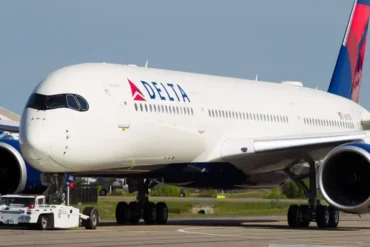
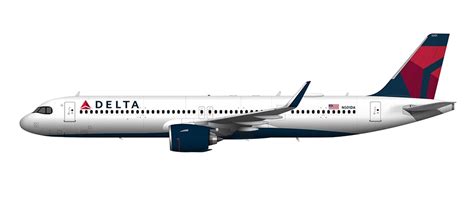
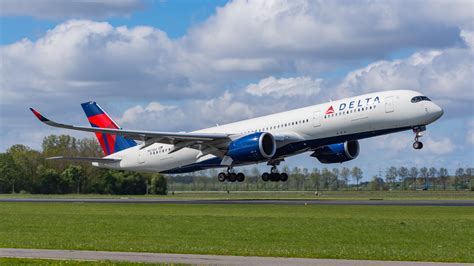
Delta maintains a mainline fleet of 983 Airbus and Boeing aircraft, with an average fleet age of 14.9 years as of December 2024. The airline has made substantial investments in fuel-efficient aircraft, including the Airbus A321neo and the Airbus A350-900, aimed at reducing operational costs and environmental impact. Its growing presence on long-haul international routes has led to new services like Atlanta–Marrakech and resumed operations from JFK to Tel Aviv.
Cabin Classes and Passenger Experience
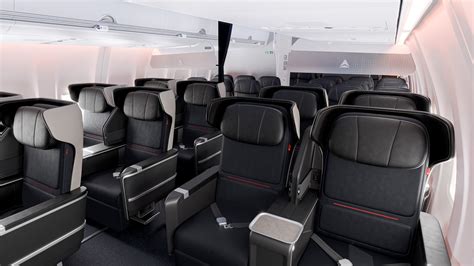
Delta’s cabin offerings are structured to appeal to both luxury and value-driven travelers:
- Delta One: A premium product featuring lie-flat seats and the exclusive Delta One Suites, introduced in 2016 on the A350, 777, and A330-900.
- First Class: Offering wider seats (18.5–20.75 inches), complimentary meals, and priority boarding.
- Premium Select: Delta’s premium economy offering on international routes, delivering extra legroom and enhanced meal service.
- Comfort+: An upgrade from Main Cabin, with increased pitch (34–36 inches), early boarding, and premium snacks.
- Main Cabin: Standard economy with complimentary snacks and meals on long-haul flights.
- Basic Economy: A no-frills option with restricted flexibility and no SkyMiles accrual.
Loyalty, Lounges, and Business Programs
Delta’s SkyMiles loyalty program is distinguished by the absence of expiration on miles and the 2025 addition of free in-flight Wi-Fi for members. The airline’s exclusive Delta Sky Clubs offer business and premium travelers access to luxurious lounges. Recent expansions have introduced new premium Sky Clubs at JFK, Boston, and LAX, catering to Delta One and Medallion members.
Corporate travelers benefit from SkyBonus, a points-based program designed for small and mid-sized businesses, which was streamlined after the merger with Biz Perks in 2010.
Brand Identity and Livery Evolution
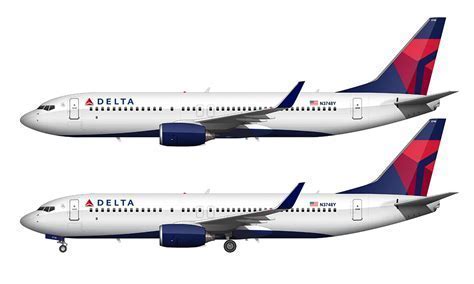
Delta’s visual identity is iconic. The “Widget” logo, introduced in 1959, draws inspiration from the Greek letter Delta and the triangular form of a DC-8 wing. The “Upward & Onward” livery, adopted in 2007, was engineered to minimize repainting costs while reinforcing Delta’s brand narrative of ascension and momentum.
Environmental Commitment and Legal Challenges
Delta has consistently promoted its environmental stewardship. In 2008, it was recognized by the EPA for using PreKote, a paint process that significantly reduces emissions and waste. However, recent years have tested its environmental claims. A 2023 class-action lawsuit challenged Delta’s assertion of carbon neutrality, sparking broader industry conversations around the validity of carbon offsets versus direct emissions reduction.
Cultural Impact and Digital Recognition
Delta has not shied away from engaging with contemporary media. The 2008 launch of its viral safety video featuring Katherine Lee, affectionately dubbed “Deltalina,” redefined how airlines could integrate brand personality with mandatory procedures. This blend of professionalism and digital savvy helped humanize a brand in an industry often viewed as impersonal.
Operational Performance and Accolades
Delta’s commitment to reliability is evident in its 2023 on-time performance rate of 84.72% and a completion factor of 98.82%. These metrics contributed to it being named Best North American Airline by Skytrax in 2024 and holding the top spot in the Wall Street Journal airline rankings from 2022 to 2024.
Safety Incidents and Oversight
Despite its stellar safety record, Delta has faced scrutiny. By April 2025, it had reported 14 fatal accidents since inception. Most recently, the airline was the subject of a DOT investigation following the July 2024 CrowdStrike software disruption, which led to over 7,000 flight cancellations. Additionally, issues such as detached ceiling panels on older 757 and 717 models and multiple pressurization diversions have prompted a comprehensive internal review of maintenance protocols.
Conclusion: A Legacy in Motion
From crop dusters to global skies, Delta Air Lines embodies the evolving spirit of aviation. With its blend of strategic foresight, technological innovation, and passenger-centric philosophy, Delta continues to set benchmarks for operational excellence. As the company forges ahead, navigating both market opportunities and existential challenges, it remains a central figure in the ongoing story of global air travel.