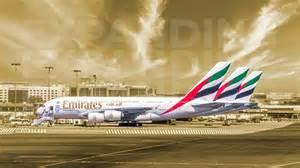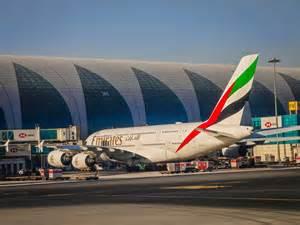
Emirates has long been synonymous with Dubai International Airport (DXB)—a glittering crossroads where continents, cultures, and connecting flights intersect with near-mythic efficiency. Yet the airline’s strategic horizon stretches far beyond the desert metropolis that birthed it. In recent years, Emirates has been methodically expanding its operational footprint through partnerships, fifth freedom routes, and infrastructure evolution, building a network that behaves less like a hub-and-spoke system and more like a planetary web.
This expansion is not a retreat from Dubai, but an amplification of its influence. Aviation networks thrive on connectivity density—the more nodes you add, the more valuable each existing node becomes. Emirates understands this principle with almost gravitational clarity. By extending its reach beyond the UAE through alliances and foreign route rights, the airline multiplies passenger flows without multiplying fleet complexity.
At the center of this strategy sits a simple constraint: Emirates operates an almost entirely widebody fleet. Without narrowbody aircraft for short regional hops, partnerships and fifth freedom flights become not just useful—but structurally necessary.
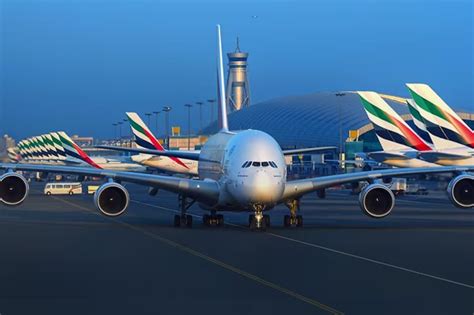
Dubai International Airport: The Engine Room of Emirates’ Empire
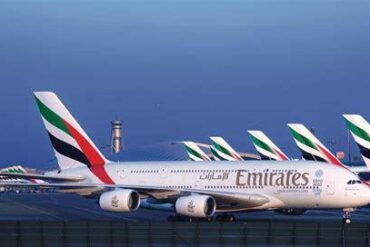
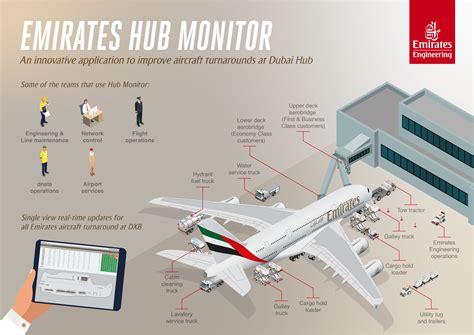
Dubai International Airport remains one of the most concentrated aviation powerhouses on Earth. Emirates operates more than 3,600 weekly flights from Terminal 3 alone—the largest airport terminal by floor area globally. The scale is staggering: a single airline effectively animating an entire aviation megastructure.
This dominance did not emerge by accident. Emirates was founded in 1985 with direct backing from Dubai’s ruling leadership, embedding aviation into the emirate’s economic DNA. Ownership through the Investment Corporation of Dubai ensures strategic alignment between airline growth and national development.
Yet success breeds pressure. DXB’s city-center geography makes expansion physically difficult. Each additional route pushes infrastructure closer to saturation. Even as Emirates adds destinations—such as Shenzhen, Da Nang, and Siem Reap—the airport’s capacity strains against urban boundaries.
The paradox is elegant: the very hub that enabled Emirates’ rise now compels it to evolve beyond itself.
Codeshare Strategy: Extending Reach Without Adding Aircraft
Airlines traditionally expand by buying planes. Emirates expands by buying access.
Through interline agreements and codeshares, the carrier taps into nearly 1,800 global destinations—far beyond what its fleet alone could serve. These partnerships allow Emirates to sell seamless itineraries while partners handle regional legs.
Key long-standing collaborators include:
- Qantas
- United Airlines
- Air Canada
Such alliances convert Emirates from a point-to-point carrier into a network orchestrator. A passenger booking through Dubai can connect to secondary cities across North America, Europe, or Oceania without ever noticing the operational handoff.
It is aviation as systems engineering: modular, scalable, efficient.
Emirates & Condor: Strategic Expansion Into Leisure Corridors
The partnership with German leisure airline Condor exemplifies how Emirates targets high-yield tourism flows. Activated for the 2025 summer season, the reciprocal codeshare unlocked 11 additional destinations for Emirates customers via German gateways like Frankfurt, Düsseldorf, and Hamburg.
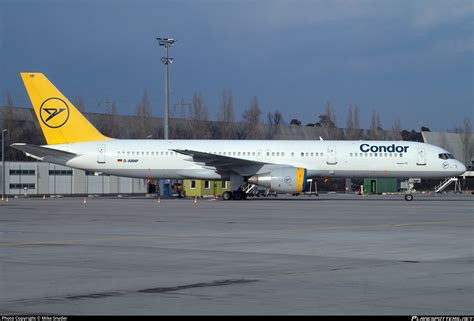
From there, Emirates passengers gained access to sun-heavy leisure markets including:
- Palma de Mallorca
- Ibiza
- Gran Canaria
- Fuerteventura
- Tenerife
- Cancún
- Montego Bay
Condor customers, in return, plugged into Emirates’ long-haul luxury network—reaching destinations such as Bali, the Maldives, Phuket, Bangkok, and Cape Town.
The commercial logic runs deeper than route maps. Leisure routes are seasonal and volatile; partnerships allow Emirates to participate in demand spikes without dedicating widebody aircraft year-round. Revenue rises, risk diffuses.
Frequent flyer reciprocity through Emirates Skywards further binds customer loyalty across both brands, transforming two airlines into a shared ecosystem.
Emirates & Air Seychelles: Precision Connectivity in the Indian Ocean
If the Condor deal targets volume tourism, the partnership with Air Seychelles targets geographic precision.
Through this agreement, Emirates passengers flying into Mahé can seamlessly connect onward to Praslin Island—a smaller destination previously requiring fragmented bookings and baggage transfers.
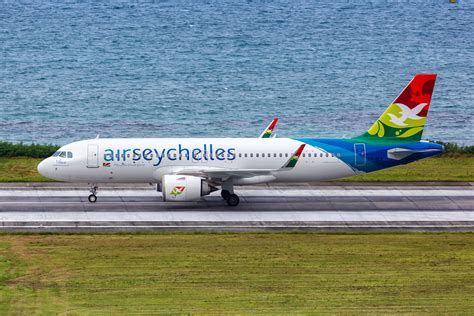
The improvement sounds logistical, but its impact is experiential. Single-ticket itineraries, through-checked baggage, and coordinated schedules transform what was once a multi-step journey into a frictionless transit.
Most passengers on the Dubai–Mahé route originate from European markets—France, Italy, Germany, Switzerland, and the UK—making the codeshare a demand multiplier rather than a speculative gamble.
In network theory terms, Emirates isn’t just adding destinations; it’s increasing connectivity resolution—filling in smaller nodes that enhance the value of major ones.
Fifth Freedom Flights: Emirates Operating Beyond Home Borders
Then there is the exotic creature of aviation policy: the fifth freedom flight.
This traffic right allows an airline to carry passengers between two foreign countries on a service that originates or terminates in its home nation. For Emirates, it is both a commercial instrument and a brand showcase.
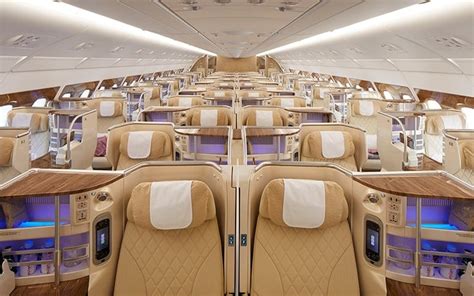
These routes let travelers experience Emirates’ long-haul product—A380s, lie-flat seats, premium cabins—without ever setting foot in the Middle East.
Notable examples include:
- Athens – Newark
- Milan – New York
- Bangkok – Hong Kong
- Sydney – Christchurch
- Barcelona – Mexico City
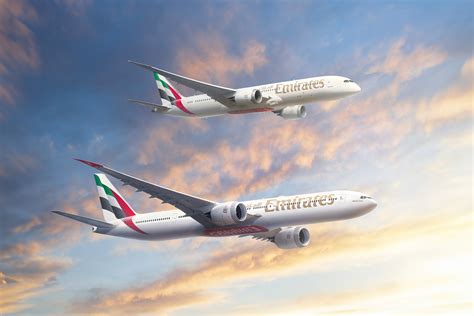
Some of these flights exist for operational necessity. Mexico City’s high altitude, for instance, limits aircraft fuel loads, making a nonstop Dubai departure impractical. A European stop solves the physics problem elegantly.
Others serve cargo demand as much as passengers. The Milan–New York route moves significant freight volumes across the Atlantic, leveraging Emirates’ belly-hold capacity.
Shorter fifth freedom sectors also exist—such as Accra–Abidjan or Harare–Lusaka—proving the model works at multiple scales.
Two particularly intriguing services function as island connectors:
- Larnaca – Malta
- Malé – Colombo
These routes blur the line between long-haul luxury carrier and regional connector—an operational hybrid few airlines attempt.
The Mega-Hub Future: Dubai World Central
Even as Emirates expands outward, it is simultaneously preparing for a geographic shift inward—relocating its core hub from DXB to Dubai World Central (DWC) at Al Maktoum International Airport.
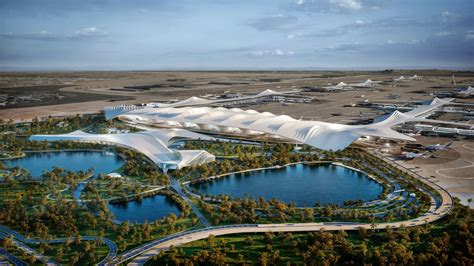
The move is less relocation than metamorphosis.
DWC is designed for a future capacity of 260 million passengers annually—more than double today’s busiest airports. The projected cost: $35 billion. Infrastructure will integrate rail, road, cargo logistics, and urban development into a single aviation megacomplex.
Dubai’s urban growth is trending southward, making DWC geographically aligned with future population centers. Once transition phases conclude—expected around 2034—DXB may close entirely, freeing central land for redevelopment.
For Emirates, the implications are profound:
- Greater slot availability
- Expanded cargo operations
- Scalable passenger throughput
- Integrated multimodal transport links
The hub model does not disappear—it evolves into something closer to an aviation supercollider.
Network Economics: Why Expansion Beyond Dubai Matters
Why not simply funnel everything through one giant hub forever?
Because aviation networks obey nonlinear economics. Over-concentration introduces vulnerabilities:
- Infrastructure bottlenecks
- Weather disruption cascades
- Slot constraints
- Regulatory exposure
By diversifying operational geography through partnerships and foreign route rights, Emirates distributes risk while preserving hub primacy.
There is also the fleet structure issue. With no narrowbodies, Emirates cannot profitably serve thinner regional routes alone. Partnerships effectively “outsource” short-haul feed traffic into its long-haul machine.
Think of Emirates as a long-distance neuron. Codeshares and fifth freedoms act as synapses, transmitting passenger impulses into the central nervous system at Dubai.
Financial Performance: The Midas Effect
Expansion strategies mean little without financial validation. Here, Emirates operates with almost theatrical success.
The airline has generated approximately $4.7 billion in annual profit, supported by revenues near $33 billion and a margin exceeding 14%—figures that place it among the world’s most profitable carriers.
Several structural advantages fuel this performance:
- Fuel hedging and fleet efficiency
- Premium cabin demand
- Cargo integration
- Geographic midpoint positioning
Partnership expansion enhances all four without proportionally increasing cost.
Profitability, in this context, becomes proof that network diversification is not dilution—it is amplification.
Digital Expansion: Payments, Crypto, and Future Consumers
Emirates’ outward expansion is not confined to geography. It is also moving into the digital economy.
A preliminary agreement with Crypto.com aims to enable cryptocurrency payments for flights. While still emerging, the initiative targets younger, tech-native consumers and aligns with the UAE’s ambition to become a global crypto hub.
Payment flexibility may sound peripheral to aviation strategy, yet frictionless transactions influence booking behavior—especially in high-value international travel.
Reducing payment barriers increases conversion rates, particularly across digitally affluent markets.
In network terms, Emirates is not just expanding where people can fly—but how they can buy the ticket.
Strategic Synthesis: A Hub That Expands by Decentralizing
At first glance, expanding beyond Dubai might appear to dilute Emirates’ identity. In practice, it reinforces it.
Partnerships feed passengers into the hub. Fifth freedom flights export the brand abroad. Infrastructure megaprojects prepare for future scale. Digital payment systems widen commercial access.
All vectors point back to the same gravitational center.
Dubai remains the heart—but Emirates is extending arteries across the globe.
This hybrid model—centralized infrastructure with decentralized reach—may represent the next evolutionary phase of long-haul aviation strategy. Airlines constrained by geography, fleet mix, or bilateral agreements can still achieve planetary presence through intelligent collaboration.
And in that sense, Emirates is not moving beyond Dubai.
It is turning Dubai into something larger than a place—a network state made of flight paths, partnerships, and engineered connectivity stretching to nearly every horizon humans choose to cross.